
All of us Kenyon students enjoyed fall break last weekend. Some of us went home, some explored new places, and some stayed on campus with friends. I spent mine babysitting a longtime family friend – a very curious nine-year-old scientist.
Twenty minutes into our otherwise chaotic evening, he asked, “What animals have you learned about?” He remembered that I’d told him I was taking a class on animal behavior. So, I explained that I was writing about how fish seem to get smarter when they have friends– an explanation of the paper fit for a nine year old.
“Duh,” he said. “I learned about that in Bubble Guppies when I was a baby.”
I started to explain how this was serious and complicated research– and then stopped. The paper I’d spent hours reading actually was about guppies (Poecilia reticulata), and it did indeed show that fish raised in social groups learn more flexibly, just like how the kids (fish?) in Bubble guppies learn more effectively when their friends are at school with them.
This field of research is a hot one; there are countless labs across the world studying how being social affects animal intelligence and decision making. Nearly every species interacts with others– lions hunting in pride to fish swimming in schools– and researchers have long wondered what animals gain from this. One idea, the social brain hypothesis, suggests that social behavior leads to increased brain size, allowing greater cognitive ability in more social animals. This may explain why primates, such as humans, have unusually large brains compared to their body size.1
In 2024, a group of researchers from University of Bern, Switzerland tested this theory on the guppy, (Poecilia reticulata). In the wild, guppies live in shoals of between 3-50 individuals, so they are indeed social creatures. Additionally, Guppies are unassumingly intelligent and are often used in studies testing cognitive abilities. This is because guppies continue to generate new neurons even as adults, a process called neurogenesis. Even human adults do not regenerate neurons to the same degree as adult guppies. This trait allowed researchers to see how an experience– such as living in a large social group – might influence the size and ability of the guppies’ brain as they grow and develop.
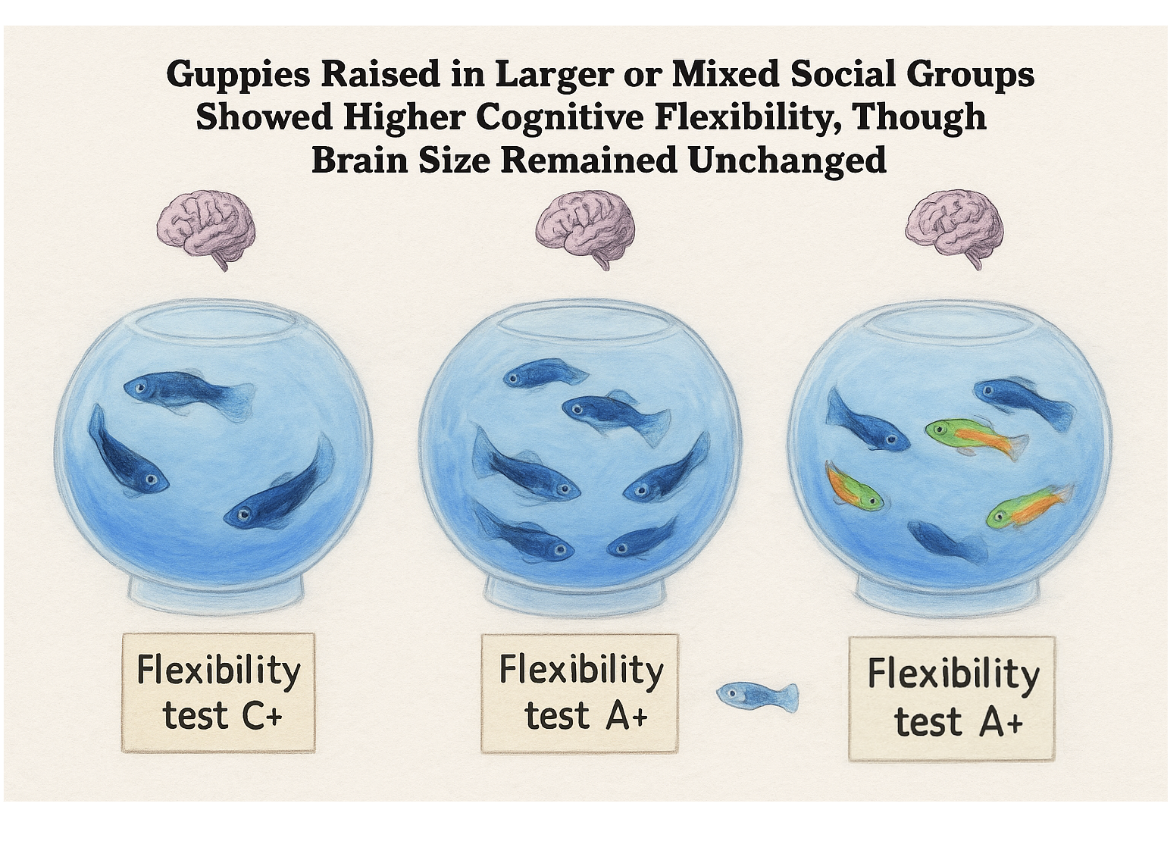
To see if social behavior had any effect on cognitive ability or brain structure in these guppies, the researchers set up an experiment. Three groups of guppies were made: one group with three guppies, one group with three guppies and three fish of a different species (splash tetra), and the third group with six guppies. This setup let them study both group size, and social diversity. After six months of living in these social settings, the fish took a few simple tests.
One test was designed to measure their self-control: could a guppy resist bumping into a transparent cylinder blocking a path to food? Another tested associative learning by teaching fish to connect a color– green– with a food reward. Finally, the researchers flipped the rule to see how quickly the fish could unlearn the old color, and learn a new one. This final test measures cognitive flexibility. (Fig. 1)
After testing, researchers compared performance across groups, and used x-ray imaging to measure the major fish brain regions. Just as the 9 year old predicted, fish in larger groups were smarter. While there was no great difference in the self control and associative learning tests, both the larger groups of fish outperformed the smaller group in the flexibility test. This demonstrates that social setting does have an impact on the cognitive ability of the guppy, just in a more specific way than the researchers anticipated.
A surprising element of the results was that no group of fish had developed a significantly different brain. Scientists often link larger brains with social complexity, but here the guppies complicate that story. The guppies’ social lives improved their flexible learning, but not by growing larger brains. While this doesn’t directly support the social brain hypothesis in regards to brain growth, it certainly supports the idea that sociability plays a role in learning and cognitive ability. It’s comforting to know that the wholesome morals regarding friendship in a kids show are now supported by science, and I think that it’s a pretty great takeaway. Just like the ultra-social apes, a guppy learns from their peers.
Sources
1. Dunbar, R. I. M. (2009). The social brain hypothesis and its implications for social evolution. Annals of Human Biology, 36(5), 562–572. https://doi.org/10.1080/03014460902960289
Paper Used: Triki, Z., et al. (2024). Social environment shapes learning flexibility in guppies (Poecilia reticulata). Proceedings of the Royal Society B, 291(20240567). https://doi.org/10.1098/rspb.2024.0567
