
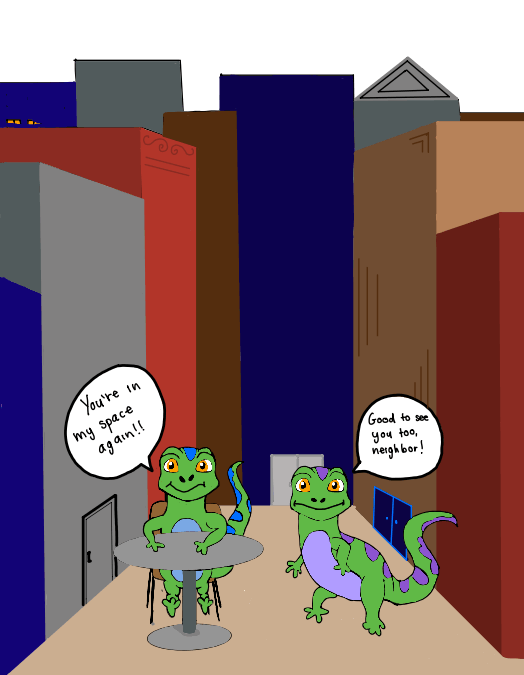
When we live in cities we are much more likely to interact with other people. We bump into each other on crowded streets, work together in large office buildings and live in apartments with hundreds of other people.
Interestingly a recent study conducted by Avery L. Maune, Tobias Wittenbreder, Duje Lisičić, Barbara A. Caspers, Ettore Camerlenghi, and Isabel Damas-Moreira, found that just like us, lizards are more social in cities! You may think that this is because there are more lizards and less space, however, it is not the only factor playing into the sociality of lizards.
To test this, the team observed three urban and three non-urban common wall lizard populations over 21 days. A total of 94 lizards were captured, marked with unique identifiers, and then monitored daily to record who spent time near whom. Using social network analysis, the team compared how many connections each lizard had. In the urban populations, 81% of individuals were part of a social network, meaning they were seen interacting with at least one other marked lizard. In rural populations, that number dropped sharply to just 23%. On average, city lizards had about six times as many social ties: 1.9 per individual compared to just 0.3 in rural areas. Even after accounting for unmarked lizards (which could distort network data), urban lizards were still observed in significantly more associations overall.
Interestingly, the researchers found that the difference in sociality wasn’t just about population size. Even when they excluded one especially dense urban site from the analysis, city lizards still showed stronger social connections.
So what causes city lizards to be more social? Lizards in cities are forced to interact more often than rural lizards because of fragmented and inhospitable habitat. So the density of the lizard population does play a role, however, it is not the only cause. When these individuals have frequent social interactions it is costly to always be aggressive and instead it is better to choose to be friendly to their neighbors. Since resources are clumped together social tolerance is favored because it allows individuals to expend less energy on conflicts when in close vicinity with other lizards. In other words, while city living has often been seen as a challenge for wildlife, it may also be nudging some animals toward surprisingly cooperative behaviors.
Maune AL, Wittenbreder T, Lisičić D, Caspers BA, Camerlenghi E, Damas Moreira I. 2025. City lizards are more social. Biol. Lett. 21: 20250326. https://doi.org/10.1098/rsbl.2025.0326
