
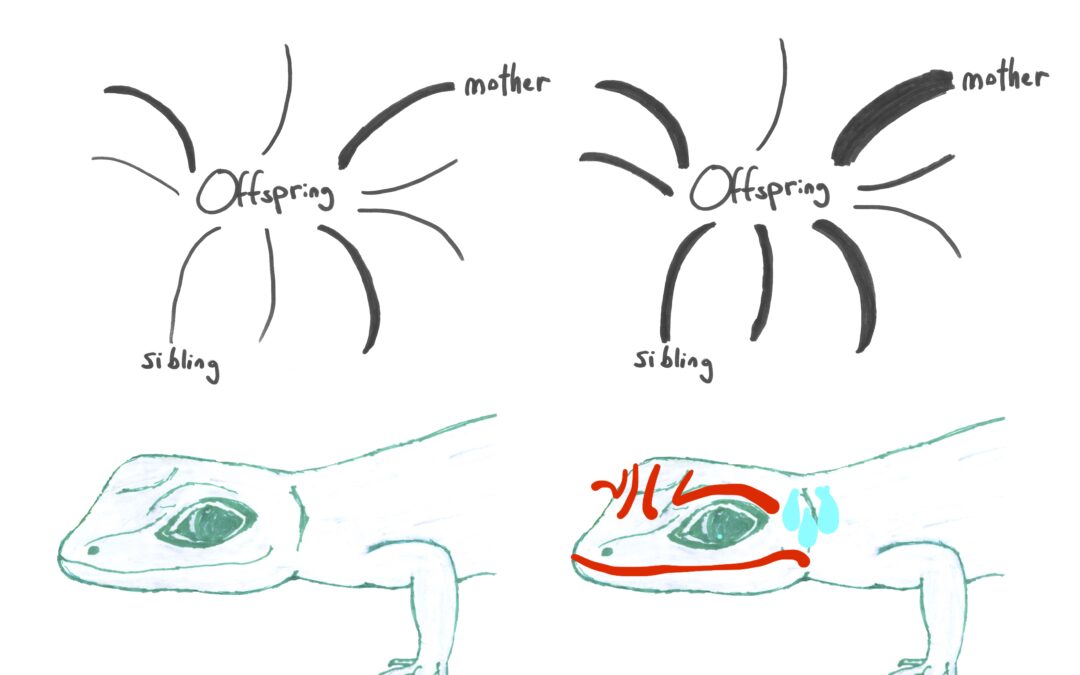
Stress, stress, stress, it changes you––literally. A new study from Tasmania complicates our understanding of how stress can affect behavior, and not just your behavior, your kids’ too. When I say you, I am of course assuming you are a skink. Researchers from the University of Tasmania artificially induced stress in pregnant White’s skinks (Liopholis whitii). Though perhaps a bit mean, they observed something interesting. The kids of these stressed mamas had stronger social bonds, not only between parent and offspring, but with their siblings and with other skinks. Admittedly, “social bonds” might be a stretch.
The White’s skink is medium-sized as far as skinks go, about 7.5 cm from snout to vent (in other words, from where the food goes in to where it comes out). Patterned with stripes and spots which stop at the tail, it’s a species endemic to south-eastern Australia where it lives across a wide range of habitats. White’s skinks give birth to live young, and though, like many reptiles, they do not care for these young, they do tolerate them staying at home in their burrows. In fact, White’s skinks commonly live in small family groups: one adult male and his female partner(s) alongside multiple juvenile and subadult skinks. The majority of studies across the animal kingdom have found that individuals exposed to stress during development (before birth or hatching) are less social. Kristy MacLeod and other scientists wanted to see if this was also true in White’s skinks. They predicted it would be.
First, the team collected pregnant skinks from Tasmania’s east coast between November and early December, when gestation was still in its early stages. After being brought back to the laboratory, the skinks were placed individually in furnished enclosures where they remained until January. During this period, half of the pregnant females were treated with corticosterone, the primary stress hormone produced by reptiles. Four times a week, researchers applied oil containing the hormone to their dry, reptilian skin.
Later, skink mothers and their first two offspring were placed in another enclosure. These enclosures were different. They were much larger (8×16 meters); they were outside, and ringed with nets to prevent predation. They were also supplied with sand-filled pallets for burrowing and bricks for basking. These enclosures simulated the natural environment. To each enclosure, researchers added five skink mothers of mixed treatment and control group as well as their first two offspring. The skinks’ positions were recorded at multiple points during the day for six weeks. Skink individuals were identified by numbered and color-coded tags. To the great disappointment of their fans, the authors did not care to explain how one gets a tag on a skink. Nevertheless, from this positional data, the researchers counted skink “interactions.” If two skinks were seen in point A and point B, respectively, within one hour, and if point A and B were within one meter, then the skinks were said to have made social contact. Less intimacy, more COVID-era elbow greetings, but, alas, it worked.
Surprisingly, the study found that juvenile skinks of stressed mothers were more social. Though the number of individuals they interacted with was no greater, stress-treated juvenile skinks interacted more with each of them. Stress-treated mothers did the same. Additionally, the stress-treated juveniles interacted more with their siblings and mothers than control juveniles. Why might that be?
Behavioral changes caused by stress during gestation may be an adaptation to a potentially harsh, unpredictable or unsafe postnatal environment. In other words, if mom is stressed then life must be stressful. Though the authors did not attempt to explain why stress-altered skinks would be more social with strangers, they proposed that juveniles may be seeking protection and resources in familial burrows. Research on other skinks of the same genus (Egernia) have found that being close to your parents reduces your risk of predation and aggression from other skinks. So maybe fear creates a mama’s boy. However, in the many species that reduce sociality in response, stress may indicate an environment where social bonds are not worthwhile, especially if competition is high due to resource scarcity. But why would a harsh environment favor a lone wolf in one species and a social butterfly in another? More research is needed to answer this question.
References
- MacLeod, K. J., Bouffet-Halle, A., Wapstra, E., Uller, T., & While, G. M. (n.d.). Maternal glucocorticoids have persistent effects on offspring social phenotype irrespective of opportunity for social buffering. Journal of Animal Ecology, n/a(n/a).
- O’Connor, D. E., & Shine, R. (2004). Parental care protects against infanticide in the lizard Egernia saxatilis (Scincidae). Animal Behaviour, 68(6), 1361-1369.
- Spencer, K. A. (2017). Developmental stress and social phenotypes: integrating neuroendocrine, behavioural and evolutionary perspectives. Philosophical Transactions of the Royal Society B: Biological Sciences, 372(1727), 20160242.
- Watson, G., Watson, J., & Green, D. W. (2021). Giving birth out in the open: Observations of the Cunningham’s skink (Egernia cunninghami) giving birth upon exposed rocks. Herpetology Notes, 14, 451-454.
- While, G. M., Uller, T., & Wapstra, E. (2009). Within‐population variation in social strategies characterize the social and mating system of an Australian lizard, Egernia whitii. Austral Ecology, 34(8), 938-949.
