
It Takes Two: Parenting Success in Burying Beetles
How many parents are too many? This may seem like it has a simple answer; the more animals that are caring for young, the better. However, nature is more complicated than that. In the case of burying beetles, while having more adults caring for young might seem to improve their condition, the presence of more adults actually increases competition between adults and offspring.
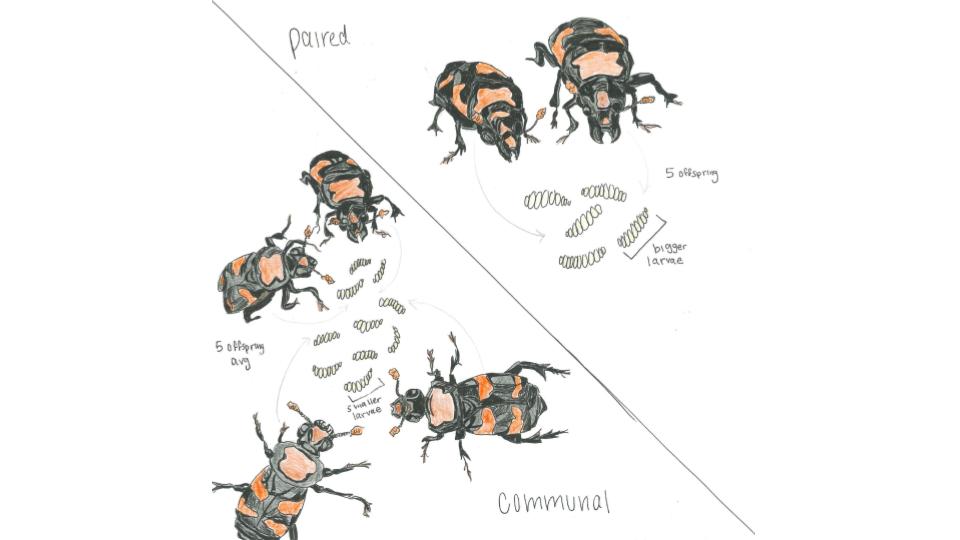
In pair breeding, two beetles mate and care for the offspring, while in communal breeding, multiple sets of beetles care for the group’s offspring. Care is performed before and after beetles hatch. Burying beetles lay their eggs in or near dead animals. Before eggs hatch, adults shape the carcasses into balls and preserve them. After eggs hatch, parents feed and defend the larvae until they are old enough to disperse. Why would any beetle pair breed when the whole colony could be caring for their larvae?
Long Ma, Joris Damhuis, and Jan Komdeur wanted to test whether pair or communal breeding improved the conditions of burying beetle offspring, measured by the number of offspring and their mass. They also tested whether caring for offspring after they hatched was beneficial, and asked whether the benefits were different based on the type of breeding.
To do this, the scientists prepared four types of groups, all given a similarly sized carcass on which to lay their eggs. Groups differed in the type of breeding and whether the adults performed only pre-hatching care, called half care, or both pre- and post-hatching care, called full care.
After all is said and done, is communal breeding the best way to breed? These scientists found that beetles who bred communally had the same brood size but smaller offspring. In both breeding types, beetles that were only cared for before hatching were smaller, but there was not a difference in size between breeding types when they did receive full care.
While communal breeding might sound like it would make raising a child easier, it is important to remember that animals act for their own good. If a beetle is ‘helping’ others with their young, it is because it has the most benefit to them and their offspring as well. Communal breeding might only happen when it is the best possible outcome, such as on large carcasses where there are more likely to be a lot of beetles.
Beetles who care for only their own young waste less energy and ensure that their offspring have the highest success. You might assume that because there are more beetles, they spend more time overall caring for all of the larvae, but that is not the case. Beetles who breed communally have to compete with each other for resources, and more importantly, to establish dominance, which takes time and energy. This means that they have less time and energy to spend on reproducing and caring for their own young.
While you might expect that communal breeding would result in bigger, better cared for offspring, the reality is that it does not mean the offspring are more attended to. The cost of competing with other beetles associated with communal breeding outweighs the potential benefits, making pair breeding the better option when it is available. It may take a village to raise a human child, but it takes two burying beetles to raise their children best.
Works Cited
Ma L, Damhuis J, Komdeur J. 2025. More parental care leads to higher offspring fitness, but
more carers do not: an experimental study in burying beetles. Animal Behaviour 227
Volume 227:123269 https://doi.org/10.1016/j.anbehav.2025.123269
