
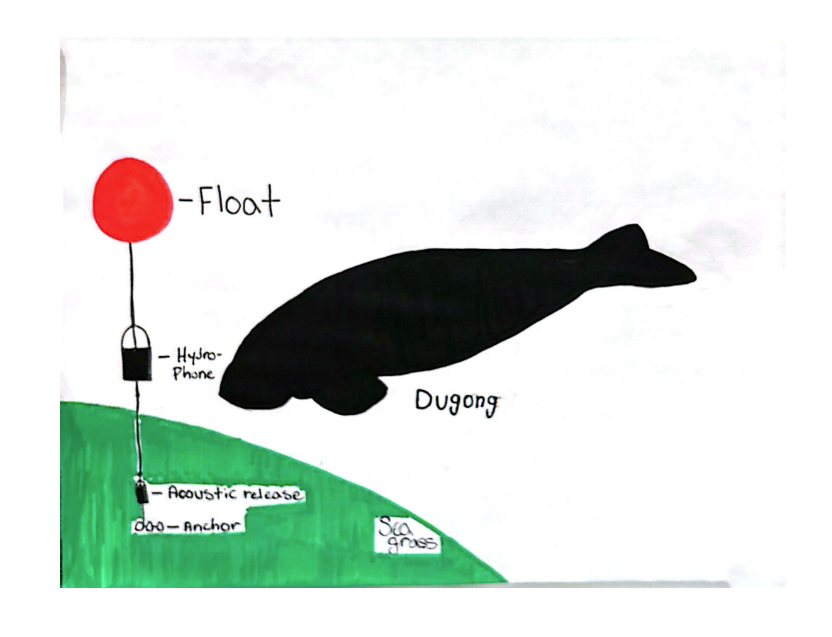
Have you ever wondered what a cow would look like underwater? The dugong (who happens to be cousins to the much more famous manatee) is the closest marine mammal to a cow that, just like cows, almost exclusively eats grass. More specifically, dugongs (who weigh 550 lbs on average) eat sea grass, and they eat a lot of it. Usually, a dugong will eat around 30kg of sea grass a day to maintain its bulbous physique. This diet comes with a hefty price to the safety of these gentle giants. Since sea grass beds are mainly found in shallow waters dugongs spend most of their time around 30ft below the surface and can dive up to 121ft which puts them at risk of being accidentally caught and drowned by fishing nets and (not as commonly) boat crashes. Since dugongs only give birth to one calf every three to seven years, these accidental deaths add up over time and all these factors have resulted in the species being placed on the IUCN red list since 1982. With the help of humans, dugong populations can be brought back to stable numbers where they can continue to leisurely glide through sea beds doing what they do best, eating!
Researchers in Japan successfully monitored dugong feeding events through the use of underwater microphones called automatic underwater sound monitoring system for dugongs (AUSOMS-D). This is an important step in dugong conversation efforts because, prior to using microphones, the only way to know a dugong was eating was to physically be at the feeding site while an individual was eating. Since there can’t be a team of scuba divers waiting at seagrass beds 24/7, planting listening devices is a great option for learning about the feeding habits of dugongs. 175 feeding sounds were recorded by Tsutsumi et al. all of which were rendered at night. This does not mean dugongs only feed at night, but it does show us that using listening devices helps researchers collect data on their feeding behaviors at times previously thought to be unfeasible.
Learning when dugongs eat is the first big step in preventing the further decline of their populations. Researchers can now place a sound monitoring system at sites that have been observed to be used by dugongs to learn how often that site is used. If a team of researchers identifies a site that is commonly used, they can then inform the local government to make sure that the site is maintained and human disturbances are kept to a minimum.
Citations
Chika Tsutsumi, Kotaro Ichikawa, Nobuaki Arai, Tomonari Akamatsu, Tomio Shinke, Takeshi Hara, Kanjana Adulyanukosol; Feeding behavior of wild dugongs monitored by a passive acoustical method. J. Acoust. Soc. Am. 1 September 2006; 120 (3): 1356–1360. https://doi.org/10.1121/1.2221529
