
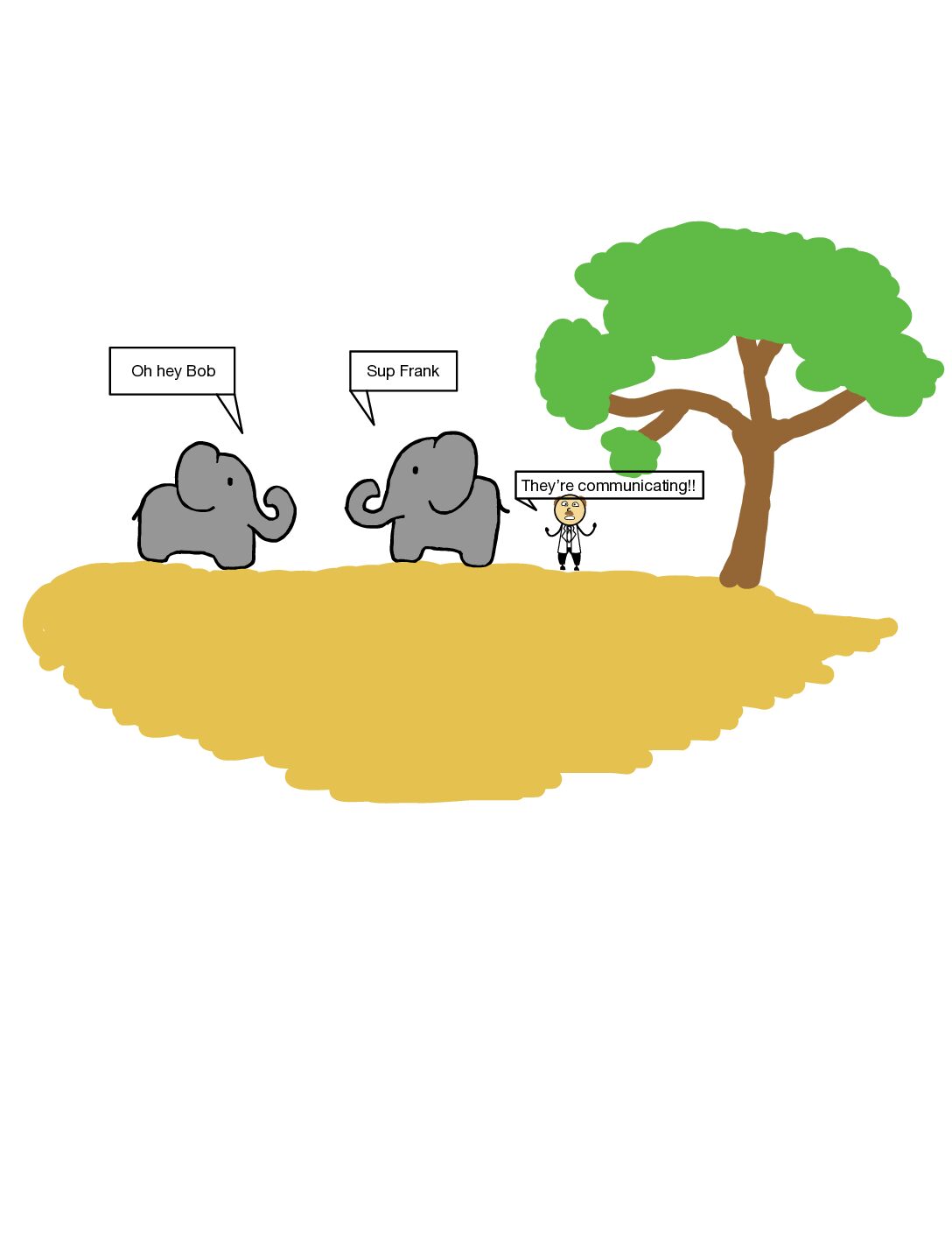
Do elephants call each other by name? Although elephants do not have the capacity to learn each other’s names, a recent study shows that elephants use individually directed calls.
The human language and species is unique in the sense that they use names. Until recently, researchers had thought that this ability was limited to humans and a few vocal learning species like parrots and dolphins. This form of communication is complex and the understanding of it in other mammals could help to learn how this form of communication evolved. African elephants are highly intelligent creatures that have shown complex communication skills. They are able to maintain relationships over vast distances through vocal contact. This aids in their social nature. If elephants are able to individually address one another, it suggests that they have a deep cognitive capacity for symbolic reference and social awareness. This would offer insight into the evolutionary roots of naming and language itself.
In order to investigate the use of these vocal calls in African elephants, the researchers recorded thousands of vocalizations from wild elephants in Kenya. They focused on situations where both the sender and receiver were known. These calls were then analyzed to see if there were any indicators that identified the intended recipient. They then used an artificial intelligence to see if the computer could accurately predict which elephant the different vocalizations were meant for. The computer accurately predicted the intended receiver more often than chance, suggesting that the calls carried individually specific information.
To further study how elephants perceive and use these calls, researchers conducted playback experiments. They played both recordings of calls intended for a specific elephant as well as recordings meant for others. It was found that elephants responded more strongly, via vocalization or movement, when the calls were originally intended for them. This showed that the elephants could recognize when the calls were addressed to them.
The researchers also tested whether these vocalizations were simply imitations of the receiver’s voice, similarly to dolphins and parrots. In their investigation, they found little evidence supporting vocal copying. This indicated that elephants create unique labels for one another, rather than mimicking.
This study reveals a strong level of social and cognitive complexity in African elephant communication. They do not merely exchange generic contact calls, rather they produce distinct vocalizations meant for specific individuals. The computer proved that these calls were individually identifiable and contained receiver identity. Even more importantly, the playback experiments showed that individuals recognized when these calls were meant for them. This suggests a shared understanding of these signals within a group.
It was also important for the researchers to prove that these calls were not imitations. Instead of copying familiar sounds, the elephants seem to be able to assign vocal labels to each other. This has long been thought to have been a trait unique to humans. These results broaden our understanding of animal behavior and offer insight into the evolution of language.
These findings suggest that the ability to use arbitrary vocal labels, which are a defining feature of human language, can have more basic evolutionary roots than has been assumed. By showing that elephants are calling each other with personal, non-imitative calls, the work highlights their advanced cognition and sociality. This capacity for symbolic reference bridges the gap between animal communication and language, demonstrating that complex societies can evolve to create flexible meaningful vocal systems. Along with opening our understanding of elephant cognition, the study prompts a reevaluation of how language-like behavior emerges in other highly social animals across the animal kingdom.
Despite being convincing, the research raises more questions than answers. The sample size in the playback experiment was small, and it is unknown whether and how stable these name-like calls are over the long term or across populations. Researchers also have yet to figure out how the animals learn or use these vocal labels. Whether it is by innovation, social learning, or both. Further research studying behavior over a longer period of time and using larger datasets might demonstrate how these unique vocal systems emerge and function within elephant societies.
Pardo, M.A., Fristrup, K., Lolchuragi, D.S. et al. African elephants address one another with individually specific name-like calls. Nat Ecol Evol 8, 1353–1364 (2024). https://doi.org/10.1038/s41559-024-02420-w
