
Imagine this: you’ve had a rough day, you get home to try and relax and not think about it and your dog comes up next to you with a concerned look on their face. It brings you joy to see that your dog is feeling empathetic towards you and wants to be there to comfort you. Although this may seem like a nice gesture by your fellow companion, research has indicated that this empathy your dog is showing may not actually be empathy after all.
A study that was published in April of 2024 on animal cognition by Juliane Bräuer and her colleagues explores the idea of whether or not dogs can actually distinguish authentic human emotions. This study helped scientists figure out the emotional intelligence that a dog is capable of understanding in humans. What did they find you might ask? Dogs are indeed able to tell the difference between different genuine human emotions that were being displayed by their owners. Although this may sound like your dog is able to have the emotional intelligence to empathize with you during difficult and sad situations, the results actually may be different than what you believed.
To test this idea of dogs’ abilities in understanding human emotions, Bräuer tested seventy-seven dogs that were proficient in the “sit” command, healthy and at least one year in age as well as have the owners of the dogs be present during the experiment . The experiment was conducted in two parts with the first being a training session with the owners using a neutral tone to tell their dog to do a task which was to sit at the start of a line, go around a cone alone and then come back to the start of the line to sit. After three minutes of testing, the experimenters started the second part of the experiment which was assigning the owners a short video to watch that would either make them happy, sad or feel neutral still. After watching their short video while ignoring their dog, they repeated the training once more to see if the genuine emotions the owners were feeling would affect how the dog listens to commands. During this phase of the experiment though there were no significant differences between thethree groups when being trained again after their owners emotions changed. The only difference seen was how much the dog jumped on their owner after the neutral clip which was more than the dogs with owners watching a sad clip.
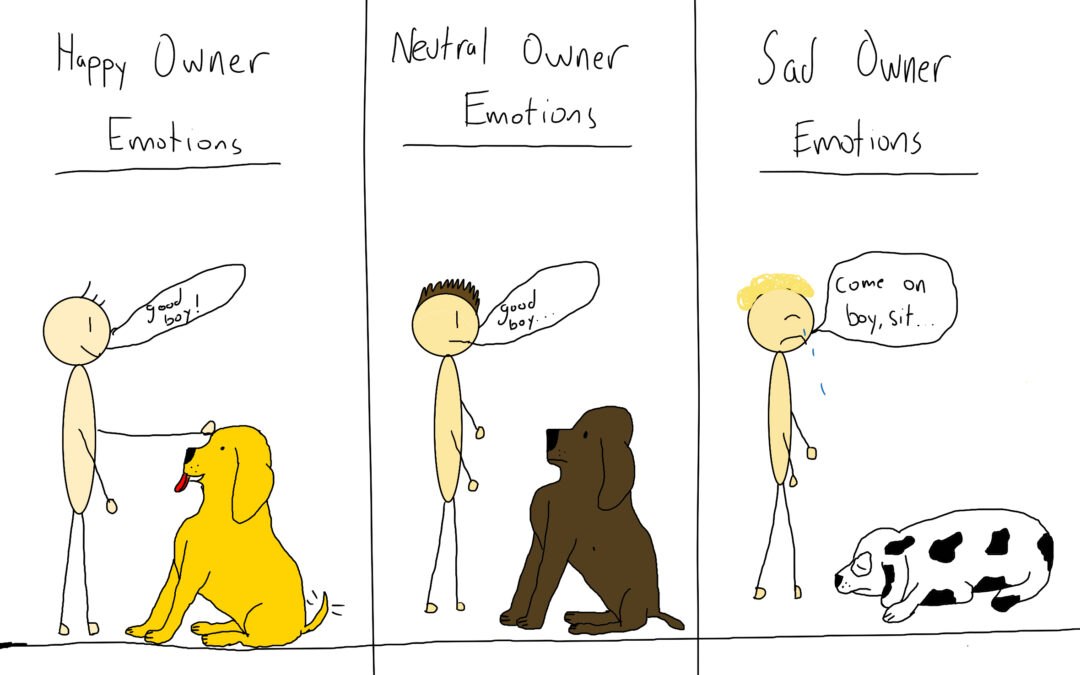
After this experiment, dogs were exposed to their owners in natural settings. When the owners were showing signs of genuine happiness the dogs seemed to perform better when asked to do the training task again. They seemed to be more engaged with their owner, maintaining eye contact with them, jumping more and would respond to their owner’s command. When the owners showed signs of genuine sadness though the dogs tended to stay close to their owner, they were also hesitant in obeying their owners command and wouldn’t always listen to them. They did not maintain eye contact nearly as much or jump as much as the dogs with happy owners. Finally, the neutral owners with their dog still seemed to display similar results when performing the task asked of them but also seemed to listen to their owners less, similar to the dogs that had owners displaying genuine emotions of sadness.
So what might these results mean about dogs understanding human emotions? The scientists argued that although dogs can recognize when humans’ emotions change, their behavior only suggests emotional recognition and not actual empathy seen in dogs. Empathy requires not only detecting what emotion that person is feeling, but also being able to understand it and share commonality among others. This is something that dogs don’t exactly understand. These results actually showed that dogs are more aware of their owners emotions rather than being empathetic.
This distinction between empathy and emotional awareness matters in our dogs behavior because it challenges the idea about our dogs behavior entirely. When a dog gets closer to youwhile you feel sad it may be because of the tone of your voice or your posture rather than the dog actually understanding that you’re sad. When your dog is listening to your commands of telling it what to do it can again be because of the tone in your voice, most likely in a positive way or how you are presenting yourself towards your dog. Dogs basically can sense that something is wrong or right, they just don’t know the reasoning behind why it might be.
Overall, this research helps to suggest that dogs may not be empathetic towards humans, but the relationship shared with them is still present. As studies continue to be conducted into dogs’ and other animals’ emotional intelligence for humans, it will further help scientists understand emotional perception in dogs and other species. Next time your dog wants to cuddle up next to you, it may not be your dog being empathetic towards you, but it’s still that loving bond you feel from your best friend.
Bräuer, J., Eichentopf, D., Gebele, N., Jandke, L., Mann, V., Schulte, K., Bender, Y. (2024). Dogs distinguish authentic human emotions without being empathic. Animal Cognition (2024) 27:60. https://link.springer.com/article/10.1007/s10071-024-01899-x
