
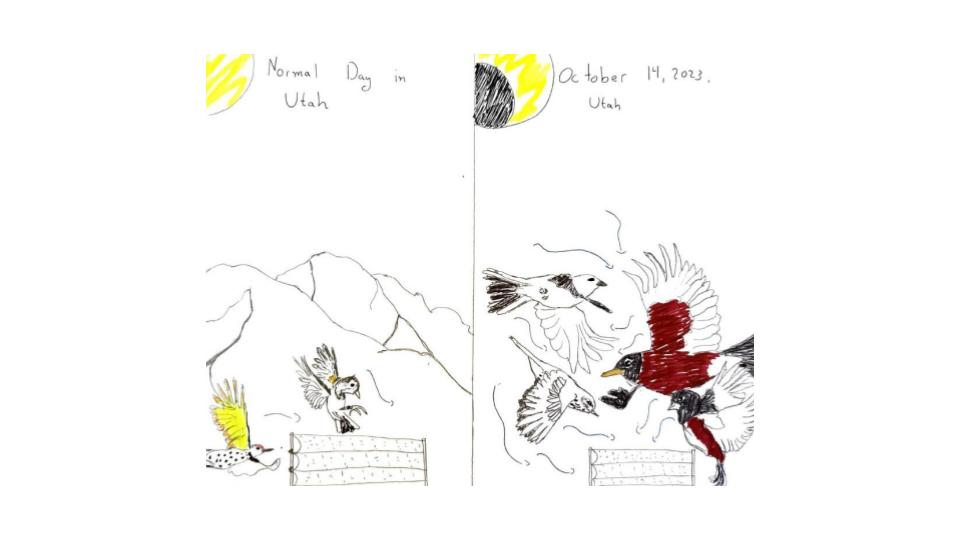
Solar eclipses are a really incredible event to witness. Watching the world suddenly go dark and the sounds of animals all around go silent is once in a lifetime. However, how do solar eclipses impact the movement of animals? Well according to researchers in Utah, birds change how they move when an eclipse occurs.
Taking advantage of the predictability of the October 14th, 2023 eclipse, researchers at the Red Butte Canyon Research Area decided to test if there were changes to bird activity during the eclipse. The canyon found in the Wasatch Range right east of Salt Lake City contains multiple research projects. Red Butte Canyon Research Area has the advantage of hosting a bird banding site at Parley’s Fork, a wetland teeming with birds. Bird banding at Parley’s Fork has been a repeated investigative tradition stretching back to 2012.
Bird banding is conducted to track individual birds which can provide information to researchers about populations and life history of species. However, the researchers were focusing instead on using the tools that bird banding is commonly conducted with, primarily misting nets. These nets are thin 38 mm mesh nets that are designed to safely catch birds as they fly through them. Researchers collect birds, measure and collect information on each individual and then release them with a small band on their leg that indicates when and where they were caught. The researchers had access to thirteen of these nets between the months of April to November as a part of a larger study. Each net is opened approximately 30 minutes before sunrise and closed six hours later. Researchers check the net every half hour and collect any bird that is found in the net.
On October 14th, 2023, the day of the eclipse, the researchers set up the thirteen mist nets at Parley’s Fork at 7:30 in the morning. The main period of the eclipse occurred from 10:00 – 11:00 and between 7:30 and 1:30 exactly 39 different bird individuals were caught in the net, measured and released back into the wild.
The researchers compared the number of individuals captured, the type of species and their maturity or stage of development between the date of the eclipse and the two week period between October 7th until October 21st. They found that the day of the eclipse had been the most frequent captures of individuals since 2012. Although they found a similar trend in types of species captured and the maturity at what they were captured at, the number of birds was significantly more than had been caught in the past. The researchers concluded that bird activity increased because of the eclipse. They hypothesized that this is due to a sudden change in the amount of light in the environment due to the eclipse, not just the lack of sunlight. To clarify, the researchers believed that the increase in bird activity is not due to night-like conditions but rather a rapid change in environment that is not normal for that time of the day. Interestingly enough, although birds were moving around more during the eclipse, they became quieter or as the researchers explained it in excellent terms – the avian soundscape went silent. So next time you are watching the experience of a lifetime at an eclipse and everything is getting quiet, think about all of the birds flying around right beyond your sight.
References
DeNiro A, Kittelberger KD, Samani AM, Şekercioğlu H. Solar bird banding: Notes on changes in avian behavior while mist-netting during an eclipse. Avian Biology Research. 2024;17(3):51-56. https://journals.sagepub.com/doi/10.1177/17581559241265581
