
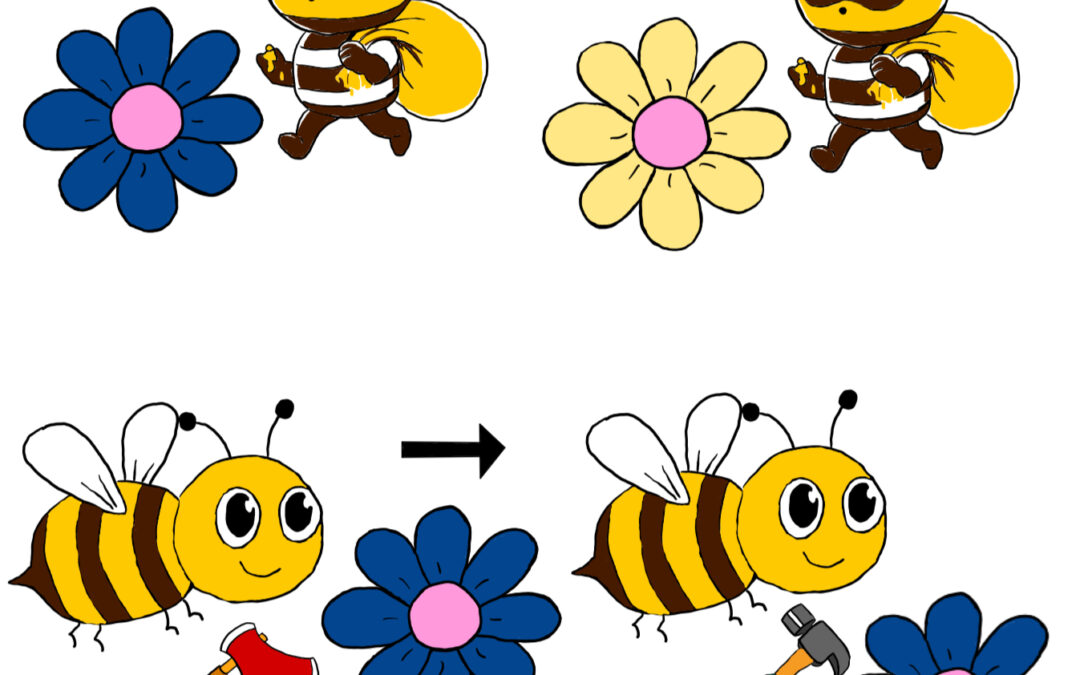
Have you noticed the bees floating around the flowers, aiming to find the perfect one on a warm sunny day? Bumble bees fly to flowers to collect nectar and pollen – their food source which provides them with energy and protein. In turn for their snack, bees stick some parts of the flower’s grains to their furry bodies and move it to another flower, allowing other flowers to be fertilized and eventually develop into a seed for a new plant. However, different changes in the environment make some types of plants disappear, leaving the bees with new flowers to chew on.
Bumble bees are highly intelligent individuals who are able to learn how to change their food tactics to collect the most food based on which flowers are available around them. But how exactly do they make it happen – is it better for them to change their feeding habits or simply find a new flower? Previous studies have shown that bees are able to detect different traits of the flower, such as its unique color, smell, or shape. This knowledge is important to them in deciding whether pursuing a specific flower is worth the effort based on how much food they will get from it. A group of scientists created a study to see how bees are able to get the most food from the plants in their surroundings by creating a laboratory setup with artificial flowers and training 68 bumble bees to extract nectar in two different ways: through legitimate visits when a bee eats the nectar and transfers a part of the plant to another one or nectar robbing when a bee steals the food without actually helping the flower. After that, they provided the bees with new types of artificial flowers to see how they would eat the nectar – would they go to the flower of the same color they usually eat from and learn how to eat nectar in a new way or would they rather just explore new source of food to use the same type of tools to collect nectar?
Results showed that most of the time, bees that are known as thieves that would just steal the nectar and leave would prefer to switch the flower colors just to continue their criminal journey. However, the bees who make legitimate visits to help the plants in return for their food would stay on the same color of the flower and learn new ways of collecting nectar. This study helps us learn how flower color similarity and the behavior of the bees help them keep up with their diet where thieves will always be stealing and honest bees will learn new ways of eating to maintain their friendships with flowers.
Bibliography
Leonard, A. S., Dornhaus, A., & Papaj, D. R. (2010). Flowers help bees cope with uncertainty: signal detection and the function of floral complexity. Journal of Experimental Biology, 214(1), 113–121. https://doi.org/10.1242/jeb.047407
Baek, M., Garcia, J. S., & Papaj, D. R. (2024). Floral cues and flower-handling tactics affect switching decisions by nectar-foraging bumble bees. Animal Behaviour, 215, 163–175. https://doi.org/10.1016/j.anbehav.2024.07.010
