
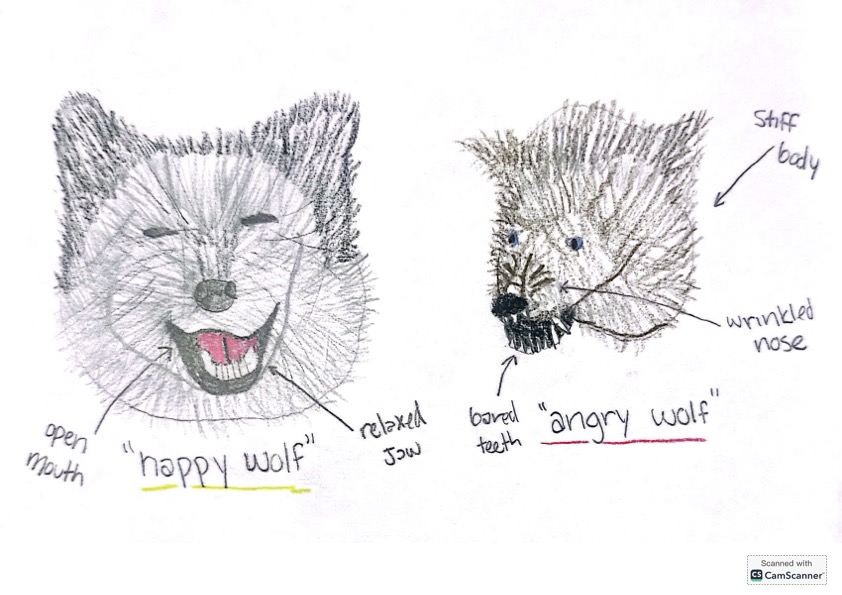
If you’re happy and you know it, clap your hands! This, along with smiling, lets everyone know your mood. When you are mad or sad, you often frown. Wolves do the same thing to let everyone know whether they are in a playful mood or an aggressive one. When wolves fight, they have the same actions when they fight playfully and aggressively, but their facial expressions let the others know if the fighting is fun to prevent it from escalating.
A group of researchers wondered what the specific faces were and what they meant. To find out, they rounded up 38 wolves and filmed them for several hours 6 days a week. After filming, they watched the footage of all the playful and serious fighting that took place and studied the facial expressions of the wolves. The scientists found that when the wolves had a relaxed and open mouth and were not biting each other hard, it was playful fighting. When the wolves were fighting aggressively, they had one of three threatening faces: light (mouth slightly open with partially visible teeth), medium (mouth open normally with teeth showing and partially visible gums), and high (mouth wide open with teeth and gums showing).
The researchers’ findings highlight that the facial expressions make the fighting mood of the wolves clear. This is very important because if the wolves weren’t able to communicate their intentions, they might accidentally hurt each other. By properly communicating, the wolves can play fight and be best friends!
Veronica Maglieri, Fosca Mastrandrea, Alice Galotti, Martin Böye, Sébastien Laurent, Andrea Marcolla, Elisabetta Palagi, Tell-tale signals: faces reveal playful and aggressive mood in wolves, Animal Behaviour, Volume 214, August 2024, Pages 1-9, https://www.sciencedirect.com/science/article/pii/S0003347224001489
