
As you probably know, humans make lots of pollution that can leak into nature and harm animals – fertilizers, salts, poisons, etc. These sorts of pollution have really nasty effects, but recently another type of pollution has been getting a lot of attention. It’s called artificial light at night, or ALAN. ALAN is caused by the bright street lights and neon signs that humans have turned on in our cities at night. It’s the reason that you might not see the stars when you look up at night. A group of scientists wanted to understand how ALAN effects animal populations, so they did an experiment on crickets.
Crickets were collected from the wild and raised in two different kinds of environments. One group was put in a dark box that mimics the crickets’ natural habitat. This box is called the control group. The other population was raised in a box with a light bulb. This box replicates the sort of ALAN that populations of crickets might be experiencing when they live near a city. By comparing the traits of the ALAN group (possibly affected or impaired) with the traits of the control group (in their natural state), the scientists can directly measure the impacts of ALAN on crickets.
The scientists chose to measure two life-history traits, which are traits involved in the big-picture survival and reproduction of an animal. First, they measure the strength of the crickets’ immune system. The stronger a cricket’s immune system, the better a cricket can fight sickness and survive. This trait is a representation of total energetic spending on the survival of crickets. Secondly, they measure the number of eggs that female crickets are laying. The average number of eggs laid by a female is a representation of the populations total energetic spending on reproduction.
An organism tries to spend its energy in the way that maximizes its ability to pass on its DNA to following generations (fitness). By using energy on survival, a cricket might ensure that it lives through a breeding season. But by spending more on egg laying, a cricket may have a more effective breeding season given that it survives. Either way, the energy of a cricket is finite, and it’s important to know how humans are affecting this spending. Life history traits are core to an organisms identity and essential for the future survival of a species.
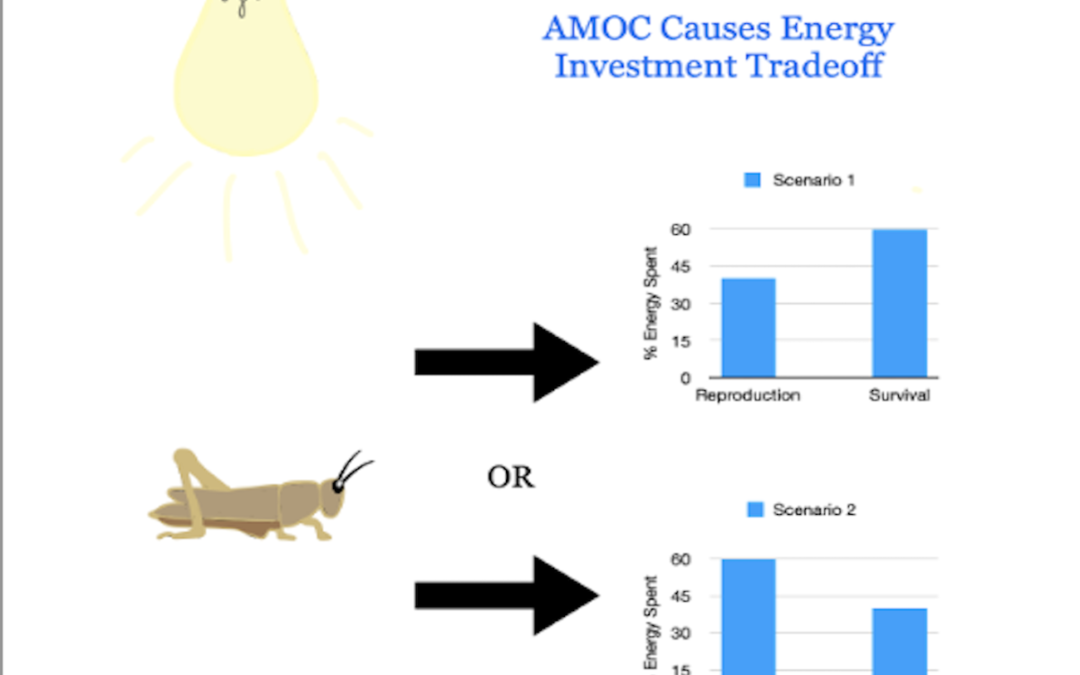
Crickets raised in ALAN environments had both relatively weaker immune systems and laid less eggs. This indicates that exposure of ALAN is reducing the overall energy budget of a cricket, resulting in a decrease of fitness. Furthermore, ALAN crickets experienced a resource tradeoff between immune strength and egg laying. In other words, crickets had to choose between spending their limited energy budget on their immune systems OR on egg laying. The stronger a cricket’s immune system, the less eggs it laid and vice versa. In wild populations this relationship is not shown because crickets have enough energy to spend on both things.
Just like you, crickets have a daily routine. They need to wake up in the morning and go to bed in the nighttime. By producing excessive light in the nighttime, humans are disrupting this delicate cricket rhythm. The crickets are so stressed that their brains aren’t producing the right chemical (melatonin) to help them sleep and be energized. The result is a reduction in overall fitness, and an induced resource investment tradeoff between reproductive traits and survival traits. It’s a sizeable problem for the crickets, and each of us is contributing. If crickets are suffering from ALAN, then many other animals may be also. It’s important we keep studying this topic, because we can only hope to fix the problems were causing if we understand them first.
Works Cited
Rebar, Darren, Tingyuan Xiao, and Elizabeth Murdock. “Anthropogenic light impacts life-history traits and induces a trade-off in female field crickets.” Behavioral Ecology 35.5 (2024): arae064.
