
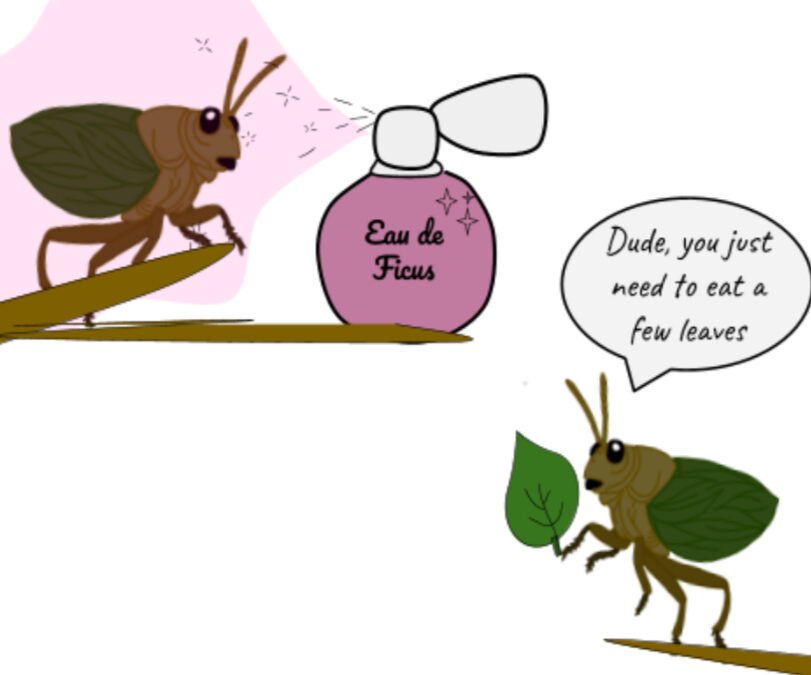
The word “camouflage” often conjures images of chameleons seamlessly blending into leaves and grass by imitating the color of their background. However, some animals don’t use visual cues for camouflage at all, instead using chemical signals to conceal themselves. One treehopper species, Aetalion reticulatum, uses chemical camouflage so efficiently that predatory ants perceive it as part of a tree in the background, rather than a source of food.
A. reticulatum are pests that frequent citrus plants in South America. Although the species produces a sugar-rich honeydew that attracts ants, interactions between the ants and treehoppers are often mutually beneficial, with the ants providing grooming or protection in exchange for the liquid. However, the ants will sometimes attack and kill the treehoppers for the resource instead of partnering with them. Consequently, the treehoppers have developed a mechanism to minimize risk of attack: mimicking the chemical composition of the plants on which they live to disguise themselves.
Many plants and insects release chemical signals called “cuticular hydrocarbons,” or CHCs. CHCs signal recipients to act in a certain way — for example, CHCs produced by many plants are processed as background noise to ants, and indicate that the ants should move on in their search for food and resources. When one organism mimics the CHCs of another, it can have a disguising effect; it can also help that organism in obtaining resources, as in the case of another treehopper species that uses chemical camouflage to trick butterflies into laying their eggs directly on them.
Chemical camouflage can be accomplished in different ways, with some species obtaining a chemical compound by simply touching the target they wish to imitate. These chemical signals are flexible and can change depending on environmental factors. As in the case of A. reticulatum, camouflage is accomplished via diet, with organisms mimicking the CHC’s of the leaves and flowers that they consume.
When Lima et al. 2024 analyzed the CHC similarity between A. reticulatum nymphs and the host plants on which they were raised, the ability to imitate plant signals was profound. The nymphs’ CHCs had a similarity of greater than 80% with Ficus clusiifolia and greater than 95% with Luehea grandiflora. However, this observation did not hold true for all host plants, as a third tree tested only had 60% similarity, which did not meet the threshold to be considered camouflage. Because nymphs from the same parents and generation could produce different chemical signals depending on where they were reared, this suggests a level of flexibility and adaptivity between generations (although the flexibility within an individual’s lifespan has been less examined).
This process represents a complex strategy specifically intended to evade ants’ highly adapted sense of smell. Being equipped with a human sensory system, it is easy to evaluate the world through only the chemical and visual stimuli we are accustomed to. However, considering the novel sensory and camouflage systems of other creatures can have extensive practical implications, especially when considering strategies to control pests such as A. reticulatum in agriculture or design products such as insect repellent.
References
Lima LD, Ceballos-González AV, Prato A, Cavalleri A, Trigo JR, Nascimento FSd. Chemical Camouflage Induced by Diet in a Pest
Treehopper on Host Plants. Plants. 2024; 13(2):216. https://doi.org/10.3390/plants13020216
