
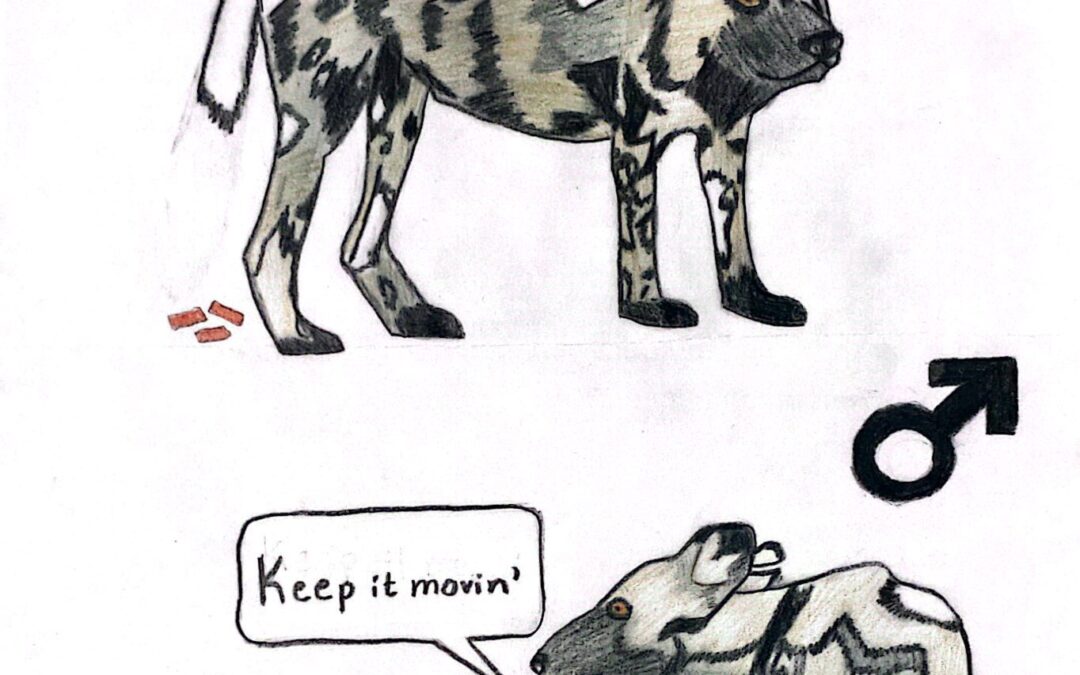
The Scent Markings of African Wild Dogs
Whether you’re a dog owner, lover, or observer, South Africa’s painted dogs, formally termed African wild dogs (Lycaon pictus) will undoubtedly grasp your attention with its unique morphology and social behaviors [1]. The canine distinguishes itself from other dogs with its large bat-like ears, patchy coat, and 4 toed-paws [1]. A distinctive feature of the dog’s morphology is its white tipped tail, which is evolutionarily adapted for pack solidarity [1]. Although these cute dogs are non-aggressive within their packs, they are excellent killers who have more hunting success than larger animals comparative in size, including Africa’s apex predator, the lion [2]. Ranging from 40-79 pounds in weight and about 1 meter in length, packs containing 7-40 members undergo pursuit predation to capture stocky wildebeests weighing hundreds of pounds [3] !
At the top of each successful hierarchical pack are two fit individuals, the monogamous alpha males and females who tend to eat first and are the only individuals responsible for breeding [3] . One feature of social behaviors exhibited by African wild dogs that make them admirable is their collective efforts to not only survive as individuals, but to thrive as a kennel. The unity of a pack is revealed best through the responsibilities each member holds to its community. All members of a Wild dog pack play a role in raising the pups of the alphas along with caring for vulnerable members of the group [3] . The commendable collaborative nature of African wild dogs is unobtainable without the communication which takes place under the surface.
The great intellectual capacity of the dogs has influenced the evolution of numerous communicational signals. Perhaps you happen to find yourself on a South African safari, and you witness the dispersal of an African wild dog pack after the successful escape of a hungry lion. Due to the absence of a missing member, the dogs vocalize a “Hoo-Hoo-Hoo” cry in hopes of assisting the vulnerable dog in finding its way back to the pack [4] . The vocalization of African wild dogs and its behavioral functionality is a knowledgeable sector in the field of animal behavior. Other complex signals, such as scent marking, have left scientists with many unanswered questions about the dynamics of dominant sexes, individual motives for scent marking, and the importance of the place in which scent marking occurs.
M.J. Claase et al (2023) gives insight into some of these inquiries through its study, which took place early to mid-winter over the course of more than a year, in northern Botswana [5]. The experiment analyzed the scent marking behavior of 13 “free-ranging” dog packs at 22 shared marking sites referred to as latrines [5]. Researchers placed multiple cameras at each latrine to capture the scent marking and over marking behaviors of the dogs. To be deemed scent marking, a behavior would have to meet specific criteria, which includes one of the following: urination, defecation, rub rolling, and dragging [5] . Overmarking was first distinguished by a dog sniffing a scent mark and followed by marking over the identified scent. Despite being a unified species in its measures of member protection and fostering, there is no one reason for why or even how African wild dogs mark. The findings suggest that scent marking in wild dogs is rather specific to the individual. Marking likelihood and motives can potentially be determined by a few different factors: Inter- and intra pack context, dominance, and sex [5].
Overall, data collected from the study unveils that dominant females and males have an equal likelihood of marking, which is much greater than that of subdominants [5] . This finding brings about the question: Does status and sex have an impact on the likelihood of a wild dog marking? Marking and overmarking were both witnessed more in dominant dogs than subdominants regardless of sex [5]. Upon the realization that sex does not have an effect on marking occurrences in African wild dogs, the focus of the study was shifted to inter- and intra pack context and dominance. Differences in overmarking between dominant males and females within interpack and intrapack contexts served as evidence for varying purposes in scent marks between sexes. In an intrapack context, dominant males overmarked more than females, while dominant females overmarked more than males in an interpack setting [5] . Dominant males always left the last mark in both intrapack and interpack contexts [5] . The results of the study have led researchers to conclude that the overmarking of males is a defensive mate mechanism, used to ward off other interested males, whereas the overmarking of females serves as territorial defense [5].
The opportunity to observe these beautiful social creatures must be quite the pleasure to the beholder’s eye. African wild dogs, through their hierarchies, have revealed to those who have studied them their intimate ways of communicating. Latrines appear to be a crucial space for African wild dogs to assert their supremacy over rival packs. Although marking is a common behavior amongst all dog species, it acts as a mediator between different packs that prevents conflicts from unfolding. Before meddling with African wild dogs, be aware that conflict with one member means retaliation from all.
References:
[1] “African Wild Dog.” African Wildlife Foundation, www.awf.org/wildlife-conservation/african-wild-dog. Accessed 09 Oct. 2024.
[2] Schmidt, Amanda. “African Wild Dog Fact Sheet.” PBS, Public Broadcasting Service, www.pbs.org/wnet/nature/blog/african-wild-dog-fact-sheet/#:~:text=African%20wild%20dogs%20have%20a,hunt%20together%20to%20capture%20prey. Accessed 09 Oct. 2024.
[3] “African Wild Dog.” African Wildlife Foundation, www.awf.org/wildlife-conservation/african-wild-dog#:~:text=The%20wild%20dog%20%E2%80%94%20also%20sometimes,pack%20in%20contact%20while%20hunting. Accessed 09 Oct. 2024.
[4] Shillaw, Jess. “Why Do Wild Dogs Hoo Call? – Londolozi Blog.” Blog, 9 May 2022, blog.londolozi.com/2022/05/11/why-do-wild-dogs-hoo-call/. Accessed 09 Oct. 2024.
[5] Author links open overlay panelM.J. Claase a b, et al. “Patterns of Scent Marking by African Wild Dogs, Lycaon Pictus, at Shared Marking Sites.” Animal Behaviour, Academic Press, 17 Nov. 2023, www.sciencedirect.com/science/article/pii/S0003347223002671. Accessed 09 Oct. 2024.
