
How do we recognize the people that we know? You might think it’s easy to walk into a room and be able to distinguish your friends from strangers, and for us it usually is. But what about other animals? Birds, for example, are highly social animals, making it very important for them to be able to recognize others as specific individuals. Modes of this recognition could be visual, chemical, auditory, or more. To eyes like ours, most birds of the same species look almost identical, so you might wonder what visual cues the birds look for to help them make distinctions between individuals. A group of researchers (Baciadonna et. al., 2024) had this same question. Looking at African Penguins, Spheniscus demersus, they found that they may be looking at spot patterns.
African penguins are found in large colonies along the southwestern coast of Africa. They are monogamous creatures, meaning that they typically have one lifelong partner. They also have ventral dot patterns on their lower bodies, which are unique to each individual and remain the same throughout their lifetime.
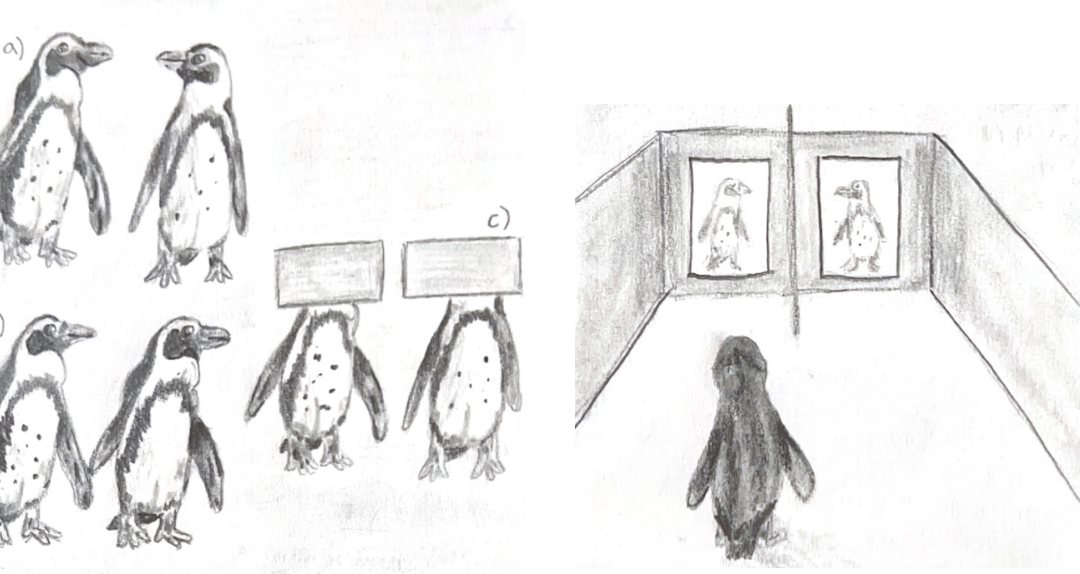
The main question of the study was whether African penguins were able to distinguish their partners from non partner colonymates using visual information only, eliminating other possible identification methods such as having specific sounds and calls, and if the visual information was the ventral dot patterns. 12 penguins from the same colony, housed at a marine park in Rome, Italy, were used in the study. There were 7 males and 5 females all of which were stable partners with another penguin in the group (5 F/M pairs, 1 M/M pair). They tested each penguin with 5 tests, all of which used photos of known penguins from the colony: Partner vs. non-partner, partner with dots vs partner with no dots, partner with no dots vs non-partner with no dots, partner head only vs non-partner head only, and partner body only vs non-partner body only. They measured both the duration the penguins looked at each photo and the duration in proximity to the photos.
The results supported the hypothesis about visual recognition. African penguins greatly favored unaltered photos of their partners over unaltered photos of non-partners. They also preferred the unaltered photos of their partners over the photos of their partners with no dots, and the photos of their partner’s body only over the photos of non-partner’s body only. This supports the idea that the African Penguins are looking at the ventral dot patterns on their partners and recognizing them, showing a more cross-modal recognition (auditory/visual) rather than the previous assumption of penguins having limited visual involvement in their communication. It is also important to note that these recognition abilities are not dependent on the ability of a pair to mate, as the 2 male partners showed the same preference for each other as the other pairs, suggesting that it is also the bond between the partnerships in the penguins that helps to distinguish partner from non-partner.
This study was one of the first to be able to separate a specific visual cue that could be responsible for recognition by a bird. It is a good first step to being able to study this more, but it could be more difficult to isolate specific features in other species as opposed to the ventral dots on the penguins. Ultimately these results illustrate the importance of studying all sensory modalities when looking at recognition systems in animals.
Luigi Baciadonna, Cwyn Solvi, Francesca Terranova, Camilla Godi, Cristina Pilenga, Livio Favaro, African penguins utilize their ventral dot patterns for individual recognition, Animal Behaviour, Volume 207, 2024, Pages 13-21, https://doi.org/10.1016/j.anbehav.2023.10.005
