
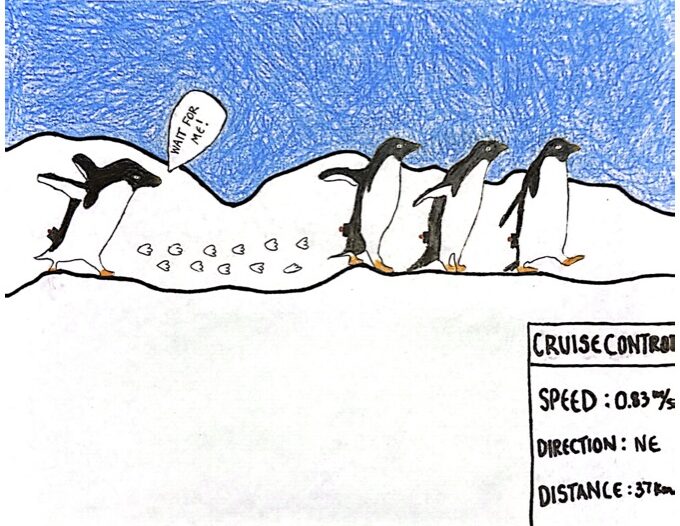
Top 3 things needed for a road trip? Snacks, music, and perhaps most importantly, cruise control. When driving, cruise control allows the driver to maintain the speed of the car whilst keeping their foot off the pedal. Similarly, Adélie penguins (Pygoscelis adeliae) have their own form of cruise control. Adélie penguins are foragers that travel in groups to the ice edge to catch fish and krill from the sea. Working in a group is quite beneficial as it reduces predation risk, increases foraging efficiency, and decreases the energetic costs of traveling. Despite being unique individuals, the group of travelers can maintain group cohesion for the duration of the trek.
A group of researchers (Imaki et. al., 2024) wondered how this was possible. As humans, we all walk at different speeds and need to rest at different times, surely the penguins do too. This led the researchers to study the behavioral coordination of the traveling penguins. Biologging was the selected method for this study. Biologging allows researchers to record the movements of the penguins and make inferences about their collective decision-making. The penguins must decide where and when to go, how fast to go, and when to take breaks if traveling a long distance. The researchers predicted that mutual social influences and adjustments to each individual’s speed is what is behind the tight-knit group cohesion.
The selected group of penguins was from a breeding colony on Mamejima Island off the coast of East Antarctica. In this region, the ice forms quickly and expands the distance to the sea, meaning the penguins have to walk further distances to forage. The Adélie penguins had been seen leaving the colony as a groups to forage, but it was still unclear how they maintained the groups for extended periods of time. The researchers sought out to examine the stability and behavioral mechanism of Adélie penguin group cohesion using biologging in the form of GPS tracking and accelerometers. More specifically, they looked at whether the penguins were able to maintain the formed group from departure to destination, which behavioral coordination allowed them to maintain cohesion, and how the birds were organized within the group and how that may influence each other’s behavior.
Fieldwork was conducted in December of 2017, and the researchers observed mating pairs incubating eggs, where the male and female switch off periodically. Once a switch was made, 17 penguins released from parental duty were caught using a net and equipped with a tracker on their lower backs. All 17 birds were given a tracker that recorded GPS position every five minutes. In addition, 7 of the birds were given trackers that recorded acceleration. Using acceleration data, researchers were able to determine penguin behavior, which was classified in 3 categories: resting, walking, or tobogganing (sliding on their bellies). Then, using the GPS tracking, they were able to determine the speed of the penguins during walking and tobogganing. Researchers were also able to note indicators of group structure: Polarization order parameters and bearing angles. Polarization order parameter indicated if the direction of movement was consistent among members of the group. Bearing angles indicate the position of each individual in the group relative to the entire group’s traveling direction. Finally, social influence among the individuals in the group were examined using two approaches. First, spatial positions of the group members identified the individual leading the group and comparing it to the travelling direction. Secondly, the researchers examined the order of simultaneous resting initiation by comparing the start time of the rest stop among individuals and the recorded time that the group rest was initiated. This indicates which bird tells the others to stop and rest.
The results of the tracking align with the researchers original predictions. After collecting trackers from 14 of the birds 12-22 days after installing them, it was concluded that each individual moved at a consistent speed and maintained short distances from one another throughout the journey. It is suggested that the matching of traveling speed is due to the penguins’ continual adjustment rather than the topography of the land, as the new sea ice was very flat. The penguins most likely achieved the speed consensus through synchronized resting and adjustment of individual locomotive behaviors (walking vs tobogganing). Despite some penguins preferring to walk rather than tobogan (and vice versa), all were able to adjust themselves to keep up with the group. Overall, the detailed analysis of the tracking data allows the researchers to gain evidence that the penguins maintained their group using synchronous resting and adjustment of locomotive behavior.
So, the next time you go on a road trip and use cruise control, think about the Adélie penguins in Antarctica who use behavioral mechanisms to stick together and cruise along the ice!
Toshitake Imaki, Nobuo Kokubun, Kozue Shiomi, Akinori Takahashi, Speed consensus and behavioural coordination of Adélie penguins travelling on sea ice in groups, Animal Behaviour, Volume 208, February 2024, Pages 1-17, https://www.sciencedirect.com/science/article/pii/S0003347223002968
