
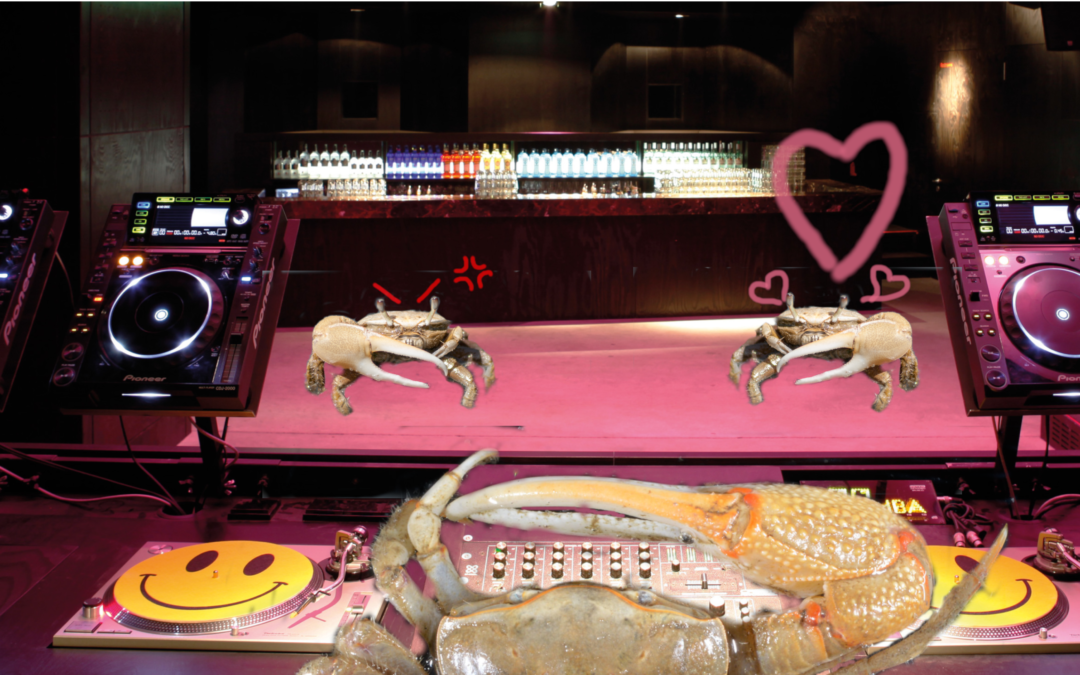
Turns out humans aren’t the only species that can lay down a slick beat change: A recent study in South Korea revealed that fiddler crabs drum up different beats based on their audience. Fiddler crabs are a very small species of burrowing crab. Only slightly larger than a quarter. Males of this species can be easily identified by their mismatched claws, one claw being comically large in comparison to the crabs’ small stature. This colossal claw is used for normal crab things like mating displays and fending off enemies from their domain.
Somewhere down the line the fiddler crab evolved an organ called Barth’s myochordotonal. This special organ allows them to sense incredibly small vibrations through their legs and has developed into a vehicle for the male crabs “mating dance”. Using the muscles in their arms, they shake their claws rapidly, drumming up rhythms to impress females that pass by their burrow. This works great for attracting a potential mate, but unfortunately for the fiddler crab things aren’t always romance. Every now and again they have to face hostility outside the burrow, and wouldn’t it be useful if they could switch up their rhythm? Maybe play something a little frightening to scare off a foe. Well that’s exactly what Minju Kim and Taewon Kim hypothesized the fiddler might be capable of, leading their team to embark on a research study of Austruca lactea (Milky Fiddler Crabs).
First things first, in order to trigger the drumming of the crabs, the team needed a possible female companion for our big clawed bachelor. Made out of clay, the decoy females were shaped to perfectly represent a female fiddler crab before being mounted on a long stick for the researcher to hold. The team’s method for recording drumming was an accelerometer placed into the mud outside the burrow. Outside of the world of crabs, these devices are used on actual spaceships to sense micro-vibrations in substrates. In addition to the accelerometer, a camera was poised on the entrance to record physical behavior associated with aggression and courting. With the decoy, camera and accelerometer in place, the experiment was ready to begin.
Placing the decoy directly outside the male’s burrow, the researchers waited for first contact to occur. Once this was made, the team gradually moved our clay lady closer to the burrow entrance in order to trigger further reaction. Once initiated, the male response was then categorized into one of two categories. If the crab gave a friendly wave and retreated into its burrow to begin drumming. This was considered an attempt to draw the decoy in and categorized as courtship drumming. Alternatively, if the crab gave the decoy a rude gesture and drummed at the burrow entrance, this was categorized as combative or agonistic drumming.
After collecting and categorizing responses from a total of 76 different confused crabs, the team proceeded to the analysis stage. They found that the structure of the drumming could be broken down into a series of pulse trains. These “trains” are small groups of vibrations that the crabs string together to form their songs. Kim’s teams identified five guiding variables within each pulse train that they would use to identify differences: 1. Pulse rate within a train. 2. Pulses per train. 3. Duration of each train. 4. Pulse duration. 5. Dominant frequency of vibration.
Looking at the data, while pulse duration and dominant frequency of vibration proved to be unimportant, pulse rate, pulses per train and train duration varied significantly. Kim’s team’s hypothesis was spot on! When the crabs responded to the decoy with hostility, the pulse rate of the resulting agonistic drumming was significantly faster than that of courtship drumming. In contrast, when the crabs responded to the decoy with flirtation, the following courtship drumming held more pulses per train with longer train duration. The crabs are actively changing their rhythms based on the environment and individuals around them!
The study demonstrates how Milky Fiddler Crabs are able to communicate varying complex signals in response to changes in their environment; they are able to recognize friend and foe behavior and respond with a unique signal accordingly. This is an amazing discovery in the world of vibroacoustic communication! Kim’s team further hypothesized that the exact rate and amount of pulses may signal certain qualities like stamina. Now that we know they alter signals based on context, the extent of what these fiddler crabs are able to communicate with just rhythm alone comes into question. Opportunity for future research questions in this area of study is very clear.
References
Kim, M., Park, S., Lee, H. M., & Kim, T. (2024). Where the fiddlers sing: Fiddler Crabs change their tunes depending on the context. Animal Behaviour, 207, 37–45. https://doi.org/10.1016/j.anbehav.2023.10.006
Image Credits
“Fiddler Crab 2” by Wilfredor is in the Public Domain, CC0
“Uca minax, red-jointed fiddler crab, 28mm” by Smithsonian Environmental Research Center is licensed under CC BY 2.0
“Bob Beaman Nightclub” by Arnold Jaeger Werner is licensed under CC BY 2.0


