
Domesticated rabbits are known for their companionship, and are often friendly animals similar to a dog or cat, but this is not the case for wild rabbits. If you were to try and pick up a wild rabbit they would run away, but do you think some would be more willing than others? Some might let you get closer and be interested in you while others might be scared. The behaviors of all animals differ, some are more outgoing, while others are more reserved. But what causes this?
A study done by Rödel (2011) observes the behaviors of wild European rabbits, in order to try and find a reason for the differences in personality that leads to variety in the way they interact with the environment around them. As the individual experiences of the rabbits can have a significant impact on their behaviors. But what are these differences in their lives that have led to the differences in their behaviors, furthermore does having variety in their behaviors positively impact the success for their species, if not why do they differ? Studying how the development of rabbits impacts their personality can be helpful to understanding how they also chose to interact with the environment around them. The study by Rödel (2011) focuses on three different variables that could possibly play into the bravery aspect of their personality when interacting with the environment around them. These three variables are body mass, sex, and width at 12 days old (new borns).
In the study they took European rabbits that were descended from wild rabbits and placed them in a semi-natural field enclosure for the experiment. The population density was high but within normal range for wild rabbits. They were watched but stayed unsocialized with humans. The rabbits were observed during the breeding season as the scientist waited for the babies to be born. Once the rabbits reached 12 days old they were weighted, sexed, measured and marked to track them. The actual experiment didn’t occur until the rabbits were between 130 and 241 days old in which they were removed from the field enclosure with other rabbits and placed in a new outdoor enclosure (360 x 400 cm) by themselves. They were kept in a burrow in the enclosure for 30 minutes to let them settle. Once opened they were monitored by a video camera for 24 hours but had no human contact in order to observe behaviors of the rabbits and how they interacted with the new environment. Two variables were tracked. One being the start of activity (when they left their burrow) and the other being Exploration (Time spent outside burrow moving and sniffing).
After 16 days the experiment moved to the next step where they tested the behaviors of the rabbits when there was possibly a predator around. They did this by placing fox odor(feces) outside the enclosure. Once again there was no human contact and they were monitored for 24 hours by video camera. Three variables were tracked this time: change in time spent outside, number of times they went to the bathroom, and change in alertness while feeding.
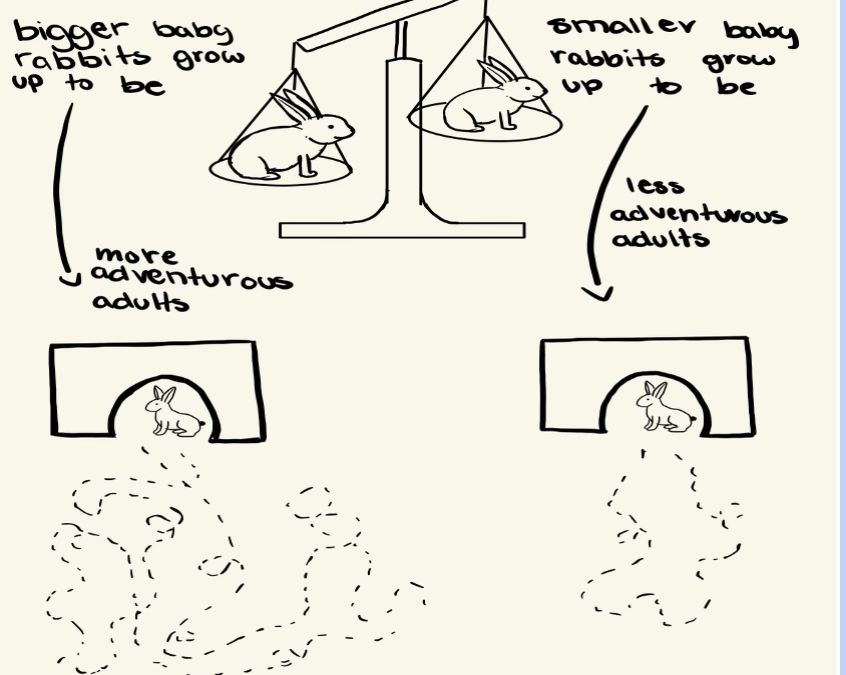
The study found that for the novel environment (new environment with no predator odor) there was no significant correlation between body mass, sex, or size on day 12 and time they rabbits left the enclosure, but there was a correlation between body mass on day 12 and time spent outside. The rabbits who weighed more on day 12 spent significantly more time exploring than those who weighed less on day 12. The study also showed that in the predator environment the rabbits did not have a change in time spent outside, or alertness when the scientist added the fox orders, which was a surprise finding that differed from other studies. However the study did find that the rabbits that had a smaller body mass at day 12 defecated significantly less after the odor was added, while there was no change in defecation for the rabbits with a larger body mass on day 12. This study shows the impact of early development on behaviors of mammals such as wild rabbits. Studies like this can explain a lot about where animals’ personalities stem from and the major implications they have on social and environmental interactions.
References:
Heiko G. Rödel, Raquel Monclús, Long-term consequences of early development on personality traits: a study in European rabbits, Behavioral Ecology, Volume 22, Issue 5, September-October 2011, Pages 1123–1130, https://doi.org/10.1093/beheco/arr100
