
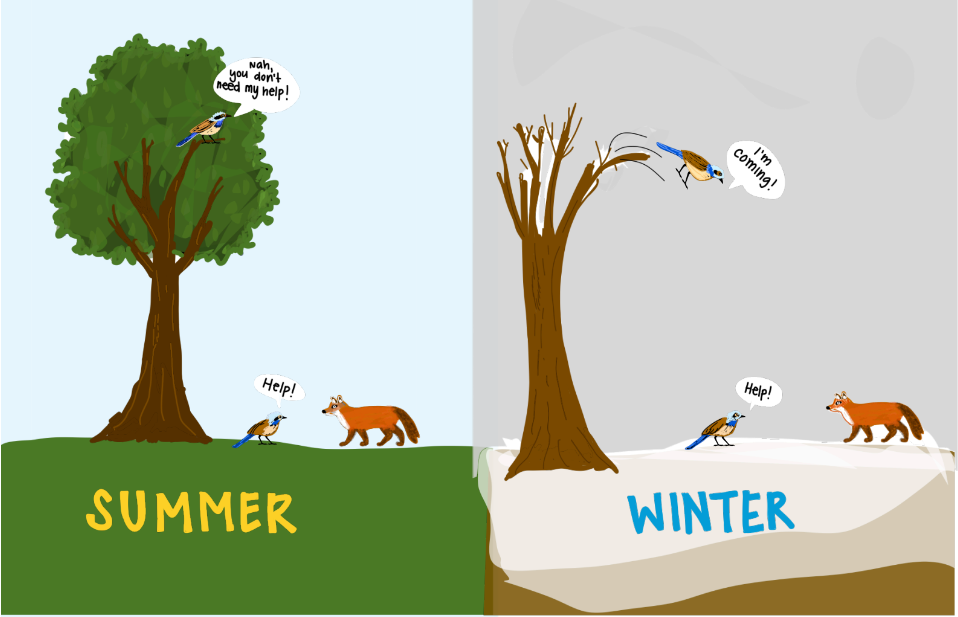
We are always taught to “treat others how we want to be treated” and always help out our friends. So what would you do if someone was hurting your classmate? Or if your friend was hungry? I think everyone would help save their classmate or give their friend half of their sandwich! Birds though, are not always like this. Their behavior might change depending on the weather!
The birds that were being observed are called superb fairy-wrens (Malurus cyaneus) in Melbourne, Australia. Scientists picked these songbirds because they live in a multilevel society where there are different groups that the birds join depending on a social hierarchy. These groups are called breeding groups, and when there are a lot of different breeding groups that come together in a specified land area, that is called the community. During the summertime, they settle and defend their territory as a group from other fairy-wren groups because they have babies to take care of. But in the winter, the groups try to work together to get more food, and more land, and stay away from predators as much as possible. So they are working together more in the wintertime because it is difficult to live in the cold!
The researchers were trying to find out if the birds work together because of changes in their social structure between the winter and summer, or if the harshness of the winter causes the birds to be nicer to each other. To answer this question they recorded distress calls from songbirds from two different breeding groups that were captured by their team. They played these recordings with a fake predator in the line of sight of the fairy wren being tested to try and trick them into thinking it was real. One of the recordings was one from the same breeding group as the bird being tested and the other recording was from a different breeding group, but still in their community. It is like when someone goes to your school but is not in your friend group. They recorded what the songbird being tested did into four categories, (0) no response, (1) approach the scene to mob the predator, (2) approach within 3 meters of the predator to mob, and (3) perform the ‘rodent run’ distraction for their friend to get away. Number 1 is thought to be a “low-risk” activity for the fairy-wren, number 2 is a “medium-risk” activity and number 3 is a “high-risk” activity. It was easy to see a pattern after recording how the fairy-wrens reacted to each of the distress calls in summer and winter. In the summertime when there is a lot of competition for a mate the songbirds responded to the distress calls only 20% of the time for birds outside of their group, and only 30% of the time for birds in their groups. On the other hand in the wintertime, they responded to birds outside of their group 50% of the time, while for birds in their group, they responded 80% of the time! This shows a major shift in their behavior because of the change in season, our authors told us that if we saw a jump in help in both the same breeding group and the community as a whole it is likely because of the environmental changes rather than the social hierarchy changes from summer to winter.
These experiments showed us that fairy-wrens responded more intensely to their group versus the others from their community all year round but, it still wasn’t all the time. On the other hand, when they heard distress calls from individuals in their group or community they helped more overall in the wintertime. They concluded that it is better for fairy wrens to be more cooperative with the rest of their community when under more environmental challenges. The benefits of being nice in the winter outweighed the cost, they could have more food, have homes across a larger area, and have better defense against predators in big groups.
Next time you see a bird in the wintertime you can think about how they are nicer to each other when they are cold!
Camerlenghi, E., Nolazco, S., Farine, D. R., Magrath, R. D., & Peters, A. (2024). Social restructuring during harsh environmental conditions promotes cooperative behaviour in a songbird. Proceedings of the Royal Society B: Biological Sciences, 291(2021), 20232427. https://doi.org/10.1098/rspb.2023.2427
