
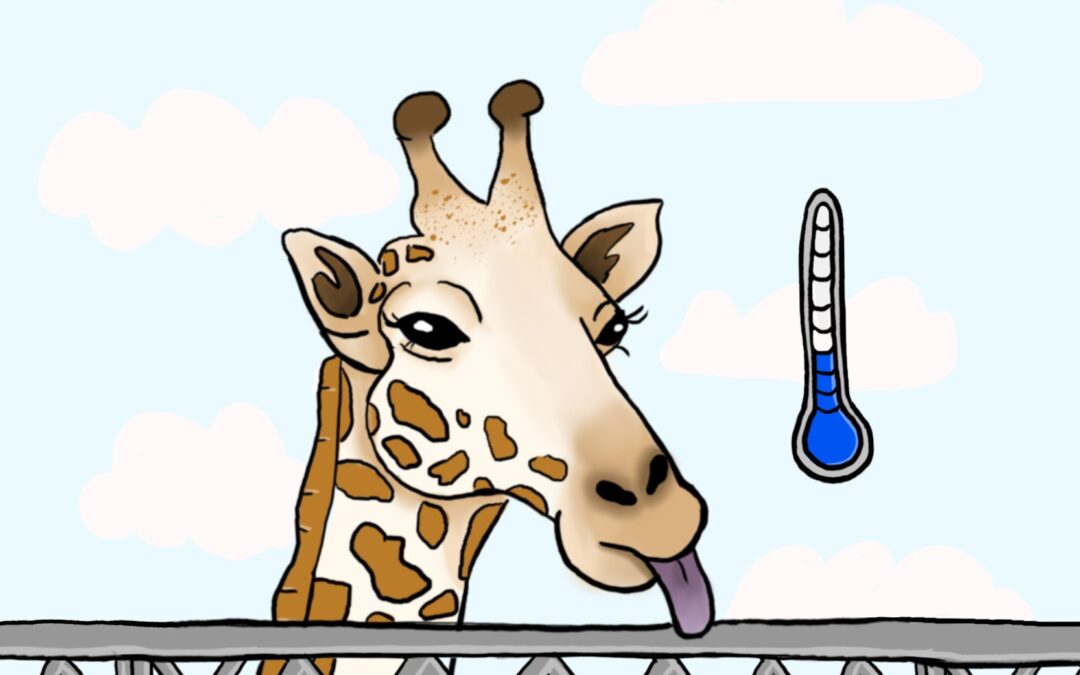
On a hot summer day, you might find yourself licking a delicious popsicle. For giraffes in captivity, it is the exact opposite! Cold days bring about an abnormal licking behavior where they lick nonfood objects in their habitat. Instead of spending time looking for leaves to eat on trees, a behavior called foraging, the giraffes lick fences, rocks, windows, and walls. While this odd behavior is comical, it signals to zoo keepers that the giraffes are living in unideal habitats because they are behaving differently than they do in the wild. To find a way to stop this behavior and make their habitats better, researchers examined how the giraffes at Kyoto City Zoo behaved in different weather conditions and paid attention to surrounding plants and foods available to the giraffes.
The temperature-humidity index (THI) is the comparison of both heat and humidity to determine how weather feels to an individual, or in this case, to giraffes. Just as if you were to walk around a humid swamp, the combination of heat and humidity would make the weather feel more intense rather than if it were heat alone. In different seasons, the intensity of THI changes, affecting giraffe behavior. With a low THI in colder seasons, giraffes showed more licking behavior.
To see if it would change licking behavior, the researchers compared the amount of trees and branches available for foraging with the amount of licking done by giraffes. Researchers found that more trees and branches for giraffes to forage decreased their licking in warmer seasons. However, with lower THI’s in colder seasons, giraffes showed licking behavior even when foraging. This means that a low THI will still cause licking even if there are plenty of trees and branches available.
So what can a zoo do if giving giraffes more branches and trees does not work? Well! The researchers suggest that heating up the water for giraffes to drink or adding outdoor heating systems to warm up giraffes may decrease the amount of licking in cold climates, increasing the quality of their habitats.
References:
Okabe, K., Fukuizumi, H., Kawamura, A., Kase, C., & Uetake, K. (2022). Effects of browsing enrichment associated with the temperature–humidity index and landscaping trees in giraffes (Giraffa camelopardalis reticulata). Journal of Thermal Biology, 104, 103190. https://www.sciencedirect.com/science/article/pii/S0306456522000043#kwrds0010
