
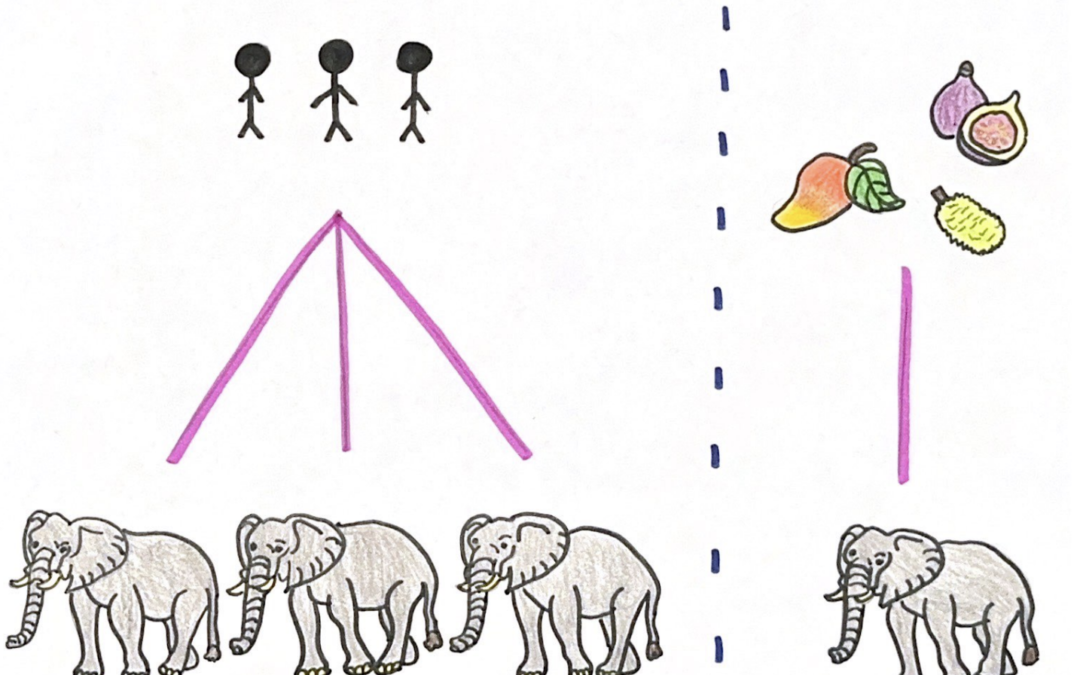
Elephants are just like us: they are social creatures. For the most part, they travel in groups that are flexible in terms of how many individuals there are at a given time (also known as fission-fusion behavior). In Gabon, a country on the west coast of central Africa, a team of researchers was curious as to what environmental conditions affected the number of individuals in elephant groups, especially in African forest elephants.
These animals are critically endangered, so understanding their group dynamics can enable us to implement conservation strategies to preserve the species. The main component of their diet is fruit, which they have to consume literally tons of in order to survive. Fruit, though, has a sporadic distribution in the forests of Africa and has different growing seasons depending on the particular type. Fruit availability is one of factors that the research team looked into in their study of elephant group size.
Another factor included in the study was human disturbance in the area. Due to an increase in industrialization in Gabon, African forest elephant habitat has decreased significantly within recent years. Poaching is also a large problem and often leads to the deaths of many elephants in this country.
In order to collect their data, the research team GPS-collared 20 elephants in Ivindo National Park and the Wonga Wongue Presidential Reserve. Half were female and half were male, but they all were the leaders, or “focal” elephants, of their respective groups. Each one was followed for up to three consecutive days at a time between February 2017 and May 2018.
Now how did the team count the number of elephants in a group at a given time without getting too close? The answer is simple – they sampled dung piles. Elephants in the same group all tend to “go” at once, which makes distinguishing elephant groups very straightforward. Every 450 meters, the team would collect dung samples from a 35 meter wide circle and use the DNA within to identify the number of elephants in a group. Every organism has a unique DNA code, which makes identification of specific individuals easy.
The team first found that groups with a female focal elephant had an average of 5 elephants per group (not counting the calves). Male focal elephants, on the other hand, had an average of 4. The range, though, was between 2 and 10 individual elephants for female focal elephants and 1-10 for males.
But how did the environment affect group size? Well, the researchers first found that areas with a large amount of fruit had smaller elephant groups. In fact, an abundance of fruit decreased group size by 45%! While the reasons for this are not explicitly known, the assumption is that smaller groups limit competition between individuals for the fruit. Because elephants require high caloric intake due to their size, a patch of fruit would not adequately feed multiple elephants. Smaller groups may be a way to combat this and ensure each elephant gets the amount of fruit that they need.
On the opposite side of the spectrum, human disturbance led to groups with more individuals. African elephant group size increased by a whopping 97% when they were near human establishments! Not only that, but the elephants exhibit much more frequent “bunching” behavior where the individuals stand more tightly packed together. Again, while the reasons are not decidedly known, it can be assumed that this increase in group number and change in behavior is due to the high levels of poaching in Gabon. Poaching leads to many deaths in the African forest elephant population, which is obviously something that elephants wish to avoid in order to survive. Staying together in larger, tighter groups when encountering humans may provide the most amount of safety.
So how many elephants are in a group? It depends! From fruit abundance to human disturbance, elephant group numbers are ever changing with their environment.
References:
Meier, A. C., Bourgeois, S., Adams, E., Bikang, H., Jasperse-Sjolander, L., Lewis, M., Masseloux, J., Morin, D. J., & Poulsen, J. R. (2023). Fruit availability and human disturbance influence forest elephant group size. Animal Behaviour, 203, 171–182. https://doi.org/10.1016/j.anbehav.2023.07.002
