
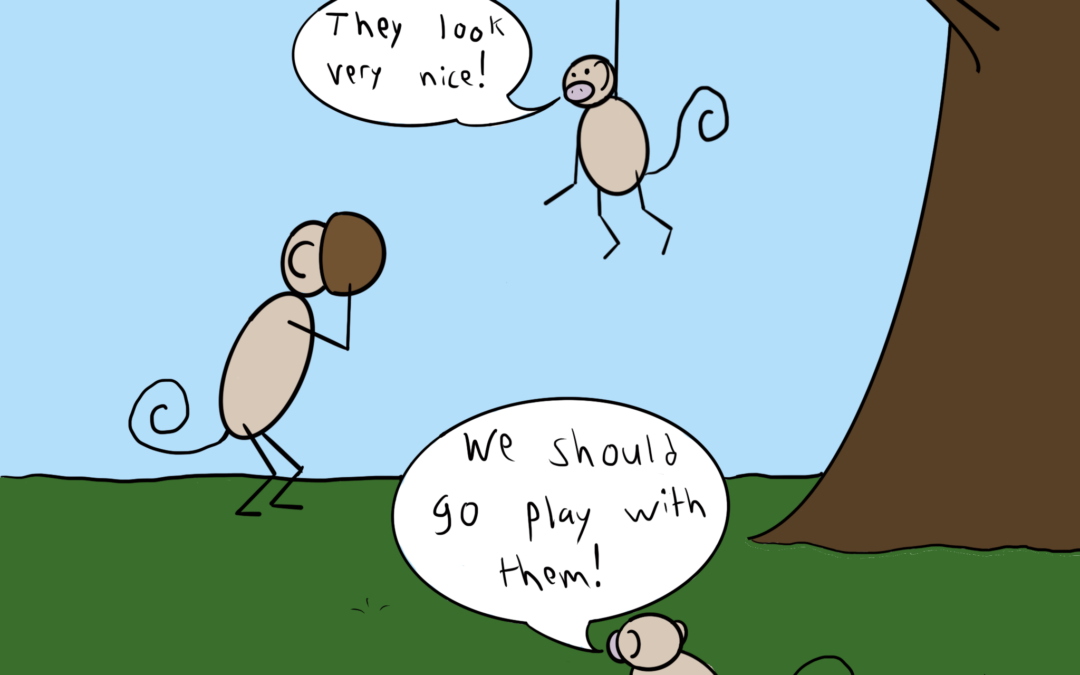
Just like humans, young monkeys love to play! In fact, many scientists have shown that playing helps primates like us humans learn many important skills (Whiten & van de Waal 2018). Scientists noticed that, when certain monkeys play, they cover their eyes using their hands or some object that they find lying around. Why do the monkeys do this?
One group of scientists (Gunst et al.) tried to help answer this question in October, 2022 by studying a group of wild monkeys called Balinese Macaques. The scientists watched this group and found that monkeys pay more attention to their friends if their friends are covering their face. The monkeys that covered their face and got more attention were also more likely to play with their friends. Covering their face might be one of the ways that monkeys ask their friends to play! While you might walk over to someone and ask “Hey, do you want to play tag?”, monkeys cover their faces to show their friends that they want to have fun. These scientists think that older, bigger monkeys ask to play like this so the younger monkeys aren’t scared to play with them. Asking an older person to play can be very scary for monkeys because they might make their older and stronger friend upset, but if the older monkey covers its face then the younger monkey knows that they will not be able to hurt them.
Many monkeys also keep their eyes covered while they are playing, even though it makes it harder for them to play. It would be really hard for you to play hide and seek or to throw a ball to your friend if your eyes were closed the entire time! This wouldn’t make a lot of sense if the monkey wanted to win, but covering their eyes while they play as kids might help the monkeys survive as adults. Scientists think that playing with their eyes covered helps monkeys safely learn how to work through new situations when they grow up. We already knew that playing is really important for young monkeys to learn about the world, but now we know that making this play more difficult helps monkeys even more!
Works Cited
Whiten, A., & van de Waal, E. (2018). The pervasive role of social learning in primate lifetime
development. Behavioral Ecology and Sociobiology, 72(5), 1-16. https://doi.org/10.1007/s00265-018-2489-3
Gunst, N., Pellis, S. M., Wandia, I. N., & Leca, J. B. (2022). A tool to act blind? Object-assisted
eye-covering as a self-handicapping behavior and social play signal in Balinese
long-tailed macaques. Animal Cognition, 1-16. https://doi.org/10.1007/s10071-022-01707-4
