
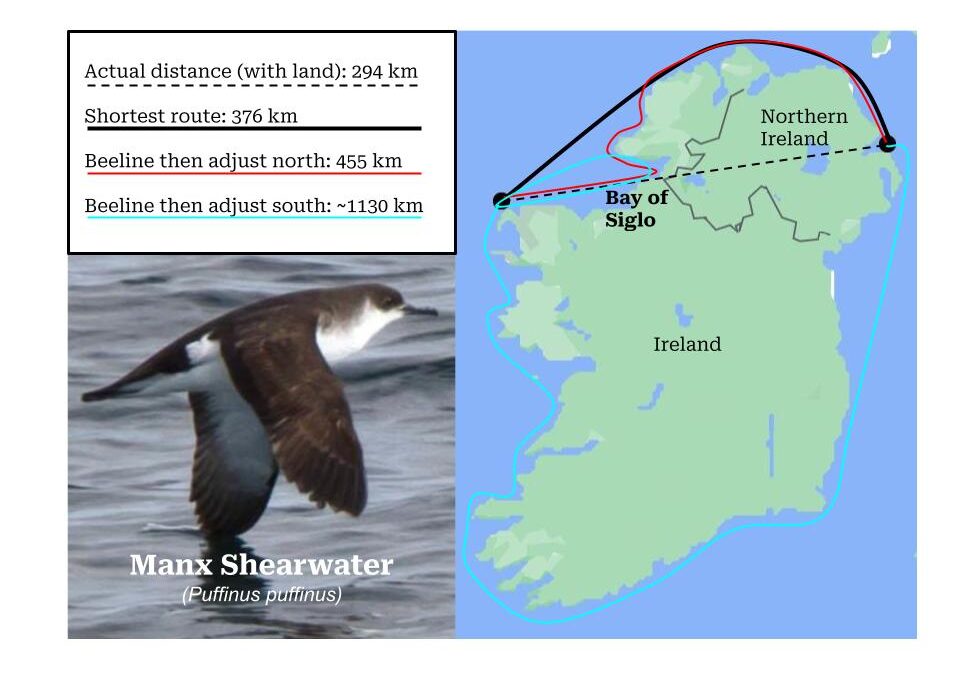
Driving is a lot of fun and is definitely something to look forward to if you can’t yet. I must admit that without GPS, I would enjoy driving a little less since I am horrible with directions. Unless it is a route I take daily, it is essential that I have GPS, or else it would take me an extra hour to reach my destination. Another common issue I have seen with young drivers is a fear of driving on highways, leading them to take less efficient routes. This is similar to the Manx Shearwater seabirds (puffinus puffinus), which choose not to travel long distances over land. Thankfully for the shearwater, they are able to orient themselves back toward their colony with the help of true navigation. True navigation involves consulting a map based on gradients of environmental cues such as atmospheric odors and magnetic cues, acting as an internal compass.
Padget and his colleagues were interested in determining whether shearwaters would follow their true navigation and beeline to their colony or if they could use previous experience to make a more efficient detour without outward journey information[1]. Outward journey information is temporary knowledge that is obtained while going one direction that can promote a better route on the way back. The removal of outward journey information is a key factor to this experiment because it has been shown in previous observations that shearwaters take the efficient route upon their return. To test this question, they displaced the birds 294 km (~183 miles) from their colony on the opposite side of Ireland. The most efficient route over water was 376 km (~234 miles) with a 20% increase in travel length if they headed directly for the colony upon release, requiring a reroute. The area they were released from is within their normal foraging range which means they have most likely made it out to this location in previous years.
What they found was really interesting. All but one of the birds oriented themselves directly towards their colony, demonstrating the capability of true navigation. The one headed in the wrong direction. Think about that for a second! These birds, 294 km from home and without any knowledge of their location, were able to fly in a path that would have taken them directly to their colony without the introduction of an obstacle, the Bay of Siglo. Unfortunately, the fact that those birds beelined for home means that they did not take the efficient route. Once they reached the bay, the majority continued north along the path 20% longer than the most efficient one. A few, however, turned back south, increasing their travel distance by about 200%.
What can we learn from these results? For starters, the importance of gathering outward journey information is potentially more important than previously expected. This is because shearwaters fail to use past experiences of homing and will only rely on true navigation without it. This also shows that there has been no evolutionary advantage for shearwaters to map their surroundings long term. It’s as if these birds have access to GPS but it doesn’t have the capability to detect closed routes. They only know if a route is closed going inbound if they encounter the closure while going outbound.
[1] Padget, O., Gillies, N., Syposz, M., Lockley, E., & Guilford, T. (2022, February 9). Shearwaters sometimes take long homing detours when denied natural outward journey information. Biology Letters. Retrieved November 8, 2022, from https://royalsocietypublishing.org/doi/10.1098/rsbl.2021.0503
