
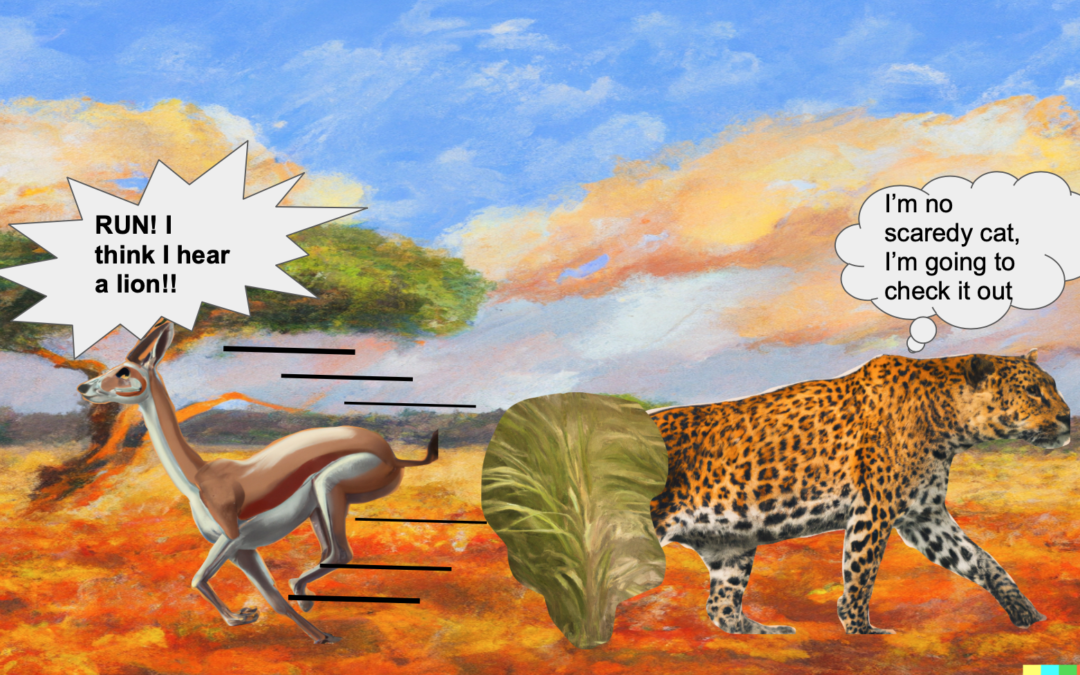
When thinking of scary places, one that might not immediately come to mind is the African savannah. While full of beautiful landscapes and open air, the open grasslands are one of the more frightening places to be: at least for the animals that live there. Predators of all shapes and sizes roam the land, in search of their next meal. The gazelles and other ungulates (hooved animals) avoid these predators at all costs. But have you wondered which of all the predators the ungulates fear the most? That is exactly what Noa Rigoudy and colleagues were thinking when they visited Greater Kruger National Park in South Africa.
Once in the park, the research team used speakers that played the vocalizations of three of Africa’s deadliest predators: lions, wild dogs, and cheetahs. Bird sounds were also played to act as a control group. They stationed these speakers in multiple spots in the park and recorded the responses of prey animals and other predators that heard the noise. Specifically, they wanted to see if the surprised animals would run, look toward the sounds, or approach the sounds. After recording the responses from dozens of animals, the scientists finally found the answer to their scary question! Ungulates were found to run more from lions, then wild dogs, and then cheetahs! They also found that when the ungulates didn’t run, they were more likely to look toward the sounds of lions than any of the other predators. The researchers predicted that lions were the most frightening due to their massive size and ability to hunt in large prides. Wild dogs were predicted to be the next scariest due to their large packs, even though they weighed less than the cheetahs. Basically, the more dangerous the predator, the more terrified the prey.
The scientists also tested the responses of hyena, leopards, and lions to the vocalizations. What they found is that the predators were a lot braver than their prey! The predators barely ran from the sound recordings. Instead of fleeing, they often looked for the sound and approached it. These courageous critters also reacted equally to all three predator sounds. They weren’t scared of any toothy beast over the other! The scientists were able to learn that ungulates had a fixed ranking of scariest predators, while the predators themselves were more fearless. So remember, the next time you are out walking in nature and a squirrel runs away, you are probably as scary to them as a lion is to a zebra!
References
Rigoudy, et al. 2022. Hierarchy of fear: experimentally testing ungulate reaction to lion, African wild dog and cheetah. Behavioral Ecology, 33(4), p.789-797.
