
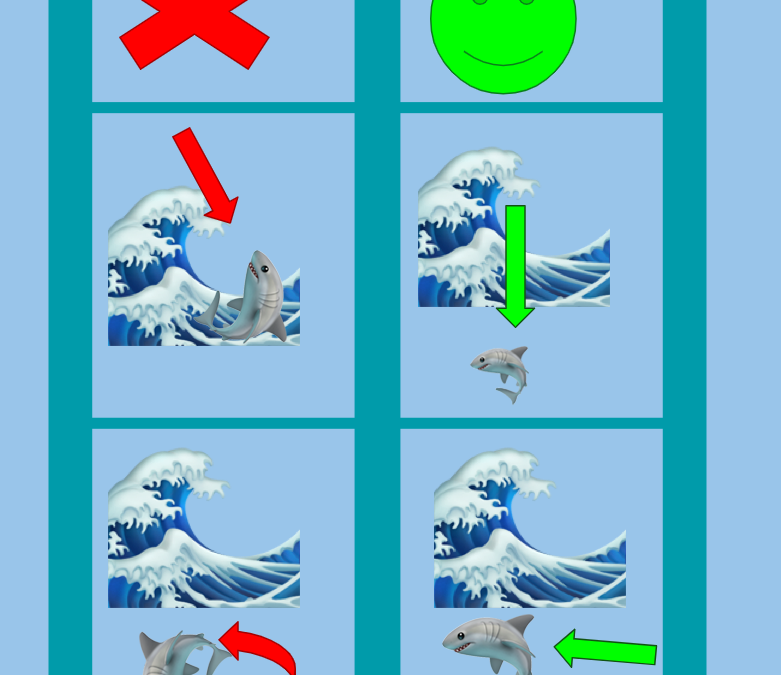
Imagine you saw a puppy walking sideways. Like most people you might think it’s strange. Now imagine this dog did this for weeks or months when it didn’t do it before. You see that no other dog does this yet this one seems to have this odd little sideway walk. For this dog this might be a stereotypical behavior. That is a behavior that is unusual for an animal to do and its natural habitat or when it is healthy and happy. Just like when you see someone biting their nails when they’re stressed.
A group of scientists working with marine animals decided to observe and try to correct these stereotypical behaviors in a shark at the Sea life Michigan aquarium. The shark they were attempting to help by changing its wrong behaviors was a smooth dogfish shark. These sharks are most active at night and they are known for their sprint swimming, resting, not coming up to the surface and swimming in place. However, the shark developed unnatural habits from being in captivity like coming up to the surface, swimming sideways and spiral swimming.
To change these behaviors they had two plans. The first one was to put the shark in a small empty tank away from others as a way to reduce anything that was encouraging these unusual behaviors. After a few days they started the second part of the correction. It was a training they did to encourage normal behaviors. This is similar to when you give a dog a treat after sitting or performing a good trick, it’s a way to encourage good behavior and behaviors we like. With this they decided to move the food around to areas of the aquarium the shark would not go to before. They also used a long stick to put the food at the bottom so that the shark would not break the surface of the water trying to eat.
What ended up happening was that the bad behaviors dropped and the sharks’ caretakers noticed a lot more good behaviors more often. Observers also noted how it had even picked up resting which is a behavior that’s considered very healthy especially on the day when people are visiting the tank. These practices that encourage good behavior are very popular in mammals but are very understudied in other animals, like sharks. This opens up the opportunity to use different training or interventions to help improve the health of other animals in captivity. Because healthier and happier is better for everyone, and who would like to see you sad shark when you could see a strong cool one.
Hart, A., Reynolds, Z., & Troxell-Smith, S. (2021). Using individual-specific conditioning to reduce stereotypic behaviours: A study on smooth dogfish Mustelus canis in captivity. Journal of Zoo and Aquarium Research, 9(3), 193–199. https://doi.org/10.19227/jzar.v9i3.536</span
