
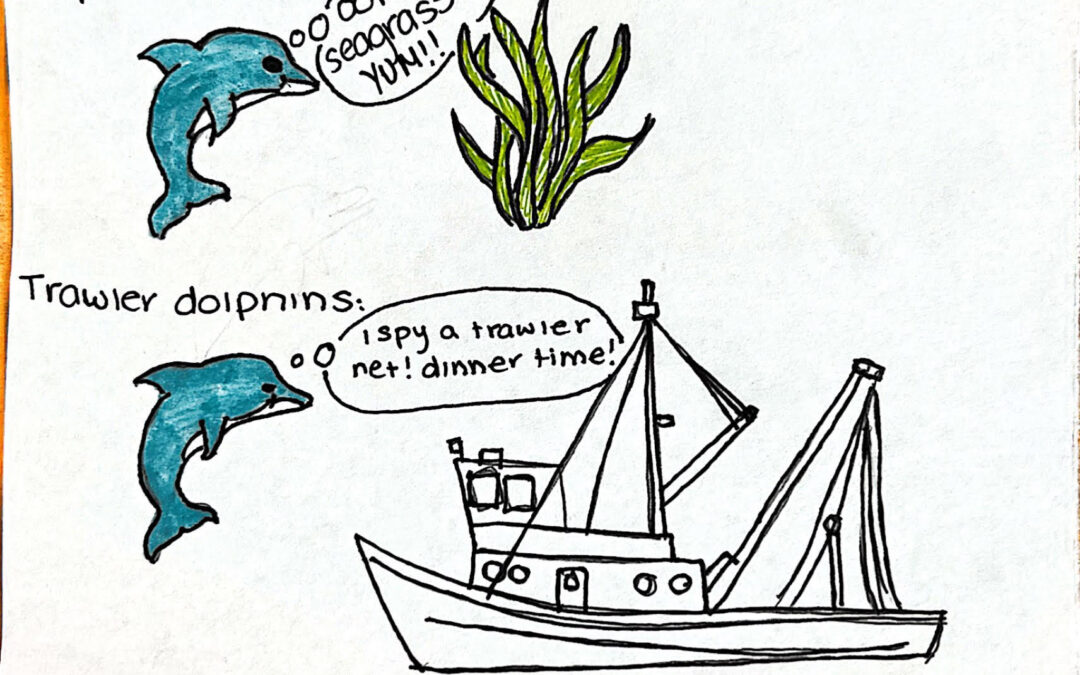
Over time humans have been known to have direct and indirect effects on marine life, such as complete species extinction. However, they have never really been found to affect the behavioral changes in marine ecosystems. Bottlenose dolphins are very social creatures that live in a fission-fusion environment, meaning that the size and composition of the social group change as time passes and the animals move throughout the environment. It has been previously documented that bottlenose dolphins will forage and obtain food from shallower waters worldwide. Trawlers can provide a sustainable food source for dolphins through what is now known as “trawler foraging.” Trawler foraging is where, through the sound of trawler engines, food patches created by the trawlers can be detected by dolphins from multiple kilometers away.
In some areas of the ocean, male bottlenose dolphins are known to form pods/schools of two or three dolphins that constantly associate with each other. Adult female bottlenose dolphin groups occur within networks of more individuals, but they have a lower association rate with males. In other ocean areas, male bottlenose dolphins do not show a clear community structure; instead, they have a “continuous mosaic of overlapping home ranges.” A school of dolphins is defined as dolphins in a close-knit spacial cohesion with individuals that remain within 10 meters of each other.
In a study done to explore this trawler behavior in bottlenose dolphins, dolphins were separated by behavior into four categories; The first is traveling behavior: “Dolphins swimming in the same direction with normal surfacing intervals and individuals in the school being spaced at least 3 meters apart”. Active surface behavior included interactions with other school members, and the units observed consisted of breaching, fluke slapping, and rolling. Feeding behavior included dives that had changeable direction, frequency, and length or other erratic movements on the surface of the water, which was indicative of chasing fish. The final behavior measured was motionless behavior, defined as slow or minimal movements at the surface with the tendency of animals to remain or also to spend long periods in the same area. Two distinct communities were identified in the 242 dolphins studied (154 observed trawler behavior and 88 observed non-trawler behavior), and their associated patterns demonstrated this. The home range of these two dolphin communities overlapped by about 7-8 kilometers; however, the trawler dolphins were found to be in larger schools and farther away from land than the non-trawler bottlenose dolphins.
There is a possible chance of an alliance between non-trawler males being associated with trawler females, suggesting the chance of genetic interchanges within the two communities being looked at. However, the two communities did not interact with each other besides to mate.
In the bottlenose dolphin community, there has been an increased risk of drowning due to neck entanglement from trawlers in Moreton Bay. Because of the trawlers, there is also a higher chance of the dolphins being exposed to toxic compounds in the sediments from the trawlers. Dolphins in the non-trawler community were found to forage more on seagrass, which is now becoming contaminated by cyanobacteria which pose a considerable threat to the viability of these plants. The trawler dolphins rely on the trawlers for much of their nutritional needs and have thus become a required piece of their environment. The trawler dolphins can forage for food on their own even when the trawlers are not present, such as on the weekends when trawling is banned.
Chilvers BL, Corkeron PJ. Trawling and bottlenose dolphins’ social structure. Proc Biol Sci. 2001 Sep 22;268(1479):1901-5. doi: 10.1098/rspb.2001.1732. PMID: 11564345; PMCID: PMC1088825.
