
Have you ever had a bad day that was made better by someone cranking up the radio and blasting your favorite song? Have you ever heard a sound that made you do a “happy dance?” Well you’re not the only one, and you may have more in common with sea life than you might have originally thought. Scientists in Riccione, Italy recently studied the impact of classical music on bottlenose dolphins (Tursiops truncatus), seeking to understand how the sharing of this music impacted the emotions of bottlenose dolphins. Playing composers you might have heard of such as Johann Sebastian Bach and Ludwig van Beethoven, they hoped to determine the ability of classical music to act as a form of enrichment and entertainment for these dolphins.
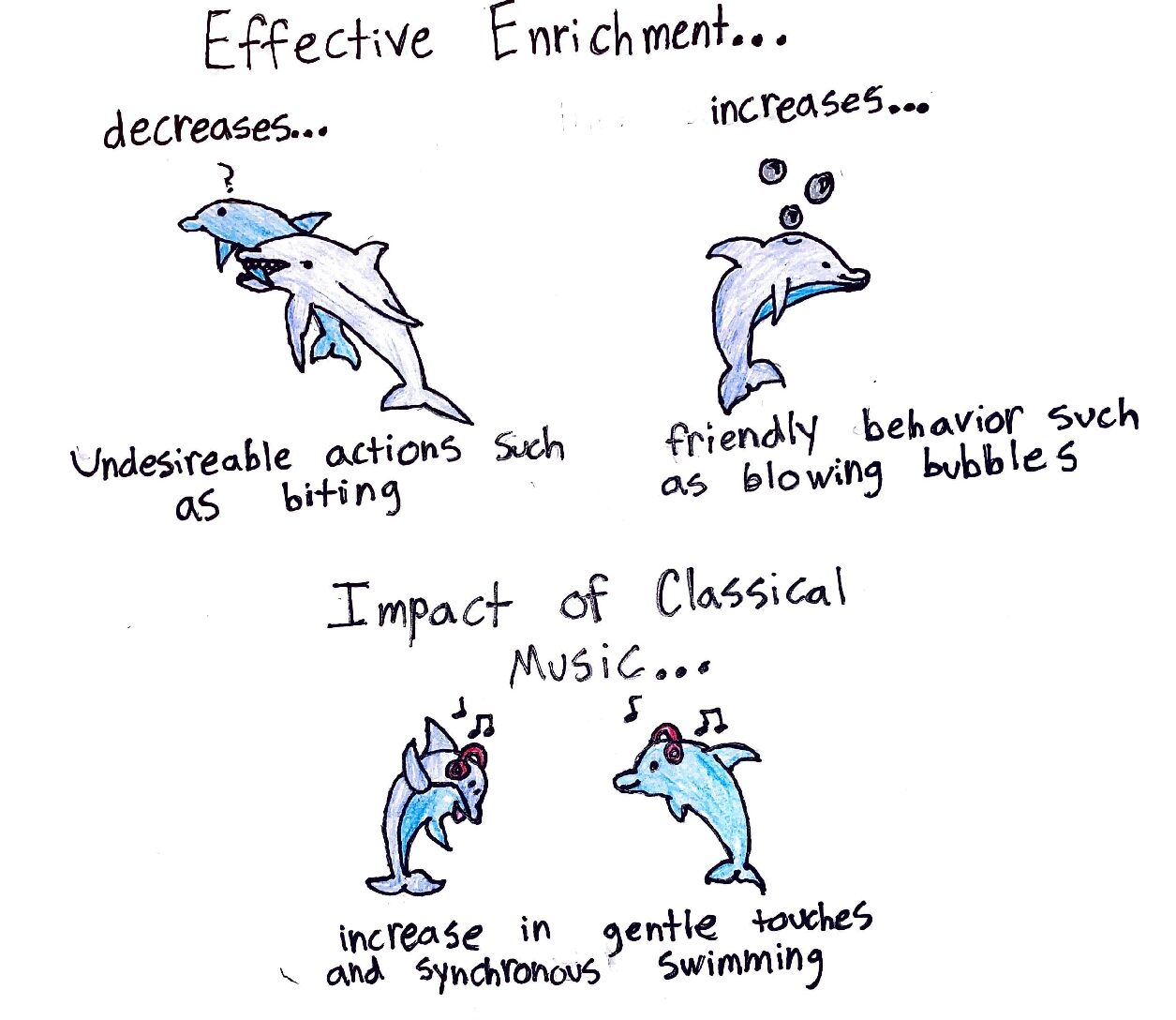
In this experiment, the scientists presented 3 new forms of entertainment that the dolphins hadn’t seen, including the focus of the study classical music, and one form of entertainment that the dolphins had experienced before. In order to compare dolphins’ responses to classical music in particular, they presented a less complicated sound (rain noises), a form of visual entertainment (slideshows of photographs), and a form of entertainment that was not new to the dolphins (floating objects). Effective entertainment is expected to decrease undesirable actions including aggressive behaviors. An aggressive behavior could include violence towards other dolphins, and even biting! That’s not very fun or pleasant, so another expectation for effective forms of entertainment is that they increase the behavior of positive emotional states that include playing (such as making bubbles), social play, and other friendly behaviors such as playing with other dolphins. Imagine you’re in a bad mood, and you’re taking it out on your sibling. An effective form of entertainment would not only make you feel happy, but would also stop you from making others feel bad.
In order to study the impact of classical music on the emotional state of the dolphins, they divided the dolphins into two groups. Each group was presented with each of the four kinds of entertainment for seven days, meaning each group was studied for 28 days total. Each time a group was given an entertainment form, the scientists used camcorders to record their behavior. With these videos, they were able to determine how long as well as how often the dolphins experienced each behavioral state (such as blowing bubbles when happy or biting dolphins when sad or stressed).
The scientists discovered some exciting information. All forms of entertainment resulted in an increase in general activity and an increase in some aspects of social behavior, both of which are good things and indicate that the dolphins were happy! Interestingly, only classical music was able to increase those friendly behaviors mentioned earlier, and this occurred both while the music was playing and afterwards. Some of the friendly behavior included an increased interest in other dolphins, an increase in “gentle touches,” and even an increase in synchronized swimming. Much like you or I might have done before, the dolphins enjoyed the classical music so much they made a dance routine with their friends! The scientists concluded that the increase in friendly behavior likely represented an expression of a positive emotional state. So the next time you’re in a bad mood and taking it out on someone, you could be like a bottlenose dolphin and play your favorite song and dance or blow some bubbles to brighten your mood.
References:
Cécile Guérineau, Miina Lõoke, Giuseppe Ganassin, Daniela Bertotto, Martina Bortoletti, Laura Cavicchioli, Stefano Furlati, Paolo Mongillo, Lieta Marinelli,
Enrichment with classical music enhances affiliative behaviours in bottlenose dolphin,
Applied Animal Behaviour Science,
Volume 254, 2022, 105696, ISSN 0168-1591 (https://doi.org/10.1016/j.applanim.2022.105696)
