
You’ve probably experienced some form of a crowded environment. From the bus you might ride to school or the gym where you may have an assembly or even the airport you visit while on a vacation. Non-human animals often experience crowded environments too. Scientists call the space-to-animal ratio spatial assortment.
Chances are that when your spatial assortment changes you behave differently, and make some friends. On your first day of school you were likely crowded in with people you didn’t know but now spend a lot of time with. Animals also form cooperative relationships when into dense social situations. Razik Imran and other scientists [1] at The Ohio State University recently wrote a paper talking about some of their discoveries on this topic. They predicted that vampire bats would eventually associate and cooperate with those they had met after being removed from the wild and placed together in captivity.
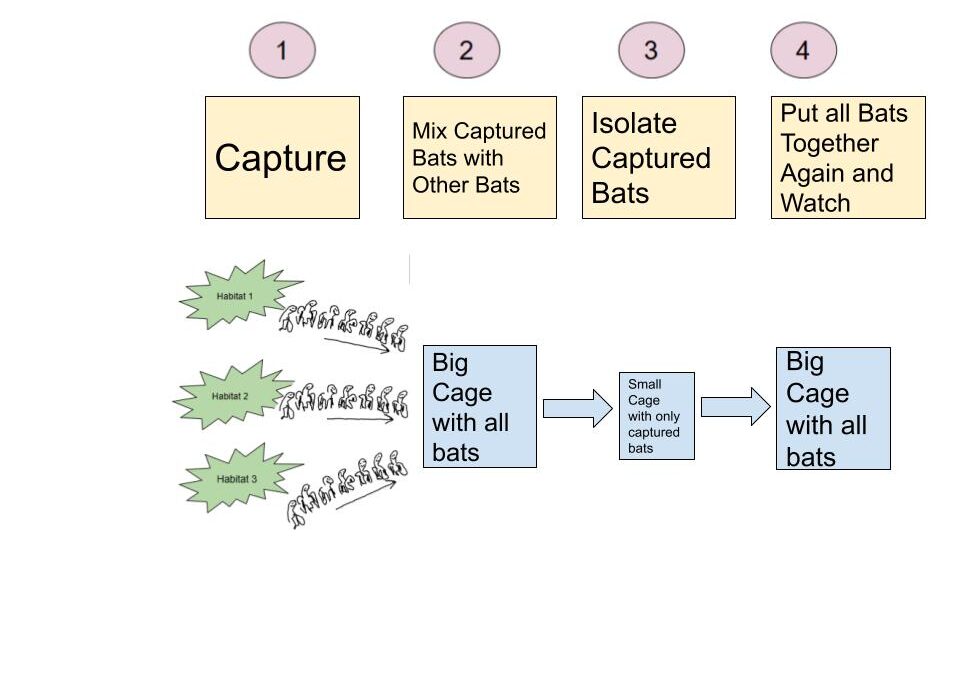
In their study the team first captured several female bats from different locations across Panama). They then placed these bats with other stranger bats to get to know each other. After six weeks, the scientists made just the original female bats live among each other for a week. Lastly, the scientists put all the bats together again for nine weeks and observed how they all interacted (Fig 1).
To measure the interactions, Imran used a special infrared surveillance camera for 3-6 hours each day for 114 days. The team documented evidence of association and cooperative behavior. Examples of such behavior include allopreening, or when one bat cleans another as well as food regurgitation, when one brings food from its stomach to its mouth to share with others).
As expected, bats that had previously been forced together associated more and had increased displays of allopreening in particular. What’s more, the bats didn’t treat those they knew before the week of crowded conditions any differently.
The study demonstrates that even a week is long enough to form new positive and long lasting relationships. Despite the findings many questions about just how bats chose their new friends during the week of cramped quarters remain unanswered.
References
- Imran R, Bridget BKG, GC Carter. 2022. Forced proximity promotes the formation of enduring cooperative relationships in vampire bats. Biology Letters 18:4 (doi:10.1098/rsbl.2022.0056)
