
Humans, particularly during the early years of their life, learn huge amounts of information at an incredible rate. Just two years after birth, most babies can run, draw, follow instructions, use short phrases, etc (March of Dimes). As we all know very well, much of this learning is facilitated by children copying what they see from adults and other children around them (for better or for worse). With so much exposure to new information, is there a way that kids can filter through what they see and “decide” which bits and pieces to learn? As early as 18 months old, children have been shown to imitate actions more frequently when the person that they’re observing makes an active effort to communicate the behavior to the child (Southgate et al. 2009).
If you were trying to let a kid know that you had something important to teach it, you might do something such as seek eye contact or call out their name. Actions like this that are meant to initiate communication with someone else are referred to as ostensive cues, and suggest to children that the following information is relevant and worth learning (Csibra & Gergely 2009).
While humans might take the cake when it comes to complex patterns of communication, ostensive cues are far from exclusive to you and I. Captive great apes such as chimpanzees, bonobos, and orangutans also respond to ostensive cues such as eye contact and having their name called (Tomasello et al. 2007, Ueno et al. 2010) . Could these apes use ostensive cues in a similar way to human infants, as a method to determine what information is important for them to pay attention to and learn?
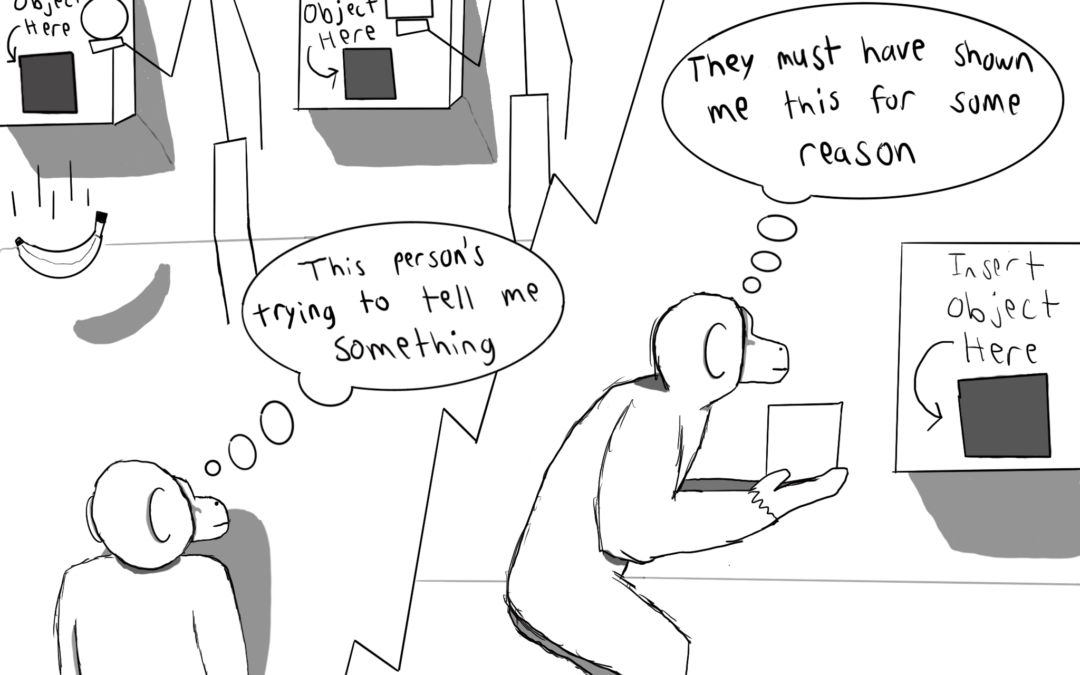
Recent work by Hanna Marno and colleagues suggests that this might be the case. Various apes were shown a device that would dispense food for them if one of two unique objects were used to interact with the machine, but do nothing if the other object was used. Researchers demonstrated the use of both of these objects back-to-back, in which the “effective” object would cause the machine to dispense food and the “ineffective” object would do nothing, and the ape was then allowed to choose between the two objects.
If the researchers demonstrated the use of both objects while getting the ape’s attention using ostensive cues, the apes more frequently chose the object that resulted in them getting food. If the researchers demonstrated the use of both objects without using ostensive cues for either, apes once again tended to choose the object whose manipulation resulted in the ape receiving food (Marno et al. 2022).
If the caretakers instead paired the demonstration of the ineffective object with ostensive cues and left the demonstration of the effective object without such cues, apes no longer showed a preference between the two objects. Although one object provided the apes with a reward, which was oftentimes enough to incentivize choosing it over the other one, the direct communication that was initiated during the ineffective object demonstration seems to have reduced their affinity for the effective object (Marno et al. 2022). These results may suggest that many of the apes interpreted the ostensive behavior as a signal that they should pay close attention to the actions that followed, sometimes at the expense of them reproducing the more effective behavior.
While the diversity of life on Earth is incredible, it’s perhaps even more impressive to see all of the many similarities between different species. Through their work, Marno and colleagues attest to this by showing that great apes use some of the same social cues that humans do when it comes to learning new information. Their results suggest that, like human infants, apes prioritize reproducing behaviors that the demonstrator portrays as being worth their attention.
Works Cited:
Developmental Milestones For Baby. March of Dimes. https://www.marchofdimes.org/baby/developmental-milestones-for-baby.aspx
Csibra, G., & Gergely, G. (2009). Natural pedagogy. Trends in cognitive sciences, 13(4), 148-153. https://doi.org/10.1016/j.tics.2009.01.005
Marno, H., Völter, C. J., Tinklenberg, B., Sperber, D., & Call, J. (2022). Learning from communication versus observation in great apes. Scientific reports, 12(1), 1-9. https://doi.org/10.1038/s41598-022-07053-2
Southgate, V., Chevallier, C., & Csibra, G. (2009). Sensitivity to communicative relevance tells young children what to imitate. Developmental science, 12(6), 1013-1019. https://doi.org/10.1111/j.1467-7687.2009.00861.x
Tomasello, M., Hare, B., Lehmann, H., & Call, J. (2007). Reliance on head versus eyes in the gaze following of great apes and human infants: the cooperative eye hypothesis. Journal of human evolution, 52(3), 314-320. https://doi.org/10.1016/j.jhevol.2006.10.001
Ueno, A., Hirata, S., Fuwa, K., Sugama, K., Kusunoki, K., Matsuda, G., … & Hasegawa, T. (2010). Brain activity in an awake chimpanzee in response to the sound of her own name. Biology letters, 6(3), 311-313. https://doi.org/10.1098/rsbl.2009.0864
