
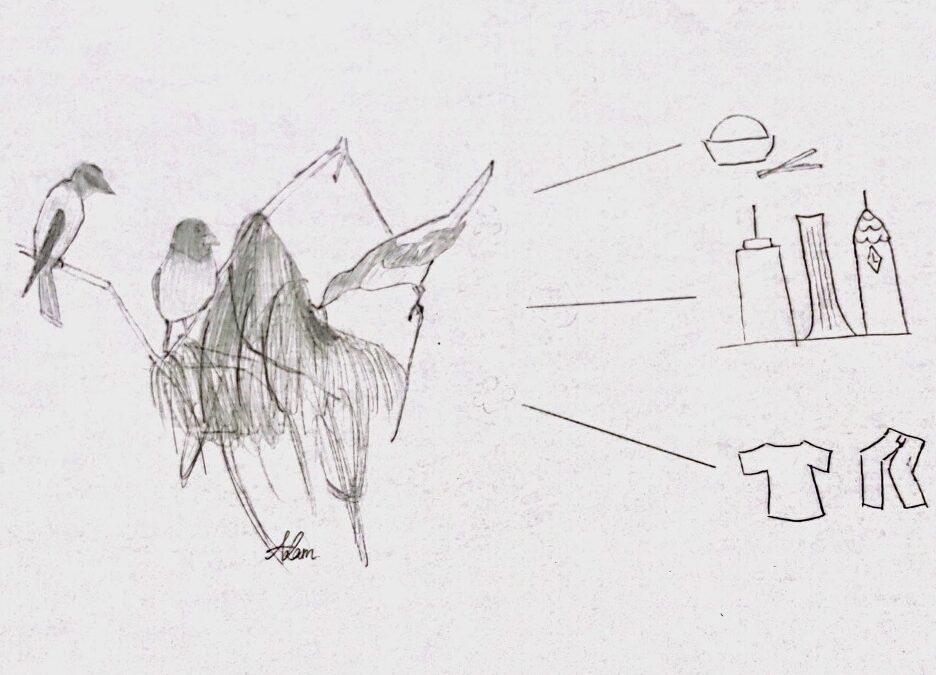
Have you ever heard of material culture? Simply put, material culture is any behavior related to objects, such as the cars we use for commuting, the clothes we wear, and the houses we build. But have you ever wondered if the nests of other animals or the tools they use are material culture? For example, we want to demonstrate that birds build nests. Is this a material culture.
Alfred Russel Wallace has concluded in many influential articles on nature that, just like humans, nesting birds exhibit socially learned architectural “practices”, a phenomenon classified by contemporary scientists as material culture. The most compelling data supporting the role of material culture in bird nesting comes from a decade-long study of North American backyard birds.
In the spring of 1923, naturalist Henry Smith Williams hung a string of red, white, blue, mauve, orange, and yellow threads from a pole in his backyard. He did this every spring until 1932. His purpose: to keep track of which birds, if any, used which colors of yarn to nest. From the beginning of the study, one female oriole nested with each color of yarn (excluding blue yarn). Over the next few years, other female orioles followed suit, all with their own distinct material color preferences. For example, in 1929 and 1930, a nesting female oriole used only white yarn. in 1931, the entire oriole flock (11 breeding pairs) preferred white yarn for nesting, and Williams credits this female with inspiring “the fashion of the season.” a similar claim was made for a female oriole in 1929, which nested exclusively in white yarn; she only nested after Orioles completed their respective nests before doing so. In subsequent seasons, two other birds adopted this material use behavior, although unlike the oriole, neither preferred white yarn. In 1931, Williams observed in five other species a preference for one or more material colors in nest building. American robin (Turdus migratorius), catbird (Ailuroedus spp.), cedar waxwing (Bombycilla cedrorum), red star (Phoenicurus spp.), and least flycatcher (Empidonax minimus).
Inspired by Professor Wallace, Professor Alexis J. Breen offers a promising new perspective for the study of bird nesting as animal material culture. He wants to demonstrate that: nesting birds can advance the field of animal behavior and animal culture research. His specific approach is as follows.
To establish material culture in avian nesting, Alexis J. Bree studied the nesting behavior of Corsican blue tits (Cyanistes caeruleus): the types of nesting materials used by females (nesters of this species) were consistent within study plots but varied between study plots; these community differences in female use of nesting materials were reproducible during the breeding season ; differences in plant availability do not adequately explain nest material selection by females . This behavioral variation, then, may be a joint product of the so-called “cultural founder effect” and “social learning strategies”, where local nesting traditions are generated by the nest material preferences of the first female to nest in each area, the ease of imitating her neighbors, those imitators, etc. Recent data suggest that this hypothesis is strengthened. During nesting, female Blue Tits visit – about 40 times – the beginning or completed nests of other breeding Blue Tits.
For at least a century and a half, human-like material culture has been observed in nesting birds, but experimental support is still lacking. But with the above experiments we can find that bird nesting is a research system that can be experimentally manipulated in the laboratory and in the field; it does not require training. So, by combining this operability with the diversity of available tracking tools, we can provide more evidence to support the inclusion of bird nesting into animal material culture.
Alexis J. Breen:Published:14 July 2021 https://doi.org/10.1098/rsbl.2021.0327
