
Imagine you are walking in the forested mountains of Rwanda and you hear what sounds like a number of bubbles popping in rapid succession. The noise sounds far away, but it reverberates swiftly through the dense vegetation and across the ridge. These sounds would be the chest beats of the male mountain gorilla (Gorilla beringei beringei). But what do these acoustic signals mean in the world of the mountain gorilla?
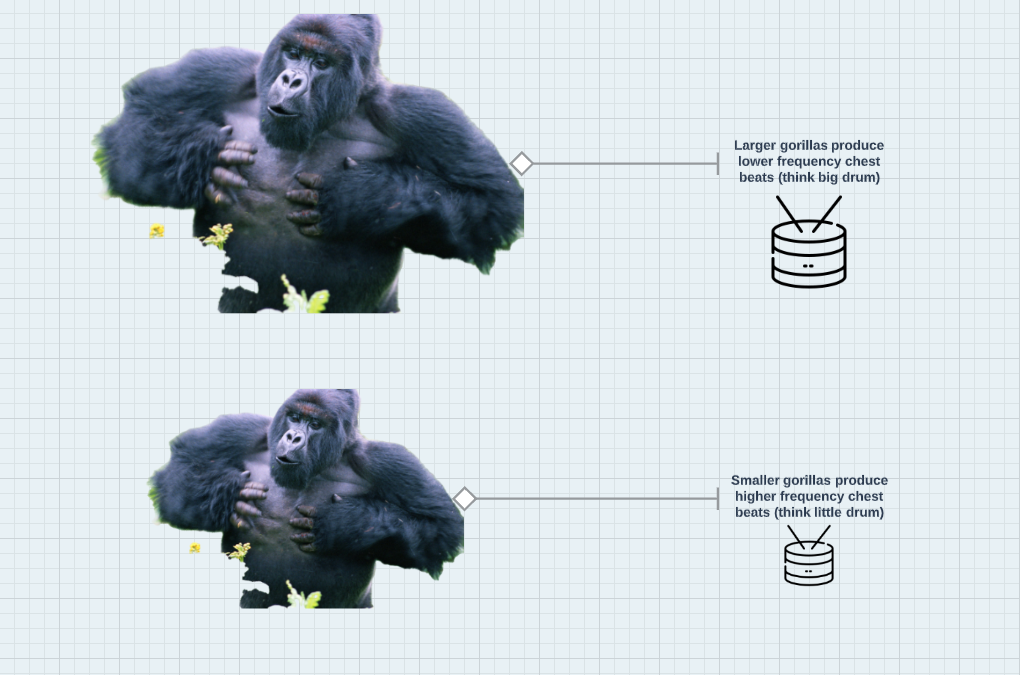
Many animals use acoustic signals, or sounds they produce, to communicate their size, strength, and mating ability: the bigger the bark, the bigger the bite. One of the most well-known non-vocal sounds of the jungle is the gorilla chest beat: when males stand up on their back legs and cup their hands to beat their chest rapidly, producing the popping sound mentioned above. Males beat their chest a number of times per day, and the sound can carry over a kilometer away from the gorilla producing it. They use these chest beating displays to attract females and intimidate potential rivals. Additionally, the body size of a male gorilla usually demonstrates his dominance within the group. However, it was unclear if there was any relationship between the properties of the chest beat and body size. So, Edward Wright and colleagues analyzed the relationship between gorilla body size and frequency (the tone, high and low) of the chest beats. To understand frequency in this context, think about two drums, one large and one small. The larger drum will resonate at a lower frequency, producing a lower tone, while the smaller drum will produce a higher one.
The team of biologists monitored 25 wild adult male silverback gorillas (over 12 years old) in Volcanoes National Park, Rwanda. They obtained audio recordings of the chest beats and used lasers to measure the shoulder width, an indicator of general body size of the animals. After analyzing their data, the team found that larger males consistently produced lower frequency chest beats than the smaller gorillas (see figure 1). They also concluded that the chest beat signal is a multimodal one, meaning that it has both visual and auditory components (standing up, and popping sound, respectively). Because gorillas inhabit areas with such dense vegetation, the multimodal nature of the chest beating signal helps them communicate with other gorillas both close, and far away.
Next time you are walking in nature, pay attention to the sounds and patterns of the forest. Though it may not be the Rwandan wilderness, there is so much to be learned from closely observing your surroundings; you might just happen upon the next biological question to answer.
References
