
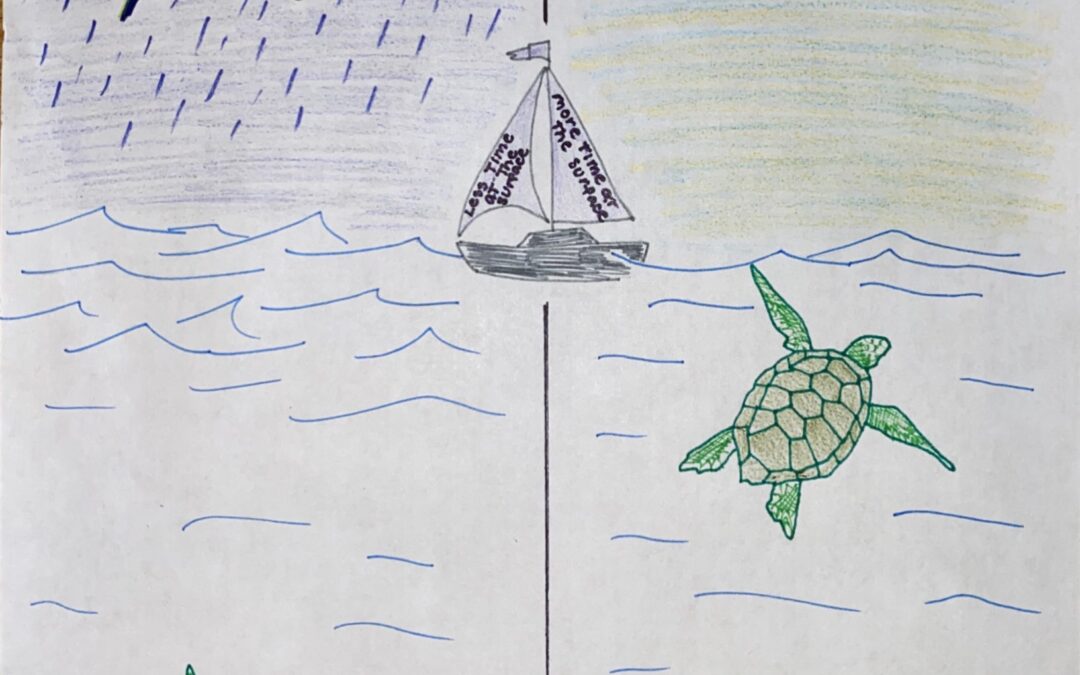
Have you ever gone swimming in a pool while it is storming outside? Or had a water fight? Near the surface you can hear and feel the rain drops and will get splashed often. However, as you dive down deeper you can no longer feel the rain, the wind, or hear loud noises. Many aquatic animals (those that live in the water) use the water to protect themselves during storms. This was seen in turtles when they were observed during Hurricane George that passed through the Caribbean in 1988. One type of turtle that lives in the Caribbean is the hawksbill sea turtle, and those were the turtles studied during this storm. Turtles, like many other animals, naturally dive below the surface when faced with a storm to protect themselves. Stormy weather impacts specific turtle behaviors such as duration of dives (time spent below the surface) and time spent at the surface as discussed below.
Before the hurricane, scientists placed a tracking device on a female turtle to look at where she traveled and decided to lay her eggs. By a coincidence, hurricane George hit in late September and the researchers were able to gather information not only about her traveling and nesting, but also about her changing behavior in response to the storm. With the hurricane upon her, the turtle spent less time underwater during each individual dive and she spent less time at the water’s surface in between dives. During the storm she spent an average of 42.0 minutes under water for each dive, while prior to the storm, her dives averaged 57.3 minutes. In addition, she spent an average of 0.7 minutes at the water’s surface in between dives during the hurricane compared to 1.4 minutes at the surface prior.
The turtle likely spent less time at the surface of the water to avoid the wind, rain, and other harsh conditions of the storm. She likely also attempted to avoid the choppy water that is most unsafe near the surface, compared to down below where the deeper water was calmer. The shorter duration dives could have been a result of the turtle’s need to come up for air more often. This could be because she was spending more time moving around and being active, possibly because she was scared and trying to avoid the harsh conditions, which used up her air faster.
As you can see, some of the behaviors of the turtle changed a lot when faced with a harsh storm. The water lessens the effects of the storm and gives some protection to the animal. Just like you or I would hide underwater and only come up for air for a second before going back under to avoid splashes during a water fight, turtles spend the least amount of time possible above water during a hurricane.
Storch, S., Hays, G. C., Hillis-Starr, Z., & Wilson, R. P. (2006). The behaviour of a hawksbill turtle data-logged during the passage of hurricane Georges through the Caribbean. Marine & Freshwater Behaviour & Physiology, 39(4), 307–313. https://doiorg.libproxy.kenyon.edu/10.1080/10236240600919796
