
Who doesn’t love a good bowl of mac and cheese, especially the easy-to-make box mac and cheese? The instructions seem simple enough: boil a pot of water, dump the noodles into the pot, use a strainer to filter out the water, add in the magical packaged cheese – along with milk and butter if you’re feeling fancy – then you stir it all together in a big bowl with a spoon. Just like that, you have yourself a very delicious bowl of mac and cheese all to yourself. This bowl of mac and cheese was incredibly easy to make thanks to the various tools we humans have made to help us with easy tasks such as making mac and cheese. In this process we’ve used at least 6 different tools: pot, bowl, spoon, strainer, fork, plate.
Humans were once thought to be unique in the way that we can use tools to help us cook, eat, defend, build, groom, and the list goes on. However, in the last century there has been discovery of a few animals using tools as well. Most famously, primates, such as monkeys, have been found using tools for self-grooming, defense, along with other tasks, but they also are not alone. Birds and elephants have also been recorded using tools, and now the list has grown even more. Now, puffins can be added to the list of animals with reported tool use.
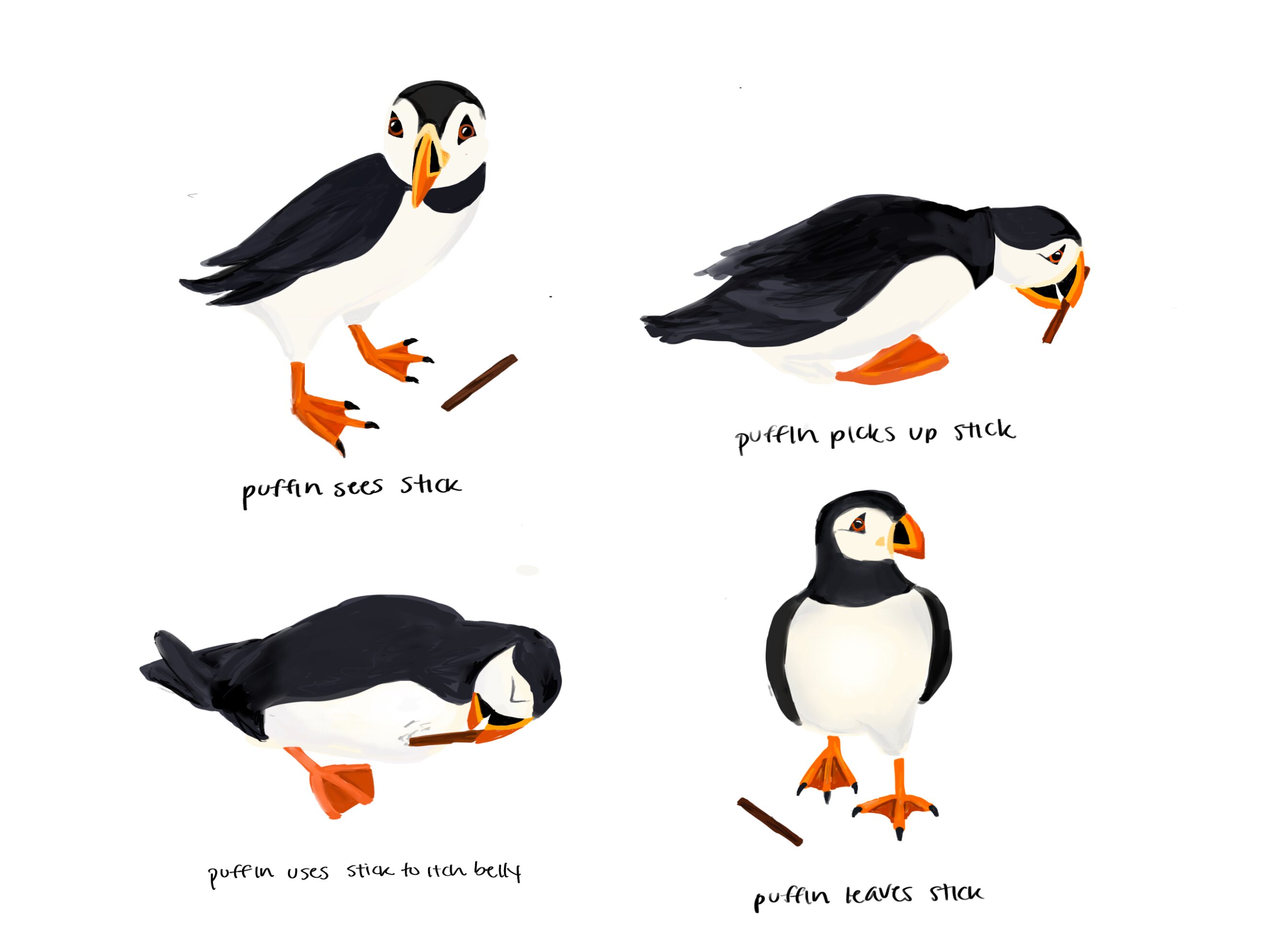
Have you ever had an itch on your back that you can’t quite reach, so you grab a stick of sorts to reach the itch? This is exactly what Annette Fayet and her team of researchers recorded in Atlantic puffins just over a year ago. As a part of their research on Atlantic puffins, they had set up cameras near the nests of the puffins in Wales and Iceland. This is how they recorded evidence of true tool use in the seabird. The team has two videos of little puffins walking near their nest, picking up a small stick, then itching either their back or stomach with the stick before leaving it on the ground and returning to their business. Using a stick to relieve an itch may seem quite simple to us, but in the world of animal behavior, this is big news.
This finding by Annette Fayet and her research team provides evidence that seabirds have more ability, need, or opportunity to use tools than was once thought to be possible for such birds. This simple task of using a stick to scratch a stick has opened up the relevance of tool use in birds. With their finding, there can be more research done on the cognition and ability of birds. So, next time you’re out on a walk or hanging out with your friends, watch the animals around you to see if they too are using tools. You could be finding something ground-breaking.
Fayet, A. L., Hansen, E. S., & Biro, D. (2020, January 21). Evidence of tool use in a Seabird. PNAS. Retrieved November 9, 2021, from https://www.pnas.org/content/117/3/1277.
