
You have probably been asked before, “What is your favorite color?” Whether it is blue or red or something else, most people have a color they enjoy more than others. While animals do not have favorite colors, some animals do have “color biases.” Color biases occur when animals prefer one color or certain colors over others. These preferences for a particular color have developed in some animals because they help the animal identify danger, food, or information about other individuals they live near.
A team of scientists led by Brett Culbert had a question about color biases: Can color biases change when animals are placed in different environments and conditions? To answer their question, they conducted a study using the fish species called African cichlid (Neolamprologus pulcher). This study, published in the Journal of Behavioral Ecology in September 2020, had two main goals. The first goal was to determine which color African cichlid fish are biased toward, and the second goal was to determine if the original color bias could change.
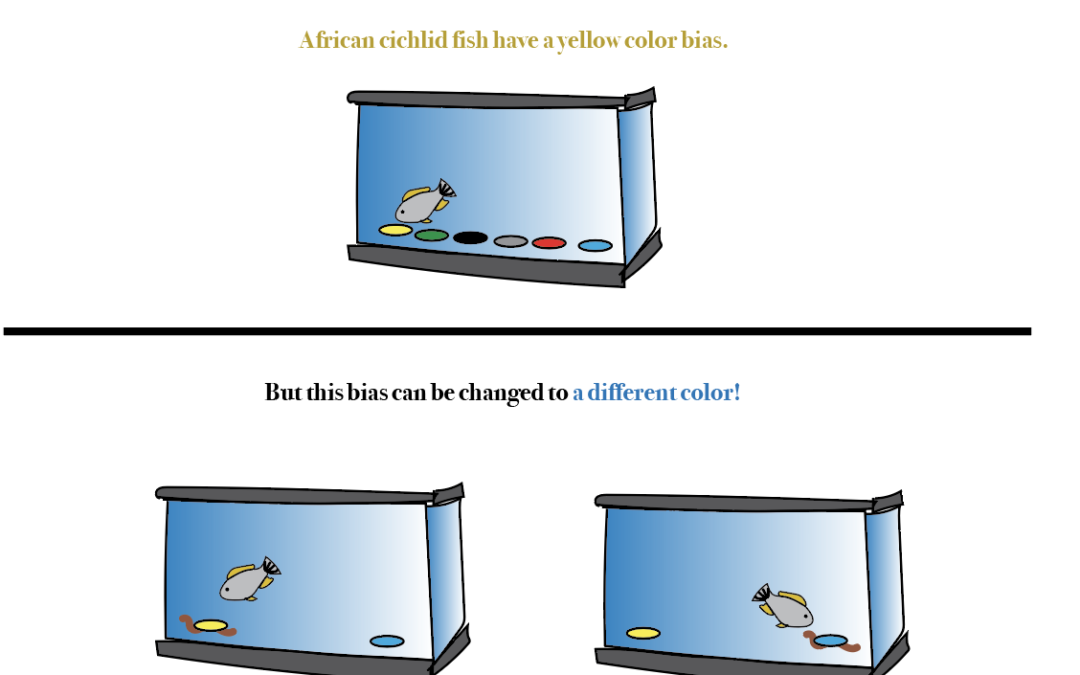
To achieve the first goal, the authors set up an experiment where African cichlid fish were placed in tanks and were allowed to interact with discs of six different colors. The fish interacted more and more quickly with the yellow disc than with the other colored disc. From these results, the authors determined the fish had a color bias for yellow. The researchers suggest that African cichlid fish could have a yellow color bias because yellow pigments are present in their two main food sources (zooplankton and invertebrates).
To test if the color bias is connected to food, the researchers set up a food-based experiment. Fish were divided into two groups and were trained to associate either blue discs with food (worms) or yellow discs with food by placing either blue or yellow discs over worms. Fish in both the yellow-trained group and the blue-trained group increased their success rates (picked the correct color first) during the experiment. However, fish in the yellow-trained group had a higher success rate. This finding implies that the yellow color bias is likely important for foraging (finding food) in the African cichlid fish.
Once fish had become well-trained within their group, the researchers switched the color that the fish had previously learned to associate with food. For instance, the group that learned to associate yellow with food was now exposed to an environment where worms were found only behind blue discs. The results showed that both the yellow-trained group and the blue-trained group could equally form new associations.
So what did the authors conclude from these results? They suggest that color bias is “context-dependent,” meaning that color biases can change when animals are exposed to new environments.
This study has helped move the scientific field forward because it implies that animals can change their color biases when their present bias becomes unhelpful and a new color bias becomes advantageous. As environments are altered due to climate change, the capacity of animals to form new associations with color likely will be an important ability for some animals.
Works Cited
Culbert, B. M., Talagala, S., Barnett, J. B., Stanbrook, E., Smale, P., & Balshine, S. (2020). Context-dependent consequences of color biases in a social fish. Behavioral Ecology, 31(6), 1410–1419. https://doi.org/10.1093/beheco/araa099
