
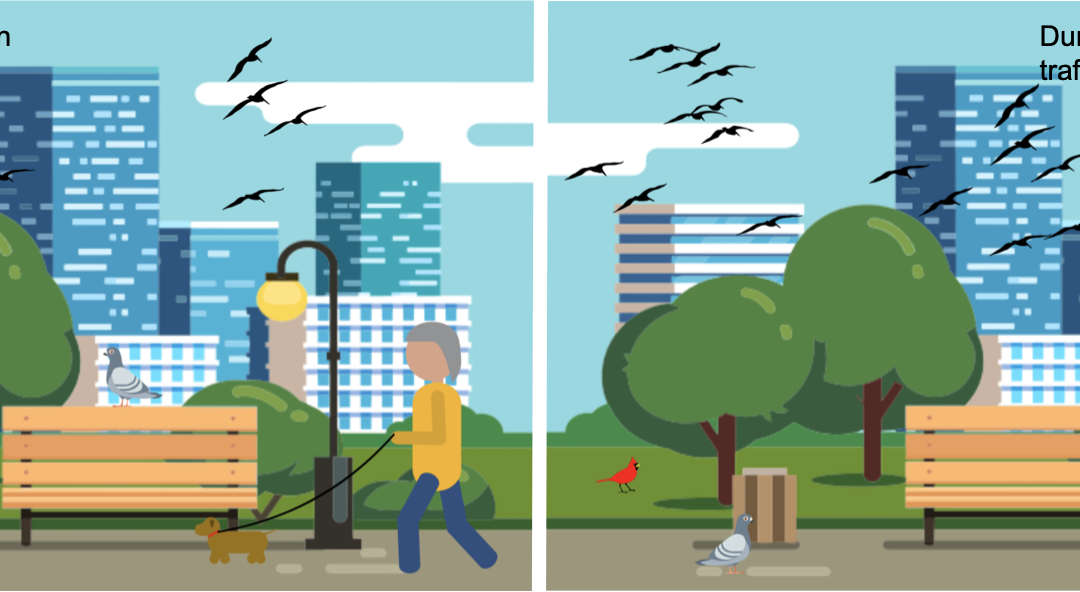
Everyone has felt the effects of COVID-19 whether that is wearing a mask in public, getting the virus, or the more serious effects of the virus. Many of these effects led to the changing of the habits in the daily lives of humans, including travel and traffic in many areas that Schrimpf et al. talks about in their paper. The paper “Reduced human activity during COVID-19 alters avian land use across North America” talks about the effects that the change in human travel and activity has altered the behavior of birds.
The team of researchers in Canada collected data for bid presence from eBird, an online database where volunteers log bird sightings, for the March to May interval in 2020 and in 2017-2019. These time intervals overlapped with migration and the largest changes in human travel found in their research of the best available data on human traffic. Comparing the data, they found a host of different results due to the wide number of species and variables analyzed in the study. The variables that were observed were: urban vs rural, distance to an airport, distance to the road, change in traffic, overlap, within county impact, among county impact, and any impact in general.
The team focused on 82 species and 66 of the 82 had a response to at least one of the variables tested for, many responding to multiple. Over all species it was 14 times more likely to see an increase rather than a decrease in populations in response to variables. Among the more important variables in the study were the overlap and the urban vs rural which highlight the changes the birds have in migration patterns. These two variables showed that during the lockdowns of the pandemic birds were more likely to be seen in urban and more heavily populated areas than before the pandemic. The responses to variables were also very large suggesting that the birds are strongly impacted by human interaction. The results of the study point towards that, in human developed land, bird activity increases in areas when human traffic decreases.
The authors bring up that there could be many negative implications in this quick shift to different locations. The quick shift in one year could lead to high volatility once the human traffic increases again. The death rate may increase due to higher rates of human encounters, reproduction rates could also decrease. But if there is a continued decrease in human activity there would be benefits for birds due to expanded breeding grounds. So, this leads us to think about what we can do as humans to help animals to prosper in nature with humans alongside them.
Sources
Schrempf, M, Des Brisbay, P, Johnston, A, et al., Reduced human activity during COVID-19 alters avian land use across North America, Science Vol. 7, No. 39 (2021). https://doi.org/10.1126/sciadv.abf5073
