
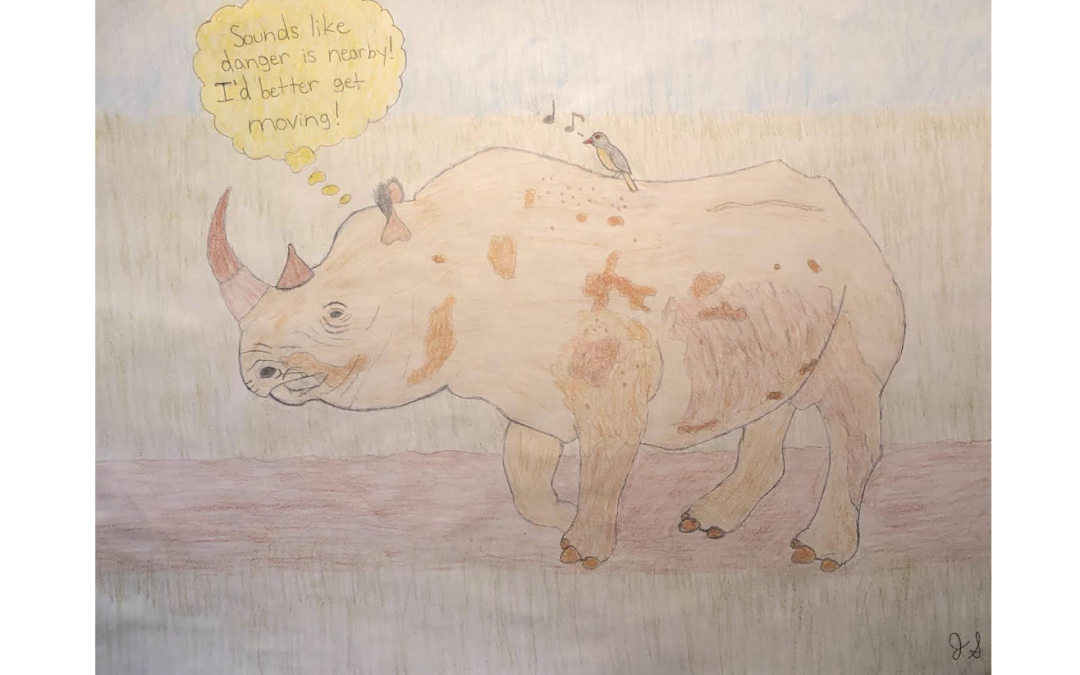
The black rhinoceros (Diceros bicornis), native to eastern and southern Africa, is critically endangered due to habitat loss and poaching. While the rhinoceros has an incredibly tough hide and large horns for defense, their eyesight is very poor and thus they cannot see when a threat such as a poacher is approaching them. There is hope for the survival of this species of rhino, however, thanks to the red-billed oxpecker (Buphagus erythrorhynchus). The red-billed oxpecker is a bird that will sometimes hitchhike on the backs of rhinos to remove ticks, flies, and maggots from their hides. The birds also give alarm calls whenever a threat (in this case a human) is spotted. A group of researchers wanted to test how effective this alarm call was in warning the rhinos of the possible presence of danger. They ran a “human approach” experiment using two groups of rhinos that the team would track with radio transmitters. One group of rhinos did not have any hitchhiking oxpeckers and the other group carried the birds as hitchhikers most of the time. Results showed that rhinos without oxpeckers detected a human approaching 23% of the time while those with oxpeckers detected an approaching human in 100% of their trials! The distance between the researcher and the rhino before being spotted was also much greater for rhinos that had oxpeckers as hitchhikers. Conservationists hope that reintroducing the bird back into rhino populations may help the rhinos evade dangerous threats like poachers and recover in numbers.
References
Press, Cell. “Black Rhinos Eavesdrop on the Alarm Calls of Hitchhiking Oxpeckers to Avoid Humans.” April 9, 2020, Apr. 2020, https://phys.org/news/2020-04-black-rhinos-eavesdrop-alarm-hitchhiking.html.
