
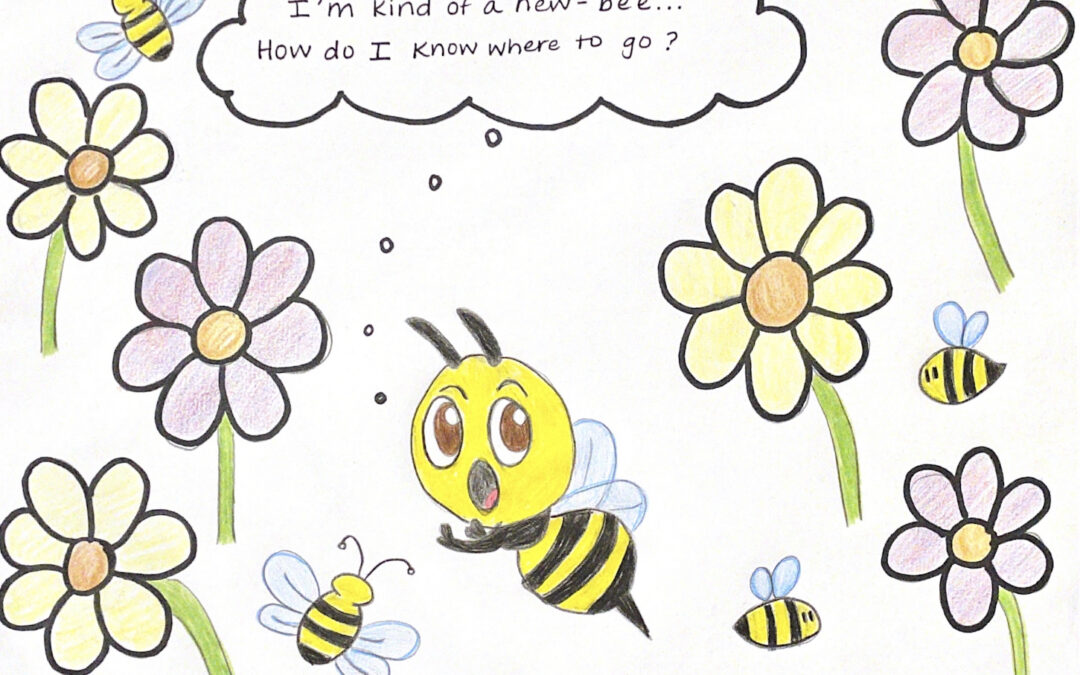
Do you ever stop to look at all of the vibrant flowers on a sunny spring afternoon and realize bees are everywhere? We know that bees are attracted to flowers because they use the flower’s pollen for pollination, and they feed on the nectar which is a great source of energy for the species. But did you ever wonder what makes a bee pick a specific flower?
Foraging, also known as the process of gathering food, comes with a lot of decisions for animals because where and what they decide to forage can affect their survival and reproduction, also known as their fitness. Sometimes animals are genetically made to or “hard-wired” to make the best foraging decisions, and other times animals have to learn how to make such decisions. In order to learn what the best foraging decisions are, animals have to rely on social cues, either from another animal or from their environment. Social cues are any type of interaction that occurs between two or more animals; in bees an example of a social cue might be one bee watching another bee inspect a specific color flower. Did you ever think that honey bees could use information from bees around them to pick the color flower they should investigate?
In most animal communities, more than one species occupies an environment at a time creating a ‘hustle and bustle’ effect. This can be challenging to navigate because everyone is giving different social information, which is why it is important to learn how animals process this information, and how they might use it to make decisions. One area of research that is still unclear, is how honey bees respond to various sources of social information and how this might affect a bee’s natural preferences for something that is nonsocial, such as flower color. Researchers at Queen Mary University of London in London, UK have been investigating just that!
In order to fill this knowledge gap, Romero-González et al. (2020) tested whether or not honey bees changed their preference for flower color based on social information from heterospecifics (different species members) or conspecifics (same species members). In this experiment, the heterospecifics were bumble bees (Bombus terrestris) and conspecifics were honey bees (Apis mellifera). This experiment was conducted using bees found in five different hives in the city of London over two consecutive summers (2017-2018).
First in order to carry out this experiment, Romero-González et al. (2020) had to train honey bees as well as bumble bees to prefer a certain flower color. They accomplished this by setting up an arena filled with 12 glass vials, topped with colored plastic chips to look like flowers. Each vial contained either unrewarding, plain water or rewarding water that contained a 50% sucrose (sugar) solution and was matched to a specific color plastic chip (yellow, magenta or clear). The honey bees were trained to see the magenta flowers as rewarding, whereas the bumble bees were trained to see the yellow flowers as rewarding. These trained bees were now called “demonstrators” and once these demonstrators were trained to their specific flower preference, the experiment could begin. Romero-González et al. (2020) introduced an “observer” (untrained) honey bee into the flower arena with a demonstrator honey bee and bumble bee and recorded what flower color the observer honey bee investigated to forage from.
Romero-González et al. (2020) observed that honey bees had a preference for inspecting magenta flowers. They also found that the color preference for magenta flowers, along with social information from a trained honey bee, allowed the observer honey bee to make quicker foraging decisions than if they watched a trained bumble bee. In addition to quicker foraging decisions, the researchers also found that observer honey bees followed trained honey bees more readily than bumble bees onto yellow flowers (the unpreferred flower type). Now the researchers are faced with this question: What do these results mean?
The researcher’s results provide sufficient evidence to claim that the color preference of honey bees can adjust in response to social information from bees of the same as well as different species. This in turn, can influence their foraging decisions when it comes to nectar collection. Since the observer honey bees preferred social information from bees of their own species, this could be seen as a reflection of prioritizing their own ecological needs. By taking in social information from your own species, you are making a choice that has a high fitness value because hopefully you can pass along valuable behavioral traits to your own kind. This choice to listen to a bee of your own kind, may also help bees prevent receiving misleading information from another species that could be harmful to their foraging success, given that a lot of species share the same environment.
In the future, we should look to investigate these types of choices in other species to determine if this is a special set of choices a honey bee makes, or if it’s a more widespread choice among multiple species. Interesting to think about right? Who would have thought a bee landing on a flower was so complicated, but so intriguing at the same time! So, the next time you see a honey bee sitting on a flower, recognize the choice that bee made to pick that particular flower and who may have told them that was the best flower of the bunch!
Romero-González, José E., Cwyn Solvi, and Lars Chittka. “Honey Bees Adjust Colour Preferences in Response to Concurrent Social Information from Conspecifics and Heterospecifics.” Animal Behaviour 170 (December 1, 2020): 219–28. https://doi.org/10.1016/j.anbehav.2020.10.008.
