
You might expect the largest animal ever to exist on Earth to eat something comparably large. Blue whales, scientifically known as Balaenoptera musculus brevicauda, clock in at about 80 to 100 feet long, or the length of about 2 school buses. Their tongues alone weigh about as much as an elephant, and total, they can weigh more than 200 tons– equivalent to almost 67 pickup trucks.
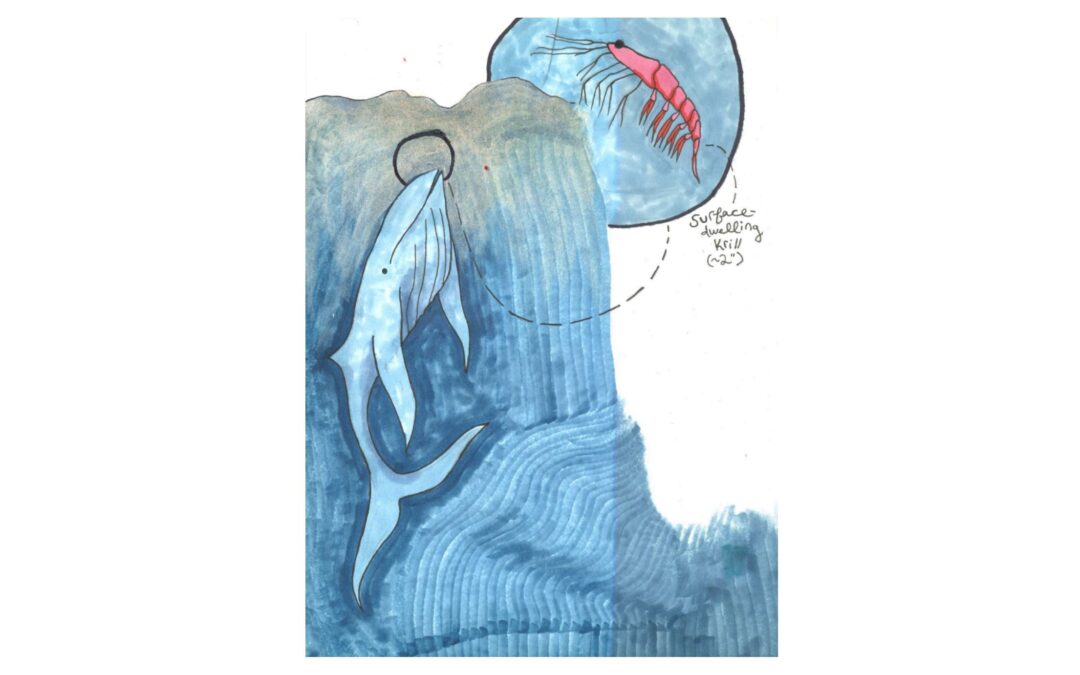
And yet, a blue whale’s diet consists almost entirely of krill. These tiny crustaceans average only 2 inches across, and, believe it or not, their name derives from the Norwegian krill, which literally means “small fry of fish”.
So how do blue whales do it? How do these mammals that give meaning to the word gargantuan survive on the literal small fry of fish? In order to capture huge numbers of krill at once, blue whales lunge at thick patches of the crustaceans, opening their giant jaws to capture as many as possible. The whales then push the captured mixture of water and krill through their baleen plates, giant comb-like structures, the whale equivalent of teeth, which allows the water to filter out, leaving the whale with a mouthful of nutritious krill.
But there’s a hitch: whales are mammals, which means they breathe air, and so this kind of lunge-diving– especially at depth– can be quite energetically costly. It would make sense that, whenever possible, whales would prefer to forage for food closer to the water’s surface, where they would not be required to expend energy propelling themselves deep into the water, and where they would be able to spend more time feeding, instead of spending valuable time and energy periodically coming up for air.
However, until recently, most documented whale feeding behavior has been of the deep-diving type: one reason is that this type of feeding is easier to capture using older experimental methods, like tagging, and another is that this type of feeding is more commonly used by southern california blue whales, which have been more thoroughly studied than other kinds of blue whales. But a recent study by researchers at Oregon State university aimed to fill in the gaps of knowledge about whale surface feeding behavior by studying pygmy blue whale behavior at a foraging ground in New Zealand. At this particular foraging ground, krill are known to gather primarily at the surface of the water, so, given the energetic costs of diving, the researchers predicted that whales here would prefer to feed at the water’s surface. By conducting their study here, the researchers had an opportunity to better describe blue whales’ behavior when surface-feeding, using newer drone technology.
The researchers found their prediction to be correct: the pygmy whales they studied did, in fact, prefer to forage at dense patches of krill closer to the water’s surface. They found that the New Zealand whales’ dive times also were much shorter than those of southern california whales, whose dive times were reported in a previous study, indicating, again, that the New Zealand whales were much more likely to forage for krill near the water’s surface, where they would not have to spend as much time underwater, diving for food.
In addition to this finding, the researchers were also able to use their drone footage of an active foraging event to lend support to the idea that whales use their sense of vision to coordinate their foraging behaviors, and to decide whether a patch of krill is dense enough to warrant spending energy lunging for it. They note that, in drone footage of whales foraging, the whales appear to keep their right eye trained on their target krill patch.
The researchers also used their drone footage to demonstrate that whale lunges at depth actually look quite similar to whale lunges near the water’s surface, even when comparing pygmy blue whales and normal blue whales. Approach speed, strike speed, and post-strike speed were all similar in both foraging approaches.
All of these findings help to paint a much fuller picture of blue whale surface foraging behavior, which, prior to this study, was relatively poorly understood. Much like how we might choose to grab a snack from the refrigerator instead of making a costly trip to the grocery store, blue whales, too, must weigh the costs and benefits of diving deep for food every day. It is this ability to weigh when diving for food is worth it, and when it isn’t, that allows these giant animals to survive on tiny fish– even the “small fry” of fish.
Torres LG, Barlow DR, Chandler TE, Burnett JD. 2020. Insight into the kinematics of blue whale surface foraging through drone observations and prey data. PeerJ 8:e8906
