
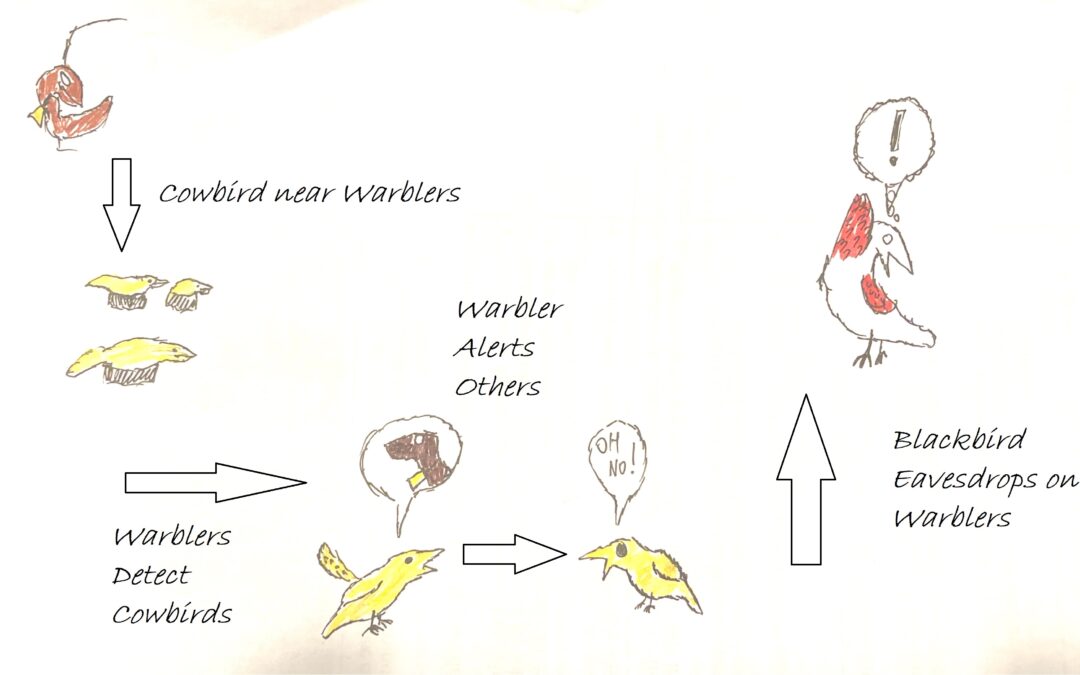
It’s hard to ignore the fact that, generally, we people have a fascination with drama. We like watching our soap operas and listening to our radio dramas, caught up in the he-said, she-said that is ever so common in modern media. Sometimes it bleeds into our lives, with workplace rumors and neighborhood gossip. When our friends talk about drama, we lean in to listen. One saga often overlooked, however, is that of the natural world, and there’s one such web of arguments and rumors loose in the marshlands of the Midwest, and it’s being held by an unexpected band of participants: birds. Shelby Lawson, part of Dr. Mark Hauber’s lab at University of Illinois at Urbana-Champaign, published a 2020 paper on eavesdropping in Red-winged blackbirds (Agelaius Phoeniceus), showing that these aggressive birds listen in on their neighbors to figure out what the rumpus is all about.
If you’ve ever listened in on another person’s conversation, you’ve got more in common with these birds than you might realize. To understand the flow of gossip in these marshlands, we first need to look at our players. There are three: the aforementioned Red-winged Blackbirds, Brown-headed Cowbirds, and Yellow Warblers.
Brown-headed Cowbirds (Molothrus ater) are brood parasites- instead of raising their young themselves, they lay their eggs in the nest of another bird, who then raises the chicks for them. It’s a bit like leaving a baby on someone’s doorstep, hoping that they’ll take them in and raise it. Different birds have different responses- some species evict the interlopers, pushing the eggs (or even the young chicks) out of the nests, while others will simply try and prevent cowbirds from ever reaching their nests. Red-winged Blackbirds fall into the latter category, relying on aggressive defense of their nest through a variety of means, ranging from attacking cowbirds or just sitting tight on the nest, even when it might be costly.
Defending your nest from cowbirds is a major time sink- time that could be dedicated to other activities, such as finding food or pursuing other mates, so you’ve got to make sure that it’s worth your time. No point wasting your time on something that you don’t need to do- so how do you make sure that you’re actually tackling something that needs to be tackled? Blackbirds have been known to use visual cues (such as seeing the cowbirds), but Lawson’s paper found that they’re also using their ears- to listen for both cowbirds and the warnings of Yellow Warblers.
Yellow Warblers (Setophaga petechia) are exactly what they say on the tin- small, yellow birds that belong to the warbler family. Like Red-winged Blackbirds, they face the threat of cowbirds parasitizing their nests. Their solution is a little different- these warblers live in communities, unlike the far more territorial blackbirds. When a member of the community detects a cowbird, they’ll start producing ‘seet’ calls- specialized calls that alert their mates and fellows to the cowbirds presence.
Lawson and colleagues noticed that blackbirds would eavesdrop on yellow warblers, listening in to seet calls. But what wasn’t known was how the blackbirds would respond to seet calls. Just because they were listening in didn’t mean that they were responding to the potential threat. So they decided to test whether they were responding to the seet calls, as well as listening to them. A playback experiment is where biologists, often ornithologists, will play recorded audio of an organism in order to illicit a response. Lawson conducted two different playback experiments to test how blackbirds responded to various calls. The first was to test whether blackbirds were more present in habitats where yellow warblers were producing seet calls- as opposed to generic ones. They played warbler calls of both types, and found that blackbirds showed up more when seet calls were played than when generic calls were played- indicating that they could distinguish between the types of calls and displayed a certain alertness for seet calls. The second test checked how long it took for the blackbirds to respond to different calls- did they act quickly, if they heard a particular species in the area? If they heard a specific call? Lo and behold- it did. Female blackbirds didn’t show any significant difference in response, but males definitely did! Seet calls and cowbird calls incised the male blackbirds to action, and elicited similar response.
So what does this all mean? Well, Lawson and colleagues held that there are a few things they’ve discovered, and a few other things they’d like to investigate further. The first thing they learned, in their opinion, is that Yellow Warbler seet calls are equivalent to cowbird calls, at least as far as Red-winged Blackbirds are concerned. What’s uncertain, however, is if they take this to mean that it’s cowbirds particularly, or a general warning that there are nest threats in the area. However, there’s a lot to still be learned about these birds and their eavesdropping ways. Going forward, Lawson wants to see if there’s other eavesdropping going on in these wetland habitats. Are other birds listening in to these seet calls? Are there other calls they listen for? Mark Hauber, head of the lab, is known for his work with cowbirds, and has expressed interest in continuing to explore how these dynamics influence survival and behavior in the ecosystem.
So next time you’re going for a walk and you hear the little cheeping of a warbler, ask yourself- is it just another bird call? Or are you listening to a drama to rival any TV sitcom?
Works Referenced in This Article. Lawson SL, Enos JK, Mendes NC, Gill SA, Hauber ME. 2020 Heterospecific eavesdropping on an anti-parasitic referential alarm call. Commun Biol3, 1–8. (doi:10.1038/s42003-020-0875-7)
