
Us humans love to revel in our creative genius. From making spears and arrowheads to building houses, tool use is undoubtedly one of the hallmarks of what it means to be human and has changed how humans interact with each other. Much to our despair, however, humans are not alone in their ability to use tools in order to enhance our lives. In fact, bottlenose dolphins have also been shown to use tools, specifically sponges. As with humans, the consequences of tool use are not limited by the utility of the tool. On the contrary, in addition to their primary purpose, using tools can dramatically change social structures and behavior, and therefore, drive evolution. As difficult as it may be to believe that a humble sponge may have far-reaching effects, this is indeed the case with bottlenose dolphins. A study published in the Proceedings of the Royal Society B: Biological Sciences studied the effect of using sponges on male social behavior, specifically observing only independent male bottlenose dolphins (Tursiops aduncus) in Shark Bay, Western Australia from 2007 to 2015 (Bizzozzero, et al., 2019).
Let’s take a step back: why would dolphins even use sponges? Bottlenose dolphins who use sponges, known as “spongers”, use the tool in order to protect the snout, or rostrum, from the ocean floor as they forage for food. This behavior grants them access to a niche which is totally unavailable to “non-spongers”. In order to determine if a dolphin was indeed a “sponger”, scientists decided that a dolphin must be observed carrying a sponge at least two times on separate occasions. How does being a “sponger” affect a dolphin’s social life? To answer that question, Bizzozzero and colleagues first decided to measure sociability, which was measured by observing how often dolphins were found alone or associating with other dolphins. They also observed “activity budgets”. Basically, the scientists wanted to understand how spongers and non-spongers differ in how they spend their time, whether it be resting, socializing, migrating, mating, or feeding.
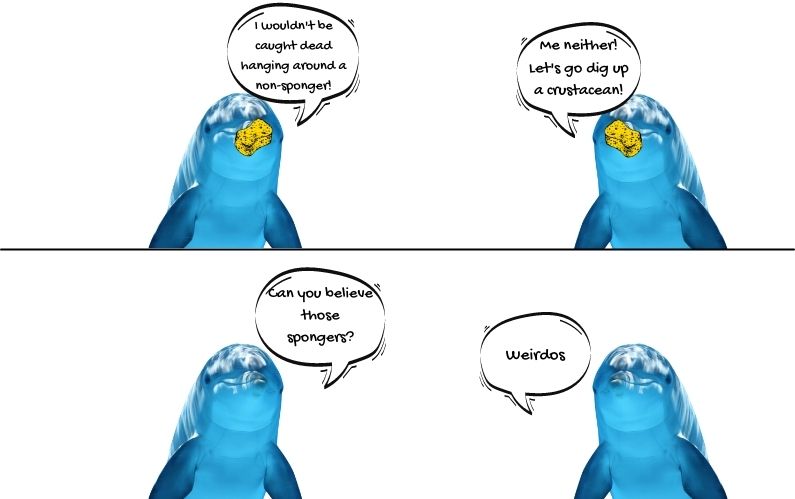
In line with their hypothesis, researchers did indeed find that male bottlenose dolphins who use sponges differ in how they spend their time and how social they are compared to non-spongers. Specifically, “…male spongers foraged more, and rested and travelled less than male non-spongers,” (Bizzozzero, et al., 2019). Interestingly, both male spongers and non-spongers spent similar amounts of time socializing with others. Furthermore, spongers spent more time with spongers, while non-spongers spent more time with non-spongers. Out of 9 dolphin alliances––groups of dolphins which hunt and travel together––8 of them were either all non-spongers or all spongers, with only one mixed group. Amazingly, the type of foraging technique employed by this aquatic mammal predicted who they would associate with better than relatedness. In other words, a sponger would be more likely to associate with another sponger than with a relative! In fact, relatedness alone did not predict how dolphins would associate with each other at all! However, as with all behaviors, is there a cost endured by male spongers and not non-spongers? Spongers seem to spend less time resting and travelling and more time in solitude. In cases where there is high competition, this cost may be far outweighed by the benefit of accessing a unique niche––delicious prey hiding beneath the seafloor. In addition, social homophily––referring to the fact that spongers readily associate with other spongers––may also outweigh the potential downsides of engaging in sponging behavior.
All in all, while spongers and non-spongers choose to spend their time differently, both still have their own close-knit group they can rely on.
Bizzozzero MR, Allen SJ, Gerber L, et al. Tool use and social homophily among male bottlenose dolphins. Proc Biol Sci. 2019;286(1904):20190898. doi:10.1098/rspb.2019.0898
