
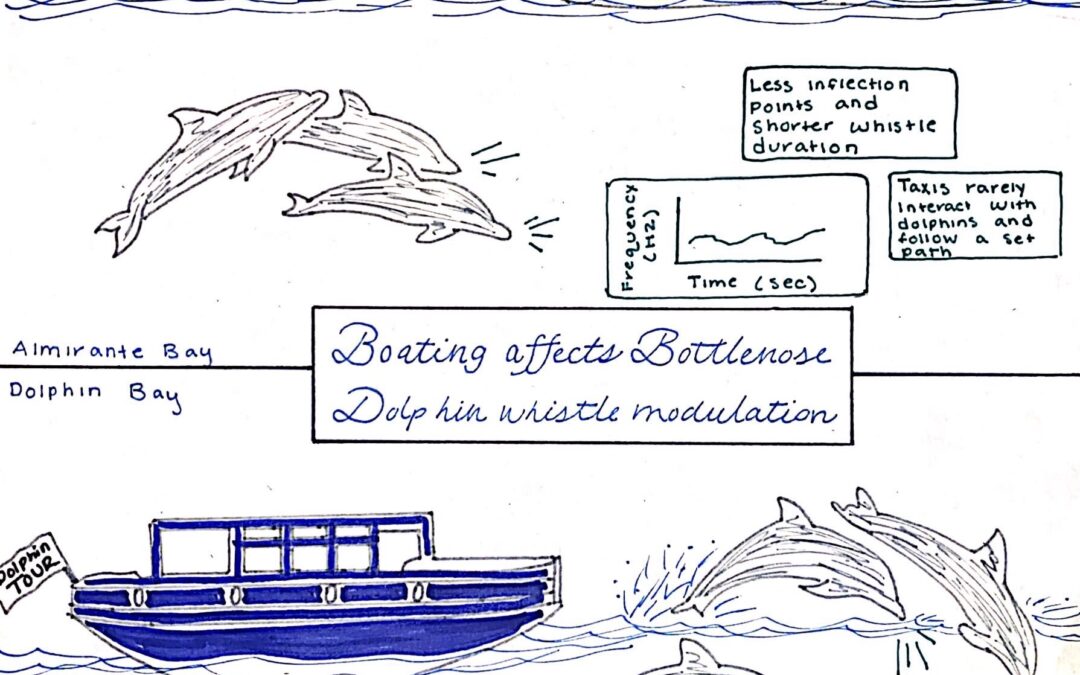
Bottlenose dolphins (Tursiops truncatus) communicate with one another via whistles, calls, screams, and other noises. These sounds convey information about prey, predators, and allow the animals to communicate in general. Whistles are often studied due to their great variation and due to the fact that dolphins are able to change their whistle acoustic frequencies in order to match frequencies of their environment and match appropriate behavioral activities. This occurs in order to decrease signal masking, the interference of other noises with their own communication. Data on whistles can also be quantified by looking at the differences in modulations and can be measured by looking at the number of inflection points and loops that occur in the whistle. Furthermore, associations have been found between stress and loop number and whistle duration. Recently, studies have looked at how humans (in the form of boat interactions among different environments) affect the dolphin’s whistles, and therefore their stress levels.
Betzi Perez-Ortega et al. (2021) centered their observational study on dolphin whistles, the relationship with stress, and how different forms of boat traffic affects communicative behavior. The study took place off of the Caribbean coast of Panama where there is shallow (<20 m in depth), clear water. In this water bottlenose dolphins live in small, isolated populations. Two different sites in the archipelago of Bocas del Toro, Panama, were chosen for their contrasting types of boats present. The first bay, Almirante Bay, is often filled with transport boats (taxi boats) that follow a specific schedule and path each day. The boats travel across the bay between the mainland and archipelago. Multiple companies run boats on 30 minute intervals each way from 6 a.m. to 6 p.m. There is always constant movement here, but the boats rarely interact with the dolphins. The other location, Dolphin Bay, contains dolphin watching/tour boats. These boats travel in search of dolphins from 9 a.m. to 12 p.m. These boats are very unpredictable in where they will travel. They search for dolphins and then actively pursue them, making quick turns and changes in speed, constantly interacting with the animals, sometimes following them for hours on end. These sometimes aggressive interactions can cause separation between mothers and calves and group members in general. Furthermore, tour boats disrupt important behaviors such as foraging and socializing and can sometimes even cause injuries among pods.
In each bay, recording devices were deployed to the seafloor and anchored at 12m depth to capture dolphin whistles. Recordings were taken in a 24 hour cycle consecutively for ten days, once a month. Analysis occurred by locating whistles among recordings, counting the whistles, classifying whistles as signature whistles (meaning they are learned and individually distinctive to the dolphin), and determining whether whistles were clear enough. Of all the data collected, 242 whistles from Almirante Bay and 1,754 whistles from Dolphin Bay were examined. Results showed that dolphins produced 4.7 times more whistles per minute in Dolphin Bay with the tour boats than in Almirante Bay with the taxi boats. Statistical tests indicated that the overall whistle acoustic structure is significantly different between the two Bays and this structure is explained by whistle modulation variables such as boat presence and whistle type. In Dolphin Bay, animals emitted whistles with an increase in frequency, duration, and modulation (two times more modulated whistles in Dolphin Bay) than those in Almirante Bay. Increasing modulation with increased boating interactions may provide insight into the “emotional state” of the dolphins, more specifically their stress levels. Frequency changes in modulation indicate stress or alertness. Therefore it is reasonable to assume that Dolphin Bay is a more stressful environment than Almirante Bay due to the interactions with boats.
In order to protect the animals and decrease their levels of stress, tour-boats on Dolphin Bay should try to reduce the number of boats in contact with the dolphins, increasing time between interactions, and reducing contact time with the dolphins.
Work Cited:
Perez-Ortega, B., Daw, R., Paradee, B., Gimbrere, E., & May-Collado, L. (2021). Dolphin-watching boats affect whistle frequency modulation in bottlenose dolphins. Frontiers in Marine Science, doi:http://dx.doi.org/10.3389/fmars.2021.618420
