
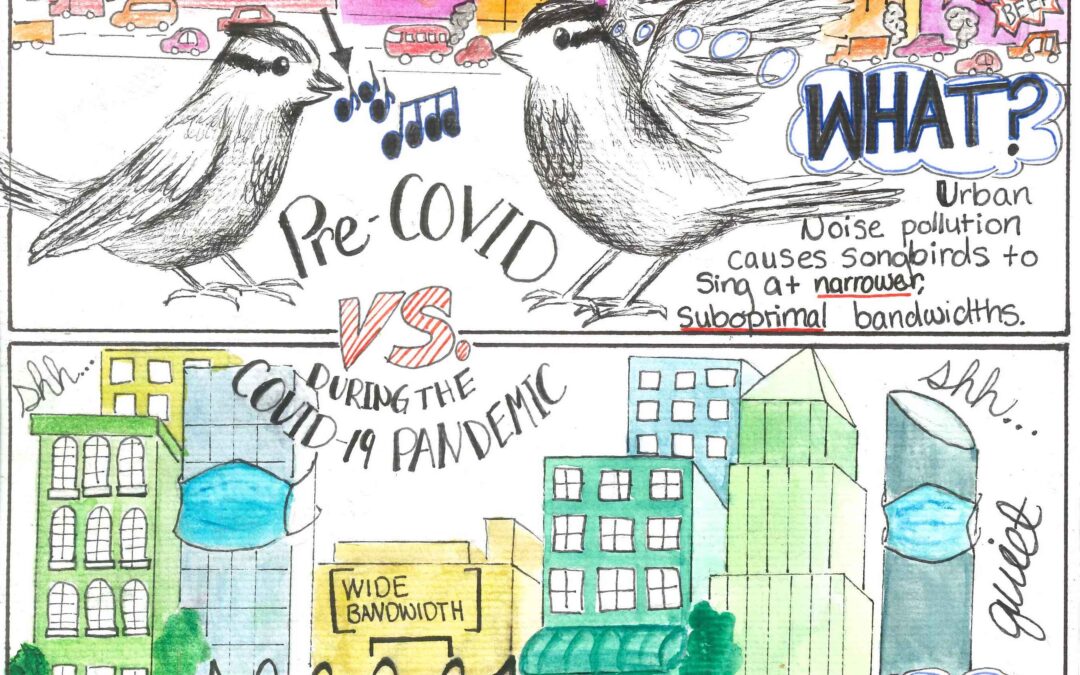
Though the COVID-19 pandemic has wrought drastic change with high mortality rates and wide-scale shutdowns, it has also given rise to some unexpected benefits. With reduced global human activity, the pandemic has provided a unique set of conditions to study climate change and ecosystems, especially with lower daily CO2 emissions, less transportation, and reduced noise pollution. One study took advantage of the lack of noise to examine how the absence of noise pollution impacts the birdsongs of White-crowned sparrows (Zonotrichia leucophrys) in the San Francisco Bay Area. Iris Levin, a professor of Biology and Animal Behavior at Kenyon College, was intrigued by this research; she comments, “this is such a great example of scientists taking advantage of a ‘natural experiment.’ COVID slowed down or prevented some science from moving forward [but] how great to see a research group take advantage of the circumstances and learn something new about biology and birdsong more specifically!”
In their recent paper, Elizabeth P. Derryberry and colleagues found that not only do songbirds shift their song frequency to improve vocal performance and communication, but they are remarkably resilient in the face of anthropogenic interference. Previous studies have proven that anthropogenic pressures, including noise pollution, can constrain animal behavior, but this experiment demonstrates that songbirds can also recover and adapt to rapidly changing soundscapes in order to improve their communication efficiency (Derryberry et al. 2020).
Songbirds employ a highly developed form of communication. In fact, only a few other taxa are able to produce such a range of sounds with such intricate vocalizations. Songs are vital modes of communication that allow these birds to share information and attract mates. Known as the Lombard Effect, songbirds often modify acoustical features of their song like frequency or pitch in the presence of background noise (Dorado-Correa et al. 2018). This communication mechanism is useful because it allows signalers to communicate over background noise. However, modifying the song is not ideal for an individual or a population. Therefore, Darryberry and colleagues predicted the sparrows would adjust their acoustic calls to a lower frequency during the COVID lockdown because there is less background noise.
Noise pollution is not the first thing that comes to mind when discussing human-induced environmental change, but it can have serious consequences for surrounding regions. When the level of noise in a certain area reaches a harmful level, it is considered noise pollution. This is often due to industrial activity and traffic. Derryberry and colleagues quantified the effect of noise on birds by measuring urban birdsongs in relation to noise levels from before and during the COVID-19 Shutdown. This experiment required a contextual understanding of how much noise pollution has dropped over the past few months. They measured background noise levels in urban and rural locations of the Bay Area. As expected, urban background noise dropped considerably during the shutdown while noise levels for rural areas remained stable. They believe this is largely due to traffic levels which have reached record lows. The amount of traffic in April was equivalent to traffic levels from 1954 (Derryberry et al. 2020). In this study, the rural regions acted as a control to illustrate what we would expect to see in an unpolluted noise environment.
White-crowned Sparrows are one of approximately 4,000 species that make up the Songbird (Passerine) family. White-crowned sparrows are popular within scientific literature because of their distinct song; they typically have a discernible whistling introduction, an assortment of whistles in the middle, and a clear trill (or buzz) at the end (Cornell Lab of Ornithology). This trill is what Derryberry and colleagues analyzed to better understand their optimal vocal performance as well as how the sparrows might alter their songs. Vocal performance was based on two things: trill rate and frequency bandwidth. Trill rate is the number of notes sung in a given timeframe while frequency bandwidth is the difference between the maximum and minimum trill frequency. Unfortunately, it is physiologically impossible for songbirds to maintain both a high trill rate and a wide frequency bandwidth. Thus, an individual is faced with a trade-off; they can have a high trill rate and low bandwidth or vice versa. This is analogous to choosing between endurance or sprinting. You can run at a fast pace for short distances, or run at a slower pace for longer distances, but you can’t physically maintain a sprint for a long-distance course. The individuals with the highest vocal performance typically fall somewhere in the middle, where they have both a moderate trill rate and a moderate bandwidth.
Derryberry and colleagues established that sparrows have greater vocal performance when singing at wider bandwidths. They also found that the frequency bandwidth during the shutdown in urban areas was substantially wider than prior to the COVID Shutdown (Derryberry et al. 2020). This optimal vocal performance was observed during the COVID shutdown because individuals did not have to compete with the low-frequency urban background noise. Moreover, with improved vocal performance and the use of wider bandwidths, signalers are able to transmit more information over longer distances. This plays a large role in elevating fitness and increasing the likelihood of survival.
This study explores extremely relevant questions about how anthropogenic pressures impact animals and further illustrates why humans need to mitigate harmful practices and behaviors. On the other hand, the white-crowned sparrows in this study displayed behavior that changed substantially over a relatively short period of time. Accordingly, this study is promising because it suggests that animals and ecosystems are even more resilient than previously thought.
References:
Derryberry, E. P., Phillips, J. N., Derryberry, G. E., Blum, M. J., Luther, D. (2020) Singing in a silent spring: Birds respond to a half-century soundscape reversion during the COVID-19 shutdown. Science, 370, 575-579. https://doi.10.1126/science.abd5777
Cornell Lab of Ornithology. 2019. All About Birds. Cornell Lab of Ornithology, Ithaca, New York. https://www.allaboutbirds.org/guide/White-crowned_Sparrow/sounds. Accessed on Nov. 10, 2020.
Dorado-Correa, A.M., Zollinger, S.A. and Brumm, H. (2018, Vocal plasticity in mallards: multiple signal changes in noise and the evolution of the Lombard effect in birds. J Avian Biol, 49: jav-01564. https://doi.org/10.1111/jav.01564.
