
Dogs have been “man’s best friend” for thousands of years, both functioning as our pets and serving integral roles in human society. So, it’s no surprise that dogs have adapted over time to be more sensitive to human signals of communication. Social cognition in dogs, especially that related to dog-human communication, likely stemmed from artificial selection by humans during their domestication. One of these selected traits includes heightened attention to humans, which probably increased their success in some of these roles. However, only so much of a dog’s sociocognitive behaviors are a result from “nature”, or human-based selection of genetic traits. In fact, environmental, or “nurture”, effects, like training or experience, also play a big role in the development of these behaviors. While some dogs are trained more in independent problem-solving, like substance detection dogs, others are more experienced in dog-human interactions, like pets or service dogs.
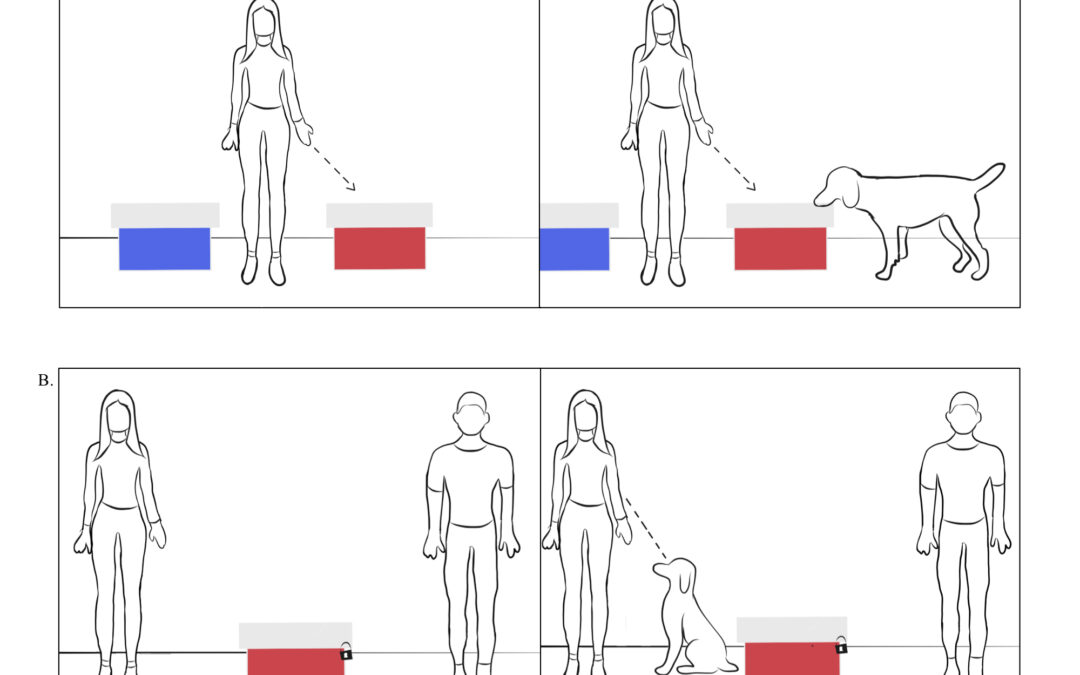
These two competing forces related to social cognition of the modern dog made Lazarowski et al., writers from Learning and Behavior, wonder: how does variation in the nature of a dog’s training affect its ability to execute sociocognitive, human-communication related behaviors? Does it relate to how regularly they interact with humans? Or are they more skilled in communicating with humans that they’re familiar with, like an owner or handler? These researchers set out to answer these questions by comparing performance of human-oriented social cognition tests in two groups of dogs: pets and detection dogs. Researchers measured performance in subjects from both groups on two standardized measures of animal social cognition: the object choice task and the unsolvable task (Fig. 1). Researchers hypothesized that variation in training and experience between groups would cause variation in performance on both of these tasks.
The object choice task (OCT) is used to measure a subject’s responsiveness to human-communicative gestures like pointing or head turning. In this task, a nearby human gestures to the correct location of some hidden reward. Each subject is measured in their ability, or lack thereof, to follow that gesture to the reward’s location (Fig. 1A). Researchers predicted that, on the OCT, detection dogs would perform either as well or better than pets. They predicted this because of detection dogs’ increased experience with problem solving tasks.
On the other hand, the unsolvable task (UT), as its name suggests, is unsolvable and measures the tendency of subjects to emit communicative signals to humans. In this task, participants are presented with an inaccessible reward (such as a treat in a locked box), by which two humans are standing: one being familiar, such as an owner or handler, and the other being unfamiliar. They are then measured in their likelihood to both send communicative signals (like gazing) to either of the nearby humans in request for assistance and persist in problem solving independently (Fig. 1B). Researchers predicted that pets, rather than detection dogs, would display more human-directed behavior during the UT, and detection dogs would display increased persistence compared to pets. This prediction is based on the differences between groups in regards to their experience and training. Detection dogs not only are required to be persistent in independent problem solving while on the job, but also spend less of their time working engaged in dog-human interactions. On the other hand, pets spend much more time interacting with humans and have little experience with problem solving.
For the most part, the results of this study were as predicted. During the UT, pet dogs spent significantly more time engaged in human oriented gazing, while detection dogs showed a greater amount of persistence during these trials than pet dogs did. And while there was no significant, overall performance difference found between the groups during the OCT, pets committed significantly more no-choices with an unfamiliar human than with a familiar human. This effect wasn’t seen in detection dogs. These results may be explained by previous findings that indicate pets pay more attention to their owners than unfamiliar individuals. On the other hand, detection dogs need to be able to flexibly respond to people, regardless of familiarity, for their work. However, there was no significant performance difference between groups, overall, during the OCT.
Overall, the results of this study suggest that dogs differ in social cognition, depending on their occupational relationship with humans and the nature of their specific role. It also shows that the modern day dog is particularly sensitive to signals of human communication, probably as a result of the historical association between dogs and humans. Although our bond with dogs is certainly unquestionable, these findings, alongside previously discovered information, suggest that humans have directly influenced this connection’s existence. Both through artificial breeding and influence of training/ the environment, humans have played a big role in the evolution of human-sensitive cognition in the modern-day dog.
References
Lazarowski L, Thompkins A, Krichbaum S et al. (2020) Comparing pet and detection dogs (Canis familiaris) on two aspects of social cognition. Learn Behav (2020): 1-12. doi.10.3758/s13420-020-00431-8
