
Despite their meek and subtle attitude, land tortoises are making us question the established belief of why animals at birth evolved to gravitate towards ‘faces.’
You may not remember being a baby, but your parents remember how often you’d touch their face, it’s almost like it’s built into us, and it might actually be… Before now, scientists commonly studied this behavior in social animals like monkeys, humans, or chicks. These animals, though, require extensive parental care and live in varying sizes of social groups for most of their adult life. However, land tortoises are solitary animals, meaning that from birth they do not require the necessary attention from parents and remain mostly to themselves for their adulthood. Some tortoises even show signs of actively avoiding their own species.
Researchers at the Queen Mary University of London wanted to better understand the adaptive reasons why newborns prefer faces (1). In particular, they were looking at two contrasting hypotheses, the first being, face preference is a tool in finding those of the same species and receiving care from parents, and secondly, it may actually be a tool more generally used to adjust to and understand other living things. Therefore, they chose five different species of land tortoises as their study’s subjects, since if the parental care and same species hypothesis are correct, one should expect the tortoise not to gravitate towards face-like stimuli.
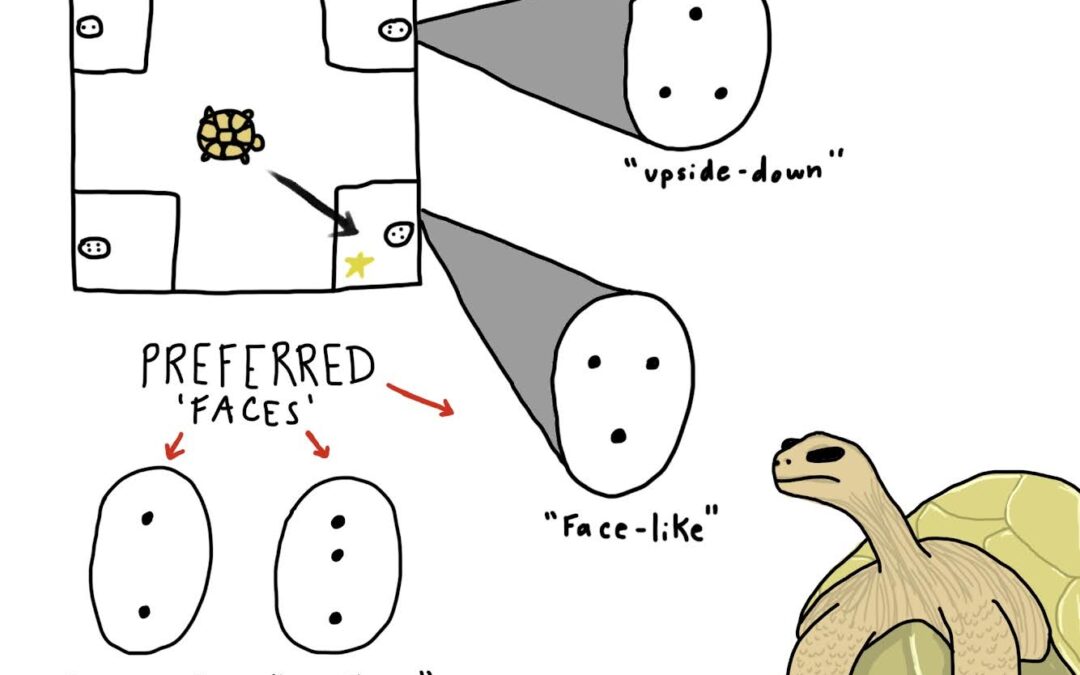
In order to test the proposed hypotheses, it required keeping the hatchlings separate from any faces until the time of the experiment. It may be a silly sight, but the researchers handling the tortoises had to wear masks that would not reveal anything to the newborns. This meant that when placed into a rectangular box it would be the first time they were exposed to face-like stimuli, which were four unique ellipses with various dot patterns in each corner. Researchers found that the tortoises, for the most part, favored the face-like, top-heavy, and vertical stimuli, which raised new questions. Specifically, in response to the found results, Dr. Elisabetta Versace said, “It was thought this early adaptation was important for helping young animals respond to their parents or other members of the same species. However, now we have shown that this behaviour is also found in solitary tortoise hatchlings, suggesting it may have evolved for another reason” (2).
Possible theories have arisen from the study and they seem to lean towards the idea that animals may gravitate toward faces because other animals can reveal lots of information, such as the availability of resources in the environment. Another theory is from a previous study in which researchers found that human newborns do not respond to actual faces, but rather general characteristics of a face that pleases the baby’s immature visual system (3). However, this possible explanation does not fully address or account for the preference of face-like stimuli to upside-down stimuli.
An argument can then be made that maybe this facial preference is an ancient mechanism that evolved as early as 300 million years ago in the ancestors of mammals, reptiles, and birds. Maybe this gravitation is innately in us all? Or maybe there are other factors at play? Overall, it seems that more research will need to be done in different solitary animals to better understand if this mechanism is something present in all living beings. But until then, the tortoises will continue on as they are and hopefully inspire other researchers to investigate this fascinating behavior.
1. Elisabetta Versacea, Silvia Damini, and Gionata Stancher. Early preference for face-like stimuli in solitary species as revealed by tortoise hatchlings. PNAS. 2020;117:24047–24049. doi:10.1073/pnas.2011453117
2. Queen Mary University of London. Tortoise hatchlings are attracted to faces from birth [Internet]. ScienceDaily. ScienceDaily; 2020. Available from: https://www.sciencedaily.com/releases/2020/09/200916131051.htm
3. F. Simion, V. Macchi Cassia, C. Turati, E. Valenza, The origins of face perception: Specific versus non-specific mechanisms. Infant Child Dev. 10, 59–65 (2001). Doi:10.1002 Available from: https://onlinelibrary.wiley.com/doi/epdf/10.1002/icd.247
