
In the quiet of the night, penny-sized frogs track each other’s calls to size each other up and potentially tussle. As they close in on one another, they prime themselves, their rivals, and even bystander frogs both physiologically and behaviorally for the upcoming brawl.
The Túngara frog is a tiny, 1-1.4 inch long frog found in South America and Mesoamerica. Most nights, the male Túngara gather together in ponds and create a chorus of croaks, similar to video game sound effects, to attract females for mating. In the presence of other males, the male Túngara stalk the others around them, closing in and becoming aggressive and sometimes initiating physical combat with one another. With all of these male frogs grouped together and calling at the same time, it is hard to pick out individuals using only auditory information. Therefore, male frogs will use other mediums of communication to supplement their classic croaks. This ability is known as multimodal communication.
As they sit in these ponds, Túngara frogs can absorb chemical signals through their highly permeable skin. Some chemical signals include secreted hormones (such as testosterone and androgens) and cortisol (a hormone linked to stress). When the frogs detect these hormones from other males in the surrounding water, it can indicate the location of another male and influence their own behavior and physiology. Researchers have studied how detecting the presence of other male frogs can increase a frog’s hormones associated with aggression and stress, priming them for aggressive behavior that may be needed upon contact.
A research group led by Still et al. (2019), had questions about the specific effect multimodal signaling has on the behavior of other male frogs in the same ponds. Prior research has shown that being in the presence and hearing the calls of other male frogs helps prime them for combat by raising their own hormone and aggressive behavior levels. While most research has focused on auditory signaling as the sole actor in producing aggression, in reality the full response requires a combination of chemical and auditory signals. While auditory calls may prime a partial response, they themself do not initiate them without the full multimodal signal input.
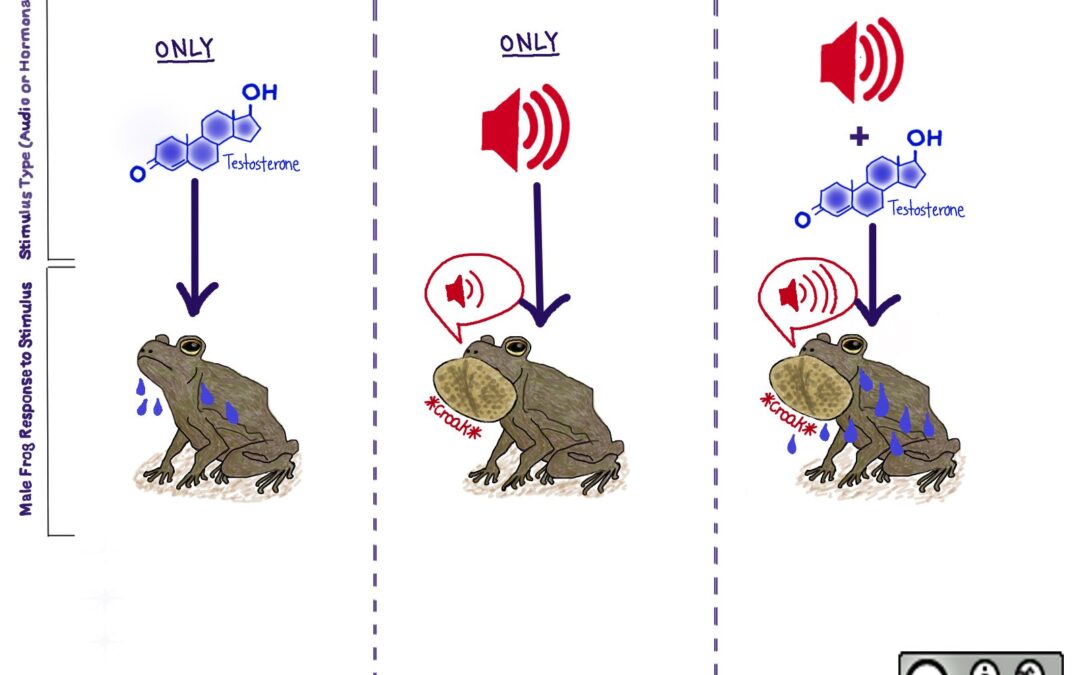
Still et al. (2019) placed male Túngara frogs into individual glass bowls to collect their changes in hormone levels by sampling the surrounding water and taking urine samples. These frogs were tested in four different stimuli groups; chemical stimulus from other male frogs (mixed into their water), acoustic stimulus of pre-recorded Túngara calls, both of these stimuli together (testing the effect of multimodal communication), and a control group with no stimulus at all. They also recorded each frog’s changes in locomotor activity, time between croaks, and total number of croaks throughout the trials. They recorded behavior and hormonal status at the frog’s resting state, during exposure to the group’s stimuli, and after being rinsed of any stimuli as well.
The researchers found that locomotive behavior and total number of croaks were increased only by auditory stimuli but not significantly influenced by chemical stimuli on its own. The time between each call also only decreased significantly in conditions with auditory stimuli. As for physiological changes, testosterone levels of the frog increased only in conditions with the presence of chemical signals, but not with auditory stimuli on its own. Meanwhile, cortisol levels were only elevated when both stimuli were present. It was generally found that the combination of the two forms of signaling resulted in stronger behavioral and physiological effects than either stimuli groups on their own. This means that the frogs need multimodal stimuli in order to detect other males around them. Both forms of stimuli are used by the frogs for combat and to stalk their pond neighbors. This combination could be used to simplify male-to-male communication as they call out to females frogs, or perhaps these chemical signals indicate the fitness of the male signalling and determine the way in which two males will interact. More research is needed into the complexities of chemical stimuli and the role it plays not only for the tussling Túngaras, but for the larger world of animal behavior as well.
Citations:
Still et al., 2019 Meghan B. Still, Amanda M. Lea, Hans A. Hofmann, Michael J. Ryan,
Multimodal stimuli regulate reproductive behavior and physiology in male túngara frogs,
Hormones and Behavior, Volume 115 (2019) 104546, ISSN 0018-506X, https://doi.org/10.1016/j.yhbeh.2019.06.010.
