
Non-social red-footed tortoises are able to use social cues to solve a task that they would otherwise be unable to solve through individual learning. This supports the hypothesis that the ability of an organism to learn socially is linked to the organism’s general ability to learn instead of their sociality. A group of researchers led by Anna Wilkinson in the Department of Cognitive Biology at the University of Vienna were the first to study social learning in solitary reptiles. Prior to this experiment, social learning had never been studied in reptiles.
The majority of studies on animal social behavior have focused on group-living organisms like mammals, birds, fish, and insects. A multitude of evidence has been gathered that suggests group-living organisms are able to learn through observing another organism of the same species, known as conspecifics. Social learning is beneficial because it allows individuals to avoid the costly process of trial and error. By observing the behavior of a conspecific, an individual is able to gain more information without expending a large amount of energy. The benefits of social learning should come as no surprise. People engage in social learning everyday. Observing someone else complete a task bypasses the trial an error necessary to solve the task individually.
Humans and group-living animals are highly social creatures, but what influence does social learning have on non-social animals? It was previously believed that living in a social environment favored the evolution of social learning; therefore, social learning is a product of social living. This suggests that non-social species are incapable of social learning because they lack knowledge of social interactions. This study examined an alternative hypothesis that disproves the idea that non-social species can not learn from social behaviors. Anna Wilkinson and her associates tested the hypothesis that the ability of an organism to learn socially is linked to the organism’s general ability to learn. From this hypothesis, it is thought that social cues and environmental cues are perceived in a similar way allowing learning through associative processes (Wilkinson et al. 2010). Therefore, any organism with the exposure to a conspecific should be able to learn socially.
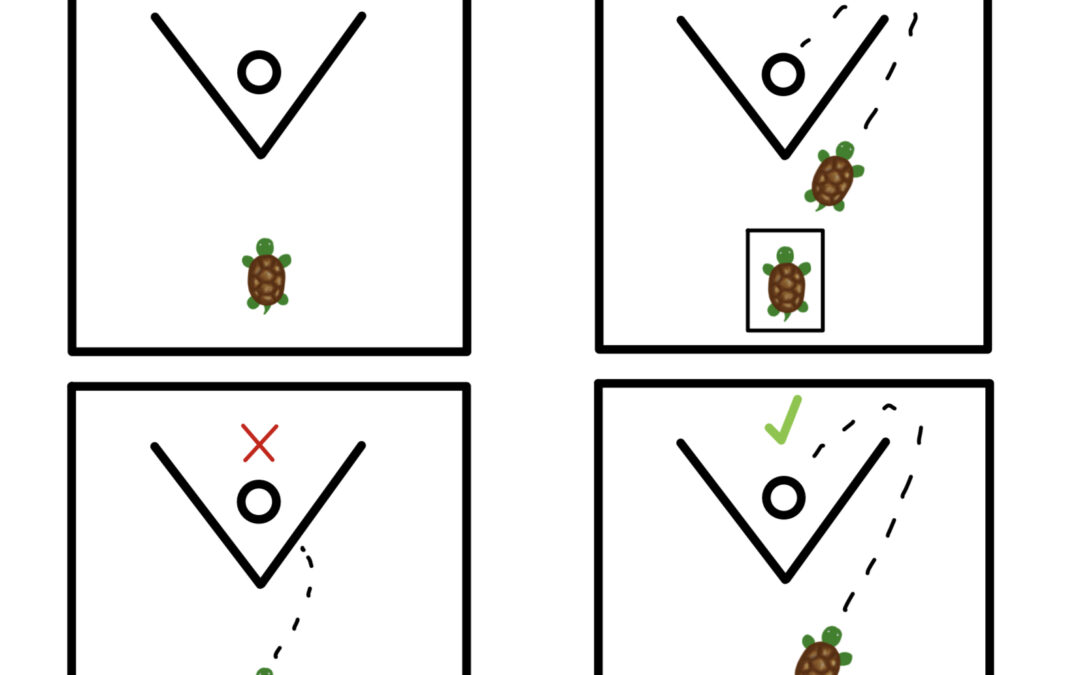
In order to test this hypothesis, the research team selected eight red-footed tortoises to try and complete a simple task. The task that the tortoises were given was to maneuver around a V-shaped fence to access food. Tortoises were split into two groups: non-observer (control) and observer. The non-observing group had to complete the task without any help. The observing group was able to watch a conspecific demonstrator complete the task correctly before they were allowed to attempt it (see figure).
It was found that non-social red-footed tortoises were able to learn to solve a task by observing the actions of a conspecific demonstrator. Following the observation of the demonstrator, all of the observer tortoises were able to successfully reach the goal. All four of the tortoises who were observers completed the task correctly at least twice and two of these tortoises completed the task correctly on the first try. In comparison, none of the four non-observer tortoises completed the task correctly during any of their trials. The tortoises that observed first were significantly more successful at completing the task than the tortoises who were non-observers. The evidence gathered from this study is the first proof of non-social reptiles having the ability to learn from social cues showing that the sociality of an animal is not the determining factor in social learning. This disproves the popular hypothesis that social learning is a product of social living and therefore is not present in non-social animals.
The findings of this study form the foundation for further research investigating the role of social learning in non-social animals. Now that it is known that some non-social animals may have the ability to learn from social information, more can be done to understand the mechanisms that control this form of learning.
Wilkinson, A., Kuenstner, K., Mueller, J., & Huber, L. 2010 Social learning in a non-social reptile. Biol. Lett. 6, 614 – 616. (doi: 10.1098/rsbl.2010.0092)
