
Picture this; one day at lunch, your coworker comes in with a freshly-made batch of warm chocolate chip cookies. Your mouth is already watering right? You expect your friend to share this wonderful creation, and four delicious chocolate chip cookies later, you thank them.
Sharing is a great thing, especially when it comes to sweet treats like chocolate chip cookies. Although it may not be for the savory taste, researchers have found that rough-toothed dolphins (Steno bredanensis) share their food too.
Food sharing is known as “a resource owner allowing a conspecific to consume part of a food item originally acquired by this owner, although the latter could defend this resource” (Ramos et al. 2020). Many species have been known to share food, but these researchers came together to prove this in rough-toothed dolphins. Rough-toothed dolphins tend to live in tropical and warmer temperate waters and have a large variety of prey, mostly teleosts. Prior to this study, there were only two reported cases of food sharing and one possible case in this particular species.
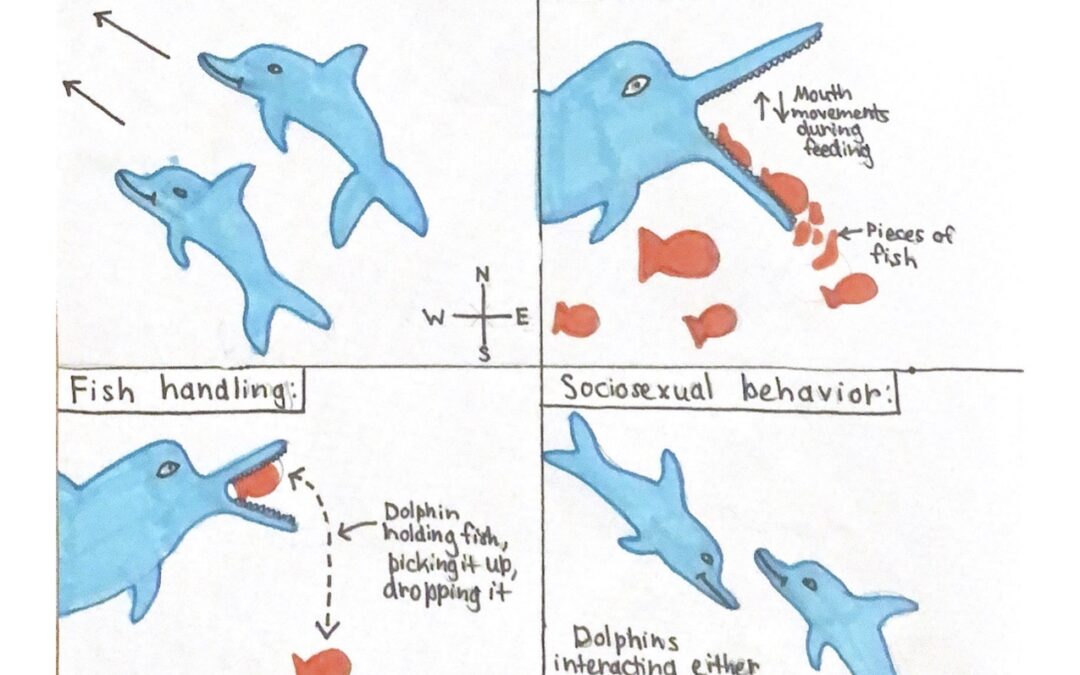
The researchers set out to observe this food sharing for themselves. They went off of the southwestern Pacific coast of Mexico. Previously, one case of food sharing was witnessed involving 5 dolphins from a small boat, and the other case of food sharing between two dolphins was seen from a drone. A small drone was used to track dolphin behavior and potential food sharing. Dolphin behavior was then coded into several states used in the experiment. Directional swimming was swimming in one direction; feeding was tearing off pieces of the fish with movements such as a head jerk, shaking of the body and chewing movements when eating; fish handling was when the dolphin picked up the fish, held the prey in its mouth, or dropped it; sociosexual represented any social and sexual behaviors. From the years 2014 to 2020, rough-toothed dolphins were seen 158 times and out of these times, they were feeding in 43 of the sightings. In two of these sightings, there was clear evidence of multiple dolphins sharing their food.
Although food sharing was only evident in two of the sightings, these two instances were significant enough to come to conclusions involving the rough-toothed dolphins and food sharing. In the first sighting in February 2016, there were 8 dolphins feeding and at least 5 of them were sharing their food, passing prey back and forth. The dolphins were seen biting a piece of the fish, and then dropping it so that another dolphin could come and do the same for about 15 minutes. Another instance of food sharing involved 4 rough-toothed dolphins in January 2020. This data was captured from a small drone and showed evidence of directional swimming of all four dolphins, along with feeding of two of the dolphins, and the handling and exchange of prey between two of the dolphins at least 6 times. One dolphin would carry the fish in its mouth, eat a piece of flesh, and then directionally swim towards another dolphin and drop the fish. The nearest dolphin would then pick it up and do the same, passing the fish back and forth. Another component of this food sharing involved the sociosexual behaviors that came with it. After sharing food, two of the dolphins approached another one and initiated sociosexual behaviors. It is not completely evident of what the reason is for sociosexual interactions during feeding, but this data made it clear that there is food sharing between rough-toothed dolphins.
The researchers had hypothesized that this species of dolphin specialize in large prey, therefore proposing that dolphins work together to forage and then share their food which would make sense as this teaming up may help them get this large prey more effectively. Food sharing and cooperation seem to be a way to become more efficient in capturing food, especially larger prey. It was also hypothesized that when hunting larger prey, rough-toothed dolphins often forage for smaller prey, feeding on multiple prey at once and therefore food sharing would be beneficial in increasing food intake when trying to capture larger prey. It is clear that whether it is food sharing, or general cooperation between individuals, rough-toothed dolphins are very social creatures when foraging and solidifying their social relationships is a very important aspect of their lives.
Although food sharing among rough-toothed dolphins has not been studied in a high frequency, this research demonstrates the importance of food sharing in these individuals, and therefore the significance of dolphins’ social lives. The researchers suggested that other studies should focus on the specifics of social structure in rough-toothed dolphins, and how that may play a role in cooperation while foraging, such as food sharing and sociosexual behavior.
Ramos, EA, Kiszka, JJ, Pouey‐Santalou, V, Ramírez Barragán, R, García Chávez, AJ, Audley, K. Food sharing in rough‐toothed dolphins off southwestern Mexico. Mar Mam Sci. 2020; 1– 26. https://doi.org/10.1111/mms.12727
