
Throughout history, humans have been fascinated by animal cognition, or the way in which animals think. One cognitive ability, for example, observed in nonhuman animals that researchers have taken particular interest in is mirror self-recognition (MSR), or the ability to recognize one’s self in a mirror. Mirror self recognition tests have been performed on various species of animals, including dolphins, elephants, and, arguably the most well known, great apes. Observations and data from such tests undergone on varying species of great apes (chimpanzees, gorillas, orangutans, etc.) have consistently provided evidence that these nonhuman primates are able to recognize themselves in mirrors.
However, these results beg the question: why? Although reflective surfaces, such as surfaces of water, were present during early primate evolution, it is unclear what selective advantages stem from the ability to recognize one’s self in a mirror. Various hypotheses have been developed over the years to try and explain this puzzling phenomenon. Most of these theories are based on the idea that selection may have occurred on a collection of adaptive traits that mirror self recognition derives from, rather than on MSR itself.
The theory that most intrigued writers from Animal Cognition, Krachun et al., is the social cognition theory of mirror self-recognition by Gordan G. Gallup. This theory proposes that MSR is a byproduct of an adaptive form of self-awareness that was selected for in early primate evolution. This type of self-awareness that causes MSR is developed and introspective, and allows individuals to engage in complex socio-cognitive processes, just one of these being MSR.
The goal of Krachun et al.’s experiment was to test the accuracy of the social cognition hypothesis, and to attempt to find a connection between MSR ability and social cognitive abilities.
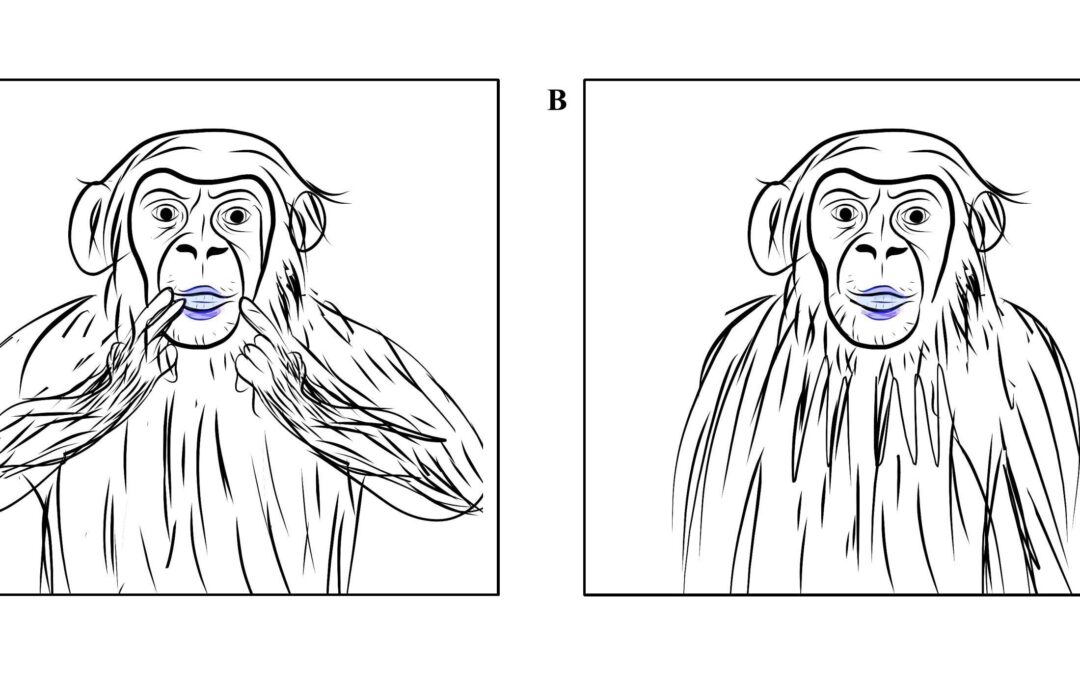
First, researchers tested participants’ mirror self-recognition abilities using a mirror-mark test (Fig 1). Based on the results of this test, chimpanzee participants were then placed into one of two groups: passing the test and having high MSR ability (Fig. 1A), or failing the test, and having low MSR ability (Fig. 1B). The authors hypothesized that chimpanzee “performance” on the mark test would be indicative of their performance on the other measures of social cognitive tests.
Researchers then compared chimpanzees’ performance between these two groups in three measures of social cognition: primate cognition test battery, a group of tasks designed to measure levels of social cognition in nonhuman primates; imitation recognition, or the ability of subjects to recognize that their own behavior is being mimicked by another individual; and perspective taking, or the ability to recognize what another individual can or cannot see from their unique perspective.
The results of this study indicate that individuals who passed the mirror-mark test performed significantly better than those who didn’t in all three tested categories of social cognition. This displays a consistent positive correlation between mirror self-recognition and socio-cognitive ability. Therefore, such results support the socio-cognitive hypothesis of MSR, which states that mirror self-recognition ability is simply a byproduct of a larger, adaptive collection of various socio-cognitive processes. The authors go on to note that, “If correct, Gallup’s hypothesis suggests that the evolutionary origins of great apes and humans’ capacity to understand ourselves are intimately linked to our ability to understand others.”
References
Krachun C, Lurz R, Mahovetz LM, Hopkins WD (2019) Mirror self-recognition and its relationship to social cognition in chimpanzees. Anim Cogn, 22: 1171-1183. doi:10.1007/s10071-019-01309-7
