
By Meg Dye ’21
Long seen as symbols of death, trickery, and bewitchment, bats have been soaring through night skies and swooping through the most eerie and sinister aspects of human storytelling and imagination for centuries. Though most often noted for representing a range of concepts and entities from the spirit of Halloween in Western culture to religious deities (note the Mayan bat god Camazote), bats are rarely credited for their adept maneuvering abilities in flight alone. The complex process of winged animal flight requires fine motor control. That being said, how exactly animals process all the noisy sensory information in order to execute the complex motor commands required for flight is relatively unknown.
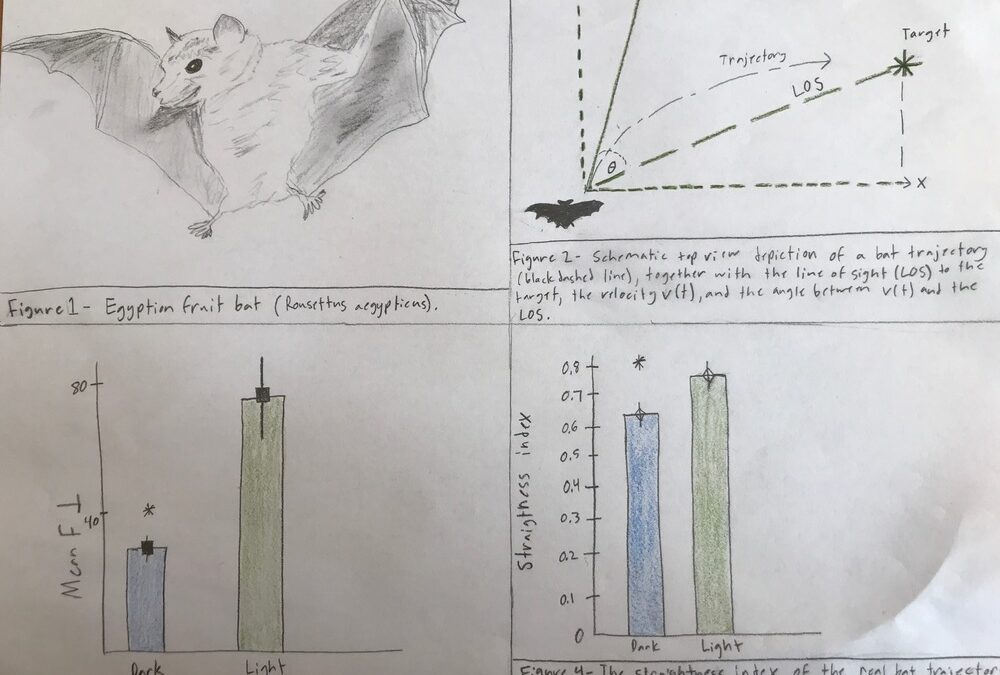
In the case of the Egyptian fruit bat (Fig. 1), also known as Rousettus aegypticus, such necessary functions include landing on small stationary targets from above and catching small mobile prey with little time to pause in flight. Researchers conducting experiments at the Weizmann Institute of Science and University of Maryland studied Egyptian fruit bats in order to determine how bats rapidly and correctly translate “noisy incoming sensory information” into complex motor commands during flight. In order to test whether animals in rapid flight adaptively change their motor control strategy to best match sensory conditions, researchers trained bats to locate a small, spherical target and then collected flight data from a small room in both dark and light conditions. Fig. 2 represents a schematic view of bat flight trajectory and velocity in relation to line of sight (LOS) between the bat and the target shown. Scientists developed a simple mathematical model that factored in the angle-to-target and its derivative while accurately modeling the bats’ integration of different pieces of sensory information and noise suppression. The model also accounted for potential sensory error, which would be the potential that bat would make a mistake due to sensory noise. In accounting for these processes within the sensorimotor control system, researchers were able to use their models to virtually replicate the flight bats under both light and dark conditions with surprising accuracy.The turning force (F1) of the bat as well the force of its forward thrust through the air were both used in order to calculate the angle of simulated bat flight trajectories.
Based on model accuracy, researchers found that bats exert stronger flight command in light conditions, as indicated by stronger forces exerted in light conditions on average (Fig. 3). In contrast, due a greater reliance on multi-sensory cues determined using echolocation (spatial orientation and object location through reflected sound) as opposed to visual cues determined through sight, bats flying in dark conditions are exposed to more sensory noise and a slower sensory update rate. These in turn result in weaker flight forces and more curved flight paths in dark conditions (as indicated by lower straightness indexes on average as represented in Fig. 4), as the bat is slower to close its angle on the target. Ultimately, by flying bats and developing this model under light and dark conditions, researchers were able to come to the unexpected conclusion that “highly curved flight trajectories often exhibited by bats in the dark are due to sensory limitations—not motor limitations.” This study reveals a “surprising link between sensory noise and movement dynamics” that is critical to understanding the intricacies of motion control in rapidly moving flying animals such as bats in a variety of environmental conditions.
Bar NS, Skogestad S, Marçal JM, Ulanovsky N, Yovel Y (2015) A Sensory-Motor Control Model of Animal Flight Explains Why Bats Fly Differently in Light Versus Dark. PLoS Biol 13(1): e1002046. doi:10.1371/journal.pbio.1002046.
