
By Mark Lang ’23
Lava Lizards? Robots? iPods? Aggressive Behavior? What in the world do all these things have in common? The answer is David Clark, a biology professor and animal communications researcher at Alma College, who recently published his work on aggressive communication by lava lizards (Microlophus albemarlensis) of the Galapagos Islands.
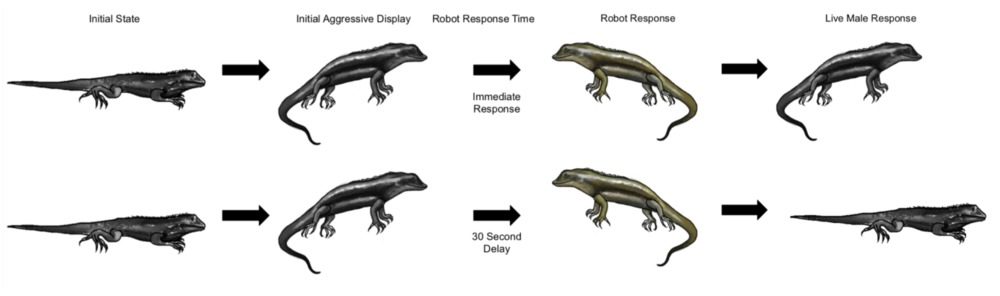
David and his team looked at how the timing of a response signal of a conspecific male (in this case a robot) influenced the behavior of the original signaling male. To do this, they first had to design a way to create a signal that looked as if it had originated from another lizard. Previous work had used playback of videos; However, the researchers wanted to take it to another level, and thus decided the only logical answer was to make robot lizards. They designed these robots so that their lower body was fixed, the upper body and front legs could raise up, making it look as though the lizard is doing some sort of half push-up (You can see some of their research footage here). This pose is a traditional dominance signal in lava lizards, and “bobbing display” – as it is described by the researchers – is used typically in aggressive precursors that may escalate into fighting and also in territory signaling (Fun fact – the spanish word for lizard, lagartija, is also the word for push-up).
The researchers hooked up these little robots to an iPod touch, which allowed them to control them remotely. They then took these robot lizards out onto the study sight, placed them near an already present male, turned the cameras on and waited. When the living male then exhibited bobbing display due to the appearance of a potential rival (the robot), the researchers activated the robot lizard to then produce a bob of its own, either immediately or after a 30 second delay period, which allowed for a break between the response of the lizard and that of the robot.
This timing difference was the main purpose of their research. They felt that in the situations where the robotic lizard immediately responded back, the living male would respond more quickly in an aggressive manner, whereas with the 30 second delay group the researchers felt that the lizard was less likely to respond aggressively due to the signal being so much later and likely viewed as unaffiliated. In the wild, this is exactly what happened. The lizards that experienced a robotic response immediately after them almost immediately displayed another response, with the cycle continuing until the living male stopped responding. Likewise, when there was the delayed response, the male often did not even bother to respond at all.
This data is similar to what other researchers have found in both birds and mammals, with longer delay periods making the conspecific appear less threatening and thus less aggressive action is taken. The researchers conclude by stating that they would like to further investigate these mechanisms of aggressive behaviors utilizing robots that are capable of movement (such a retreat when a display match is lost) to further learn about the dynamic system that is conspecific aggression.
