
By Stephanie Jordan ’20
Animal decision making is a tradeoff between risk and benefit (Weinstein 2018). When
an animal chooses to forage they are accepting decreased levels of antipredatory behavior while they eat. Fear of predation and the subsequent risk analysis is a constant determinant in foraging decision making (Weinstein 2018). However, the question remains, how do animals alter foraging behavior to respond to non-predatory threats in their environment? To answer this question Weinstein et. al analyzed foraging behavior in the parasite rich environment.
Raccoons are especially rich in roundworm and therefore their feces are a breeding ground for roundworm production with raccoons releasing upwards of one million roundworm eggs per day (Weinstein 2018). Raccoons and other mesopredators face minimal health consequences for harboring such large quantities of parasite. However, worm exposure to smaller animals such as birds, rabbits, and rodents can be fatal (Weinstein 2018). When raccoons defecate there are often large pieces of undigested seeds and plant material contaminated by their intestinal roundworm. This undigested food matter attracts a multitude of other animals in the ecosystem as potential foraging material. Therefore to test assessment of foraging risk these concentrated areas of raccoon defecation, latrines, were monitored for animal traffic and food selection by species.
50 different raccoon latrines were located within Santa Barbara County in California between December 2012 to April of 2015. Each latrine was equipped with 1-2 cameras that were rotated every 10-14 day, providing over 220 perspectives to view the sites from. If latrines became inactive footage was ceased and a new location was chosen. Weinstein’s team observed duration of visit, foraging, and avoidance behaviors in the animals captured on camera.
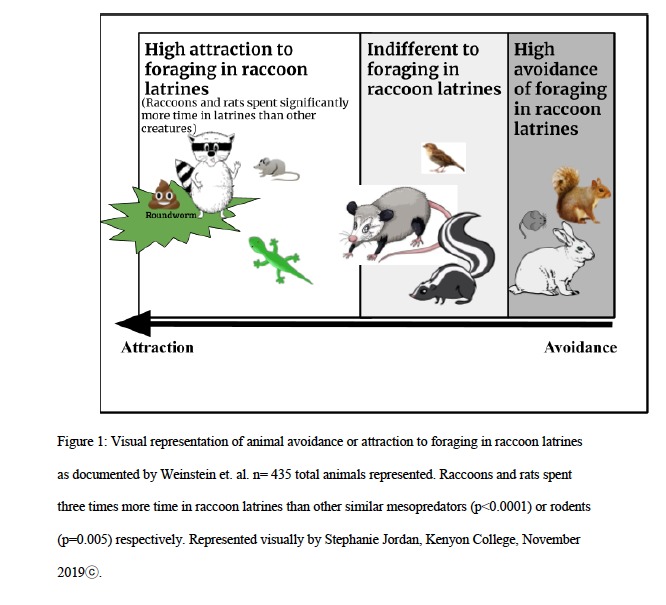
The group found that parasites, like predators, had the ability to alter animal foraging behavior. However, they also found habitat and the risk of predation while foraging within that habitat was also an influence on the observable animal decision making (Weinstein 2018). They found that animals such as rats and lizards foraged more frequently in latrines due to a perceived greater risk while foraging in adjacent habitats. Additionally, rats and lizards appear to have minimal negative health effects to parasitism, therefore experiencing decreased cost of foraging within the latrine compared to other animals. In contrast to these two scavengers, rabbits and mice experience little gain with large costs when foraging within a raccoon latrine. Rabbits, mice, and squirrels are all known to experience fatal side effects when infected with roundworm. Mesopredators not as adapted for raccoon latrines such as opossums and skunks neither avoided nor gravitated towards raccoon latrines, their duration and foraging there followed no significant pattern or motive.
Overall, animals relatively unaffected by roundworm were far more likely to forage in raccoon latrines whereas animals that are sensitive the parasite avoided the area and foraging nearby (Weinstein 2018). It should be noted however it is difficult to entirely isolate fear of predation by the raccoons themselves. Given that raccoons were by far more prevalent in and around raccoon latrines there may be predator avoidance occurring in the smaller animals such as mice and squirrels. Raccoons, while eating 90% seeds and plant matter, are omnivorous and consume approximately 10% meat (Weinstein 2018). This inability to separate the effects of predator from parasite dampen the power of the results in animal avoidance. However, a relationship cannot be denied between animal choice to forage in a parasite rich environments and having resistance to that parasite’s negative health effects as seen in all examples recorded (Weinstein 2018).
Weinstein, S. B., Moura, C. W., Mendez, J. F., & Lafferty, K. D. (2018). “Fear of feces? Tradeoffs between disease risk and foraging drive animal activity around raccoon latrines.” Oikos, 127( 7), 927-934. doi: 10.1111/oik.04866
